

Starting an old age home in India is part social mission and part serious operation. You are not just renting a building and putting beds in it. You are registering a legal entity, clearing licenses under the Maintenance and Welfare of Parents and Senior Citizens Act, 2007 (MWPSC Act), arranging funding, and hiring trained caregivers. Get the sequence right and you build something that lasts. Get it wrong and you spend months stuck in approvals.
This guide walks you through the entire process in plain English, with the exact registrations, documents, costs, and compliance steps you need in 2026.
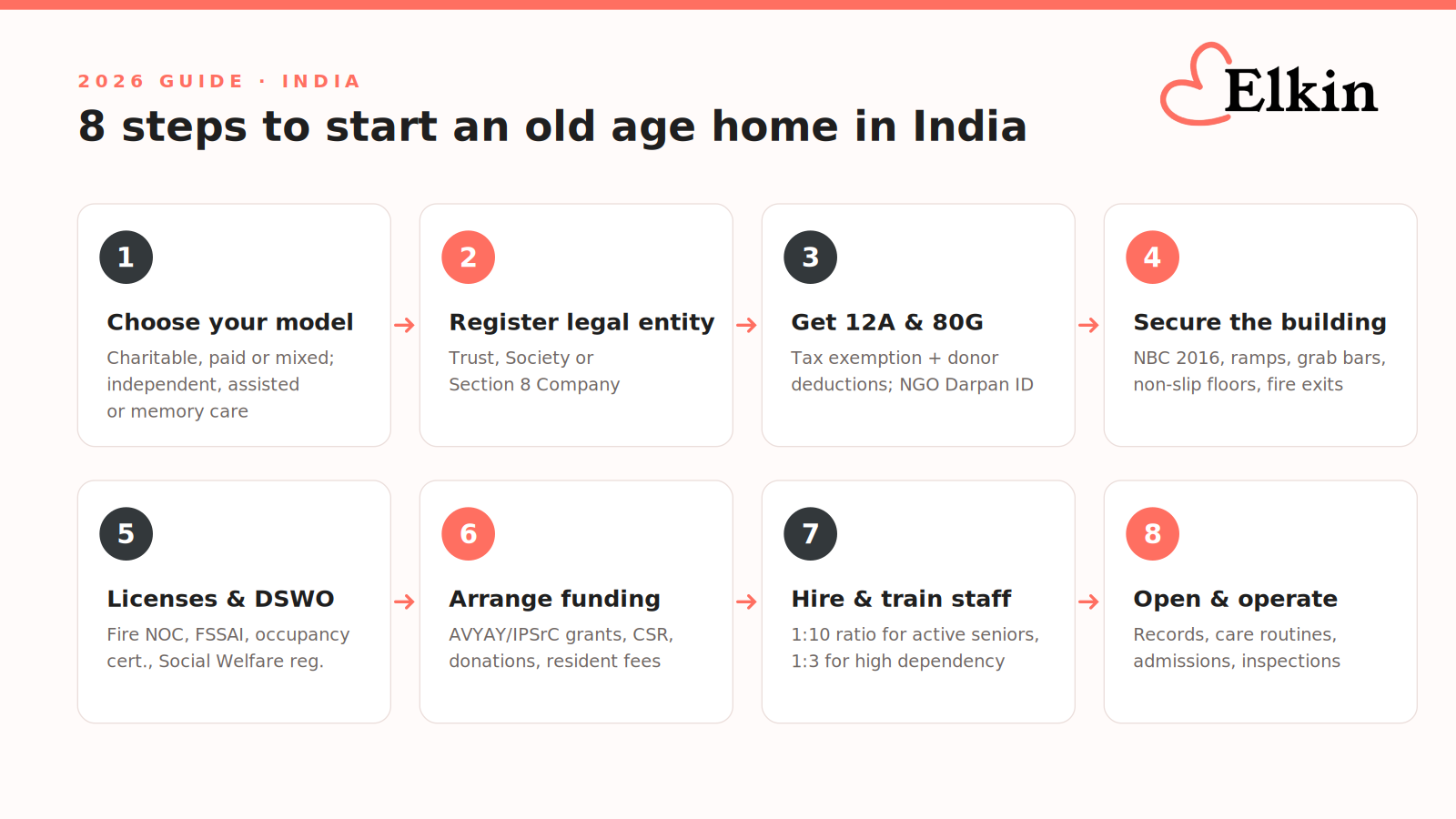
How to start an old age home in India: 8 steps at a glance
- Decide your model and care type (charitable, paid, or mixed; and independent, assisted, or memory care).
- Register a legal entity as a Public Charitable Trust, Society, or Section 8 Company.
- Get 12A and 80G tax exemptions so you can raise donations and grants.
- Secure land or a building that meets accessibility and safety norms.
- Complete the old age home registration process with your District Social Welfare Officer, plus Fire NOC, occupancy certificate, and FSSAI licence.
- Arrange funding through government schemes (AVYAY/IPSrC), CSR funds, donations, and resident fees.
- Hire and train staff at the right caregiver-to-resident ratio.
- Set up records, operations, and marketing to admit residents and stay compliant.
The rest of this guide explains each step in detail, including the registration documents most guides skip.
Why the demand for old age homes is rising
India is ageing faster than most people realise, and that is the single biggest reason the sector is growing.
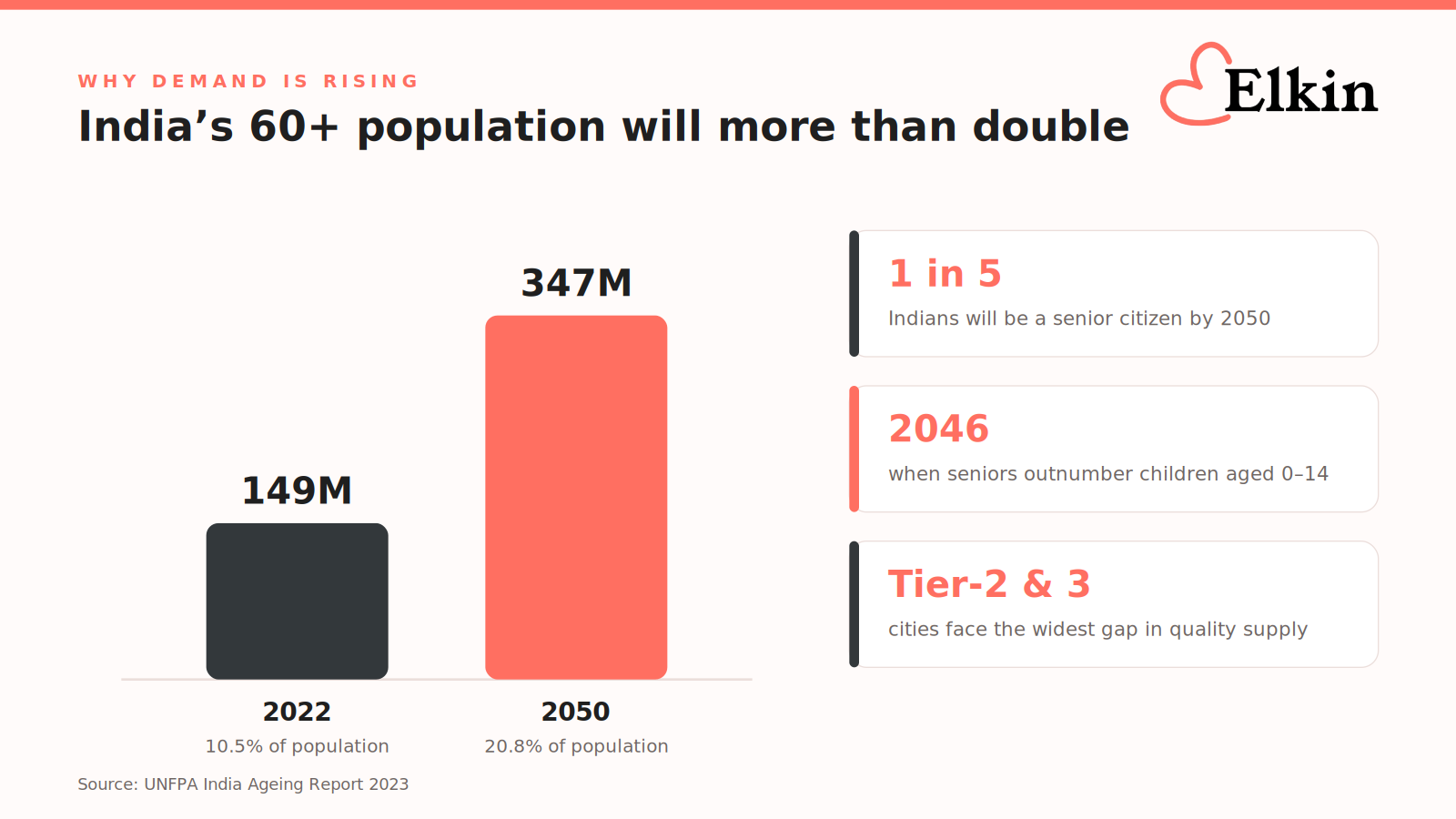
According to the UNFPA India Ageing Report 2023, the number of Indians aged 60 and above is projected to rise from about 149 million in 2022 to 347 million by 2050. The share of seniors will roughly double from 10.5% to 20.8% of the population, meaning one in every five Indians will be a senior. By 2046, elderly Indians are projected to outnumber children aged 0 to 14.
At the same time, joint families are shrinking, adults are migrating for work, and more seniors live alone or manage chronic conditions like dementia and Parkinson's.
Supply has not kept pace, especially in Tier-2 and Tier-3 cities. Industry bodies such as ASLI project strong growth in organised senior living through 2030. For a detailed breakdown of existing facilities, see our data-backed post on how many old age homes there are in India, and our explainer on why old age homes are increasing in India.
What is an old age home? Types and care models
An old age home (also called a senior citizen home or retirement home) is a residential facility that provides accommodation, meals, personal care, and health support to elderly people who cannot or prefer not to live alone. There are several types of old age homes in India, from free charitable shelters to premium retirement communities.
Before you register anything, decide two things: your business model and your care model. They shape your licenses, costs, and staffing.
Choose your business model
Charitable (free) model. Runs on donations and government grants. Serves poor and destitute seniors at no cost. Best if your goal is pure social service and you plan to apply for AVYAY grants.
Paid (commercial) model. Residents pay monthly fees. Financially self-sustaining and scalable, but you compete on quality.
Mixed model. The most common choice. A share of residents pay fees while others stay free or subsidised. This balances mission and money.
Choose your care model
Independent living. For active, healthy seniors who need community, meals, and safety, not daily medical help.
Assisted living. For seniors who need help with everyday tasks like bathing, dressing, medication, and mobility. Learn more about what assisted living is and how it works.
Memory care. Specialised, secure units for residents with dementia or Alzheimer's. This needs trained staff, higher ratios, and a safer physical layout.
Your care model directly drives your staff-to-resident ratio and your monthly running cost.
Step 1: Register your legal entity
You cannot run an old age home as an unregistered individual. Register one of these three entities first.
| Entity type | Governing law | Minimum members | Best for |
|---|---|---|---|
| Public Charitable Trust | Indian Trusts Act, 1882 (and state Public Trust Acts) | 2 trustees | Simple, property-based charitable setups |
| Society | Societies Registration Act, 1860 | 7 members | Membership-run, community-driven homes |
| Section 8 Company | Companies Act, 2013 | 2 directors | Professional, grant-ready, CSR-friendly setups |
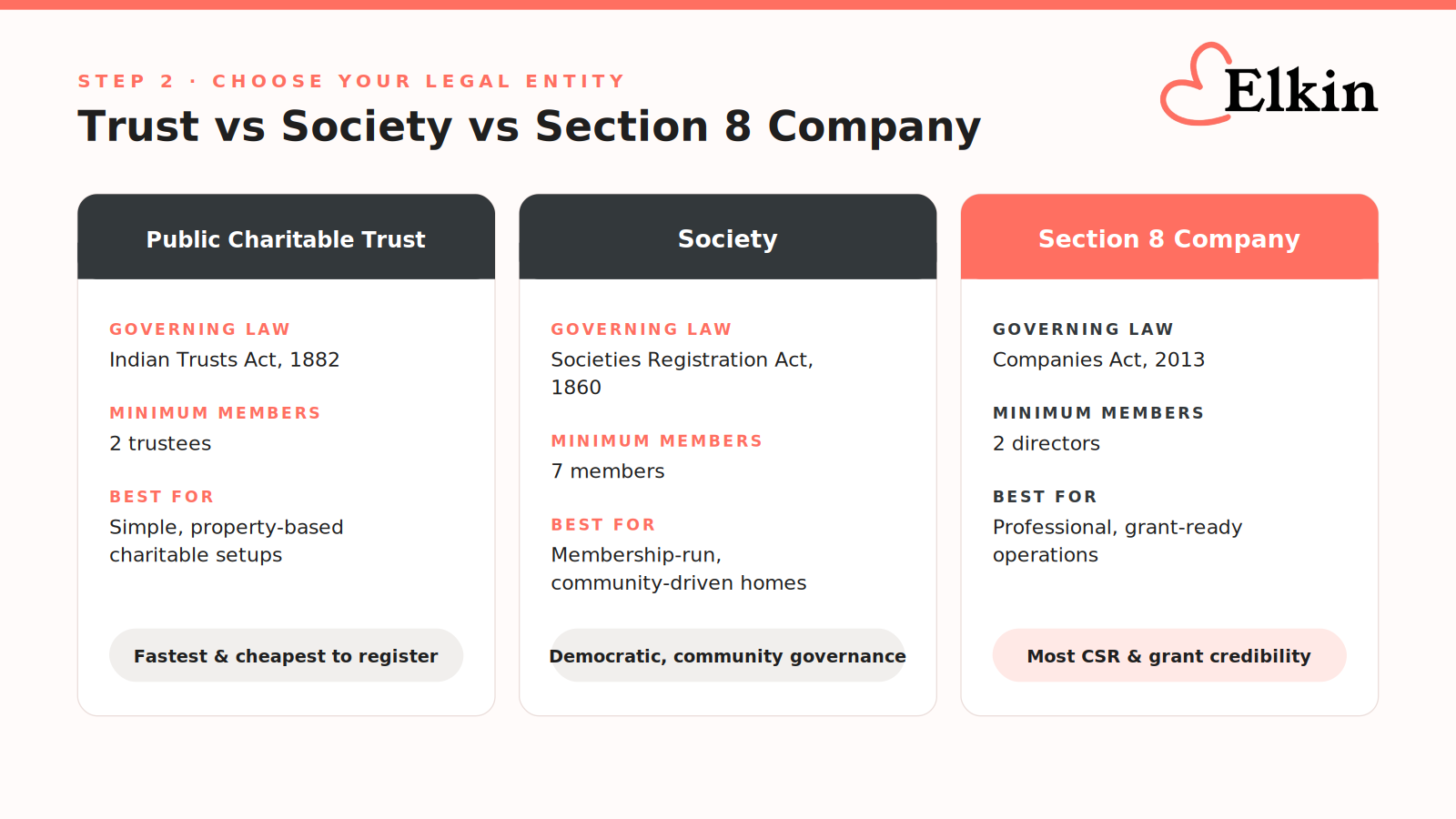
A Section 8 Company offers the most credibility with funders and CSR donors because of stricter governance and reporting. A Trust is the simplest and cheapest to set up. A Society suits community-run homes. Choose based on your funding plan and how formal you want your governance to be.
Step 2: Get tax exemptions (12A and 80G)
Once registered, apply on the Income Tax e-filing portal for:
- 12A registration, which exempts your organisation's income from tax.
- 80G registration, which lets donors claim tax deductions and makes fundraising far easier.
If you plan to accept foreign donations, you will also need FCRA registration from the Ministry of Home Affairs. Skip FCRA if you are funding domestically. Also register on the NGO Darpan portal (ngodarpan.gov.in), because a Darpan ID is mandatory for applying to central government grants.
Step 3: Secure land or a building
You can buy land, lease a building, or apply for government-allocated land in some states. Whatever you choose, the property must meet basic safety and accessibility standards:
- Wide doorways, ramps, and grab bars for wheelchairs and walkers.
- Non-slip flooring, especially in bathrooms.
- Well-ventilated rooms with enough space between beds.
- Attached or accessible toilets with safety rails.
- Clear fire exits and emergency access.
- Separate rooms for couples where possible.
Follow the National Building Code (NBC) 2016 and the barrier-free design guidelines issued by the CPWD. A ground-floor or lift-equipped layout is strongly preferred. When planning your layout, benchmark against the facilities families expect at old age homes.
Step 4: The old age home registration process (licenses and NOCs)
This is where most founders get stuck, so plan for it early. The core legal requirement comes from Section 19 of the MWPSC Act, 2007, which empowers state governments to regulate senior citizen homes and prescribe minimum standards. Registration is done with your District Social Welfare Officer (DSWO) or the State Social Welfare Department, and the exact procedure varies by state.
How the registration process works
For a dedicated, step-by-step breakdown, see our full guide to the old age home registration process. Here is the sequence in brief:
- Prepare your entity documents. Trust deed / society registration certificate / Section 8 incorporation certificate, PAN, and 12A certificate.
- Prepare your premises documents. Ownership deed or registered lease agreement, approved building plan, and occupancy certificate from the municipal corporation.
- Get your Fire NOC from the State Fire and Emergency Services department. Most states will not register a residential care facility without it.
- Get your FSSAI licence (fssai.gov.in) if you cook and serve meals, which almost every home does.
- Apply to the District Social Welfare Office with the application form, your documents, staff list, proposed capacity, and fee (where applicable). Some states accept applications online. Tamil Nadu, for example, runs online old age home registration through the Social Welfare and Women Empowerment Department portal (tnsocialwelfare.tn.gov.in).
- Facility inspection. The DSWO or an authorised officer inspects the premises against the state's minimum standards for space, safety, hygiene, and staffing.
- Receive your registration certificate. Display it at the facility. Most states require periodic renewal and allow annual inspections. Non-compliant homes can have their registration cancelled.
Documents checklist for registration
- Legal entity registration certificate and bye-laws / trust deed / MoA.
- PAN of the organisation, and 12A and 80G certificates.
- Property ownership or lease documents.
- Building plan approval and occupancy certificate.
- Fire safety NOC.
- FSSAI food licence.
- List of governing body members with ID proof.
- Staff list with qualifications (nurses, caregivers, cook, security).
- Proposed capacity, fee structure (if paid), and admission policy.
Additional registrations you may need
| License / approval | Authority | When you need it |
|---|---|---|
| Clinical Establishment / Nursing Home registration | State Health Department | If you provide nursing or medical care on site |
| GST registration | GST portal | If your paid services cross the threshold |
| Shops and Establishment registration | State Labour Department | For employing staff |
| Professional Tax | State Commercial Tax Department | In applicable states |
Register with the DSWO as early as possible. Operating without Social Welfare registration risks penalties and closure.
Step 5: Arrange your funding
Old age homes rarely run on one source of money. Combine several:
Central government grants. The Atal Vayo Abhyuday Yojana (AVYAY) of the Ministry of Social Justice and Empowerment includes the Integrated Programme for Senior Citizens (IPSrC), which funds Senior Citizen Homes run by eligible NGOs. Applications go through the E-Anudaan portal (grants-msje.gov.in), and an NGO Darpan ID is required.
State schemes. Many states run their own old age home schemes with grants routed through the Social Welfare Department. Check your state's current scheme before finalising your budget.
CSR funds. Indian companies must spend a share of profits on Corporate Social Responsibility under the Companies Act, 2013. A registered, transparent home with 80G status and audited accounts is well placed to attract CSR partners.
Donations and crowdfunding. Individual donors, trusts, and community fundraising, supported by your 80G benefit.
Resident fees. In paid or mixed models, monthly fees fund day-to-day operations.
Keep clean books and audited accounts from day one. Funders and CSR teams check governance before they release money.
Step 6: Hire and train the right staff
Care quality lives and dies on staffing. A typical old age home needs:
- A manager or administrator to run operations.
- Caregivers and attendants for daily personal care.
- Nurses (ANM/GNM) for medication and basic health monitoring.
- A visiting doctor, and ideally a physiotherapist and counsellor.
- Cook, housekeeping, and security staff.
Staff-to-resident ratios matter:
- 1:10 is a workable standard for active, independent seniors.
- 1:3 or even 1:1 for bedridden residents or those with dementia.
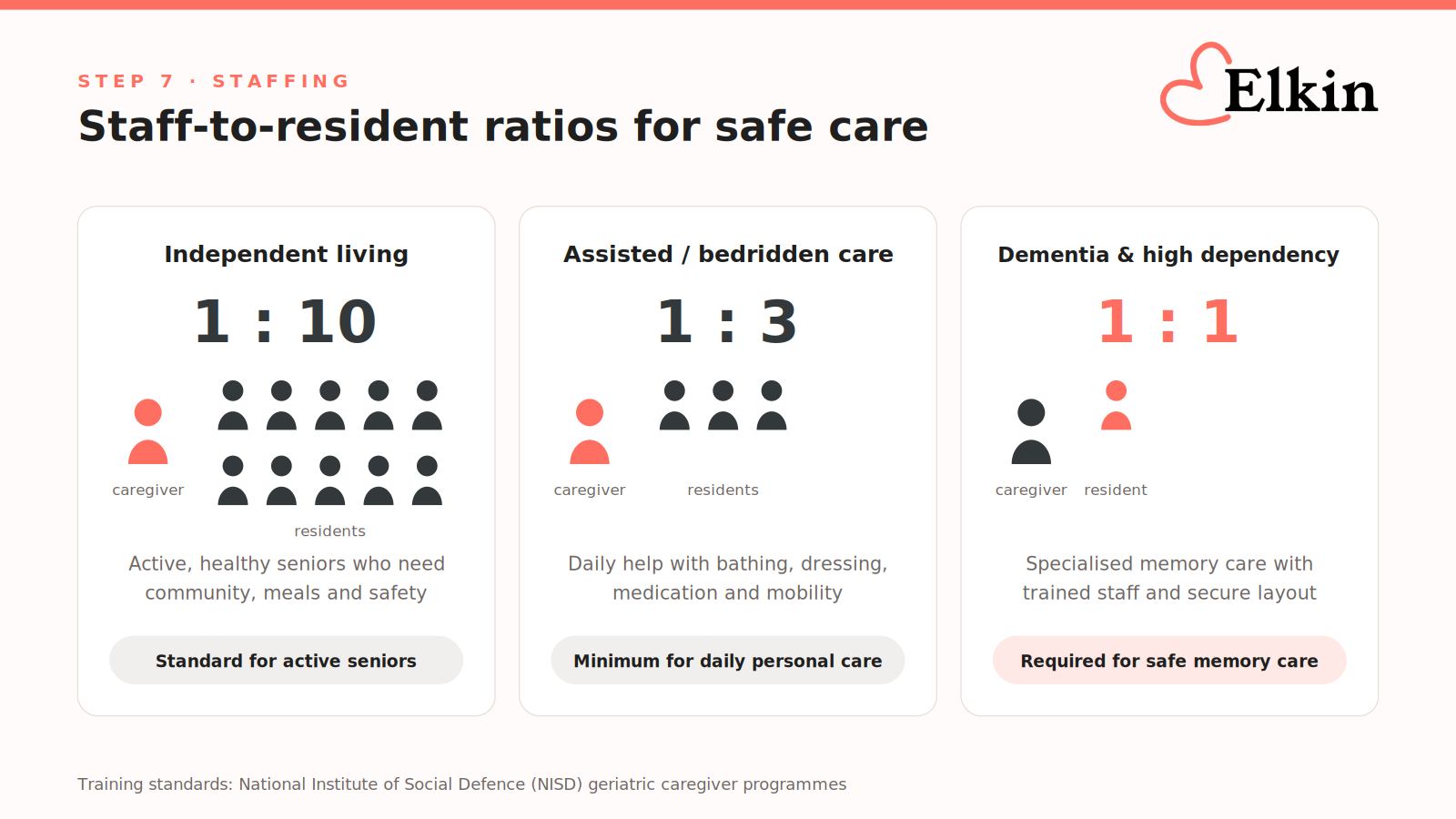
Lower staffing is a safety risk and a red flag for families and inspectors. The National Institute of Social Defence (NISD) runs geriatric caregiver training programmes. Use them to standardise your care and strengthen your grant applications.
Step 7: Set up records, systems, and daily operations
The IPSrC minimum standards require every home to maintain proper records. Set these up from day one:
- Admission and discharge register with the resident's photograph.
- Background inquiry record for each resident.
- Health history and current medical conditions.
- Record of money and valuables deposited.
- Emergency contact information for family or guardians.
- Signed consent forms from the resident or guardian.
Add clear routines for meals, medication, hygiene, activities, medical emergencies, and family visits. Documented processes protect your residents, your staff, and your registration during inspections.
Step 8: Market your home and admit residents
Even a well-run home needs visibility. Families search online first. To reach them:
- Build a simple website with photos, services, location, and fees.
- Get listed on trusted senior living directories so families can find and compare you.
- Build referral relationships with hospitals, doctors, and geriatric specialists.
- Encourage genuine reviews and family testimonials.
- Publish a clear admission policy. Families research how admission to an old age home works in India before they visit, so a transparent process builds trust early.
How much does it cost to start an old age home in India?
There is no single number. Cost depends on city, scale, care level, and whether you buy or lease property. Here is a realistic 2026 picture.
| Cost head | Typical range | Notes |
|---|---|---|
| Legal registration (Trust/Society/Section 8) | ₹10,000 – ₹50,000 | One-time; higher for Section 8 |
| Land / building (lease) | Varies widely | Metros cost far more than Tier-2/3 cities |
| Construction / renovation and fit-out | Up to ₹75 lakh+ | Depends on beds and safety upgrades |
| Licenses, NOCs, approvals | ₹50,000 – ₹2 lakh+ | Fire NOC, FSSAI, building approvals |
| Furniture, medical and safety equipment | ₹5 lakh – ₹20 lakh+ | Beds, wheelchairs, alarms, mobility aids |
| Annual staff salaries | ₹3 lakh – ₹5 lakh+ per role | Scales with capacity and care level |
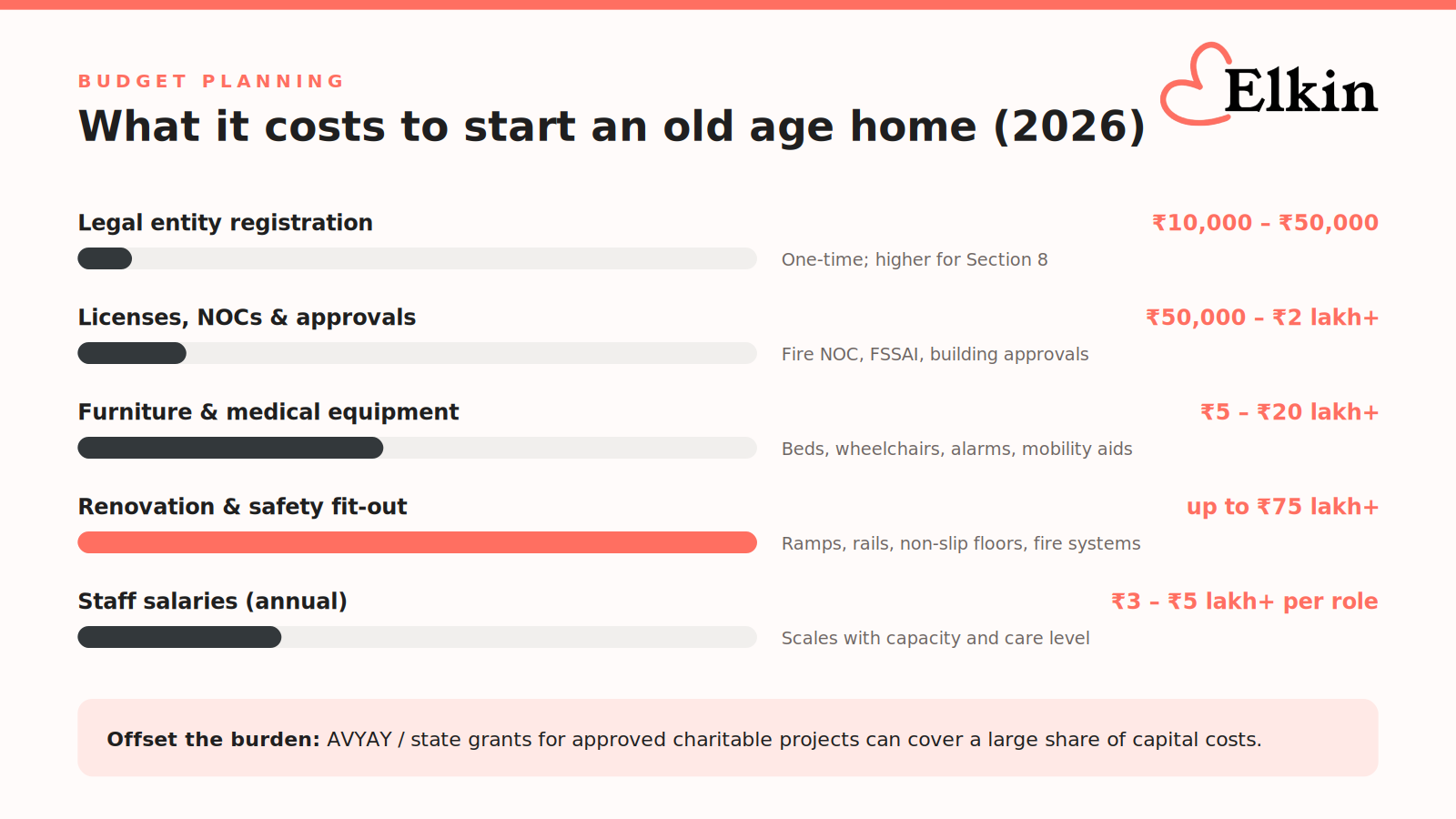
Government project grants under central and state schemes can cover a large share of capital and recurring costs for approved charitable projects. On the revenue side, monthly resident fees in the paid market typically run about ₹10,000–₹25,000 for basic care, ₹30,000–₹70,000 for assisted living, and ₹80,000–₹2,00,000 for luxury facilities. For detailed fee benchmarks, see how much an old age home costs in India and assisted living costs in India. [VERIFY: current fee ranges in your target city before publishing]
How long does it take to start an old age home?
Plan for 6 to 12 months from decision to first resident in most cases:
- Entity registration: 2 to 8 weeks depending on structure and state.
- 12A and 80G approvals: 1 to 3 months.
- Building fit-out and safety upgrades: 2 to 6 months, often in parallel.
- Fire NOC, FSSAI, and Social Welfare registration: 1 to 3 months combined.
Grant applications through E-Anudaan follow the ministry's annual cycle, so factor that into your funding timeline.
Key laws and compliance you must know
- Maintenance and Welfare of Parents and Senior Citizens Act, 2007. The central law governing senior citizen welfare. Section 19 covers establishment and regulation of old age homes.
- State old age home rules. Registration with the DSWO, periodic inspections, and adherence to state minimum standards.
- NISD guidelines for staff training and care standards.
- NBC 2016 and state fire safety norms for the physical building.
- FSSAI standards for food safety if you serve meals.
Compliance is not a one-time task. Renew licenses on time, keep records updated, and prepare for periodic inspections.
Common mistakes to avoid
- Skipping Social Welfare registration. Operating without it risks penalties and cancellation.
- Under-staffing to save money. It compromises safety and reputation, and it shows in reviews.
- Choosing the wrong care model. Running memory care without trained staff and a secure layout is dangerous.
- Relying on a single funding source. When it dries up, residents suffer.
- Weak documentation. Poor records fail inspections and scare off CSR funders.
FAQ
Is a licence required to start an old age home in India?
Yes. You must register a legal entity (Trust, Society, or Section 8 Company) and register the home with your District Social Welfare Officer under the Maintenance and Welfare of Parents and Senior Citizens Act, 2007. Depending on services, you also need a Fire NOC, FSSAI food licence, occupancy certificate, and clinical establishment registration if you provide medical care.
What is the old age home registration process?
Register your legal entity, obtain your Fire NOC, occupancy certificate, and FSSAI licence, then apply to the District Social Welfare Office with your entity documents, premises documents, staff list, and proposed capacity. The department inspects the facility against state minimum standards and issues a registration certificate, which is subject to renewal and periodic inspection.
How much money is needed to start an old age home in India?
It varies by city and scale. Legal registration costs a few thousand to around ₹50,000. Building fit-out and renovation can run up to ₹75 lakh or more, with additional spending on equipment, licenses, and staff salaries. Government grants for approved charitable projects can cover a large share of the cost.
Can an old age home be a profitable business in India?
Yes, in the paid or mixed model. With rising demand and limited quality supply, well-run paid facilities can be financially sustainable. Charitable homes, by contrast, are designed as social service and run mainly on grants and donations rather than profit.
Which legal structure is best for an old age home?
A Section 8 Company offers the strongest governance and credibility with grant and CSR funders. A Public Charitable Trust is the simplest to set up. A Society suits community-run, membership-based homes. Choose based on your funding plan and governance needs.
What government schemes fund old age homes in India?
The main central scheme is the Atal Vayo Abhyuday Yojana (AVYAY), which includes the Integrated Programme for Senior Citizens (IPSrC) under the Ministry of Social Justice and Empowerment. Apply through the E-Anudaan portal with an NGO Darpan ID. Many states also run their own schemes through the Social Welfare Department.
What staff-to-resident ratio should an old age home maintain?
Around 1:10 works for active, independent seniors. For bedridden residents or those with dementia, aim for 1:3 or even 1:1. Better ratios mean safer care and are a key marker of a quality facility.
How long does it take to open an old age home in India?
Typically 6 to 12 months from starting entity registration to admitting the first resident. Entity and tax registrations take 2 to 4 months, building fit-out 2 to 6 months, and licensing and Social Welfare registration 1 to 3 months, with several stages running in parallel.