

India does not have a single official count of every old age home. The most reliable estimates place the number of documented old age homes between roughly 700 and 1,700. As of 2021, the Ministry of Social Justice and Empowerment reported directly funding 551 NGO-run old age homes housing about 16,290 destitute elderly. By July 2023, the government stated it was maintaining 1,658 old age homes across the country under its expanded senior citizen welfare programmes, with over Rs 321 crore disbursed to them.
HelpAge India's widely cited 2009 directory recorded 1,176 senior living facilities nationwide. Kerala has the highest number of old age homes of any Indian state, a finding consistent across every major study, followed by West Bengal, Tamil Nadu, and Maharashtra.
The reason the number changes from one report to another is simple: the government primarily counts the homes it pays for. Thousands of privately run and charitable homes are never added to any central list. This guide explains the real numbers, where they come from, why an exact figure does not exist, and what families should actually look for.
Old age homes in India: statistics from official sources
Here is what the trusted sources actually say. The figures differ because each one measures a different thing, and each was published at a different time.
| Source | What it counts | Number |
|---|---|---|
| Ministry of Social Justice and Empowerment (PIB, Dec 2021) | NGO-run homes funded by the government | 551 homes, 16,290 elderly |
| Ministry of Social Justice and Empowerment (July 2023 statement) | Old age homes maintained with central government support | 1,658 homes |
| HelpAge India directory (2009) | Registered senior living / old age facilities | 1,176 |
| Indian Journal of Community Medicine (2024) | Documented old age homes (detailed data for 547) | ~728 |
| Tata Trusts report on old age facilities | Secondary estimate of operational senior facilities | 600–1,700 |
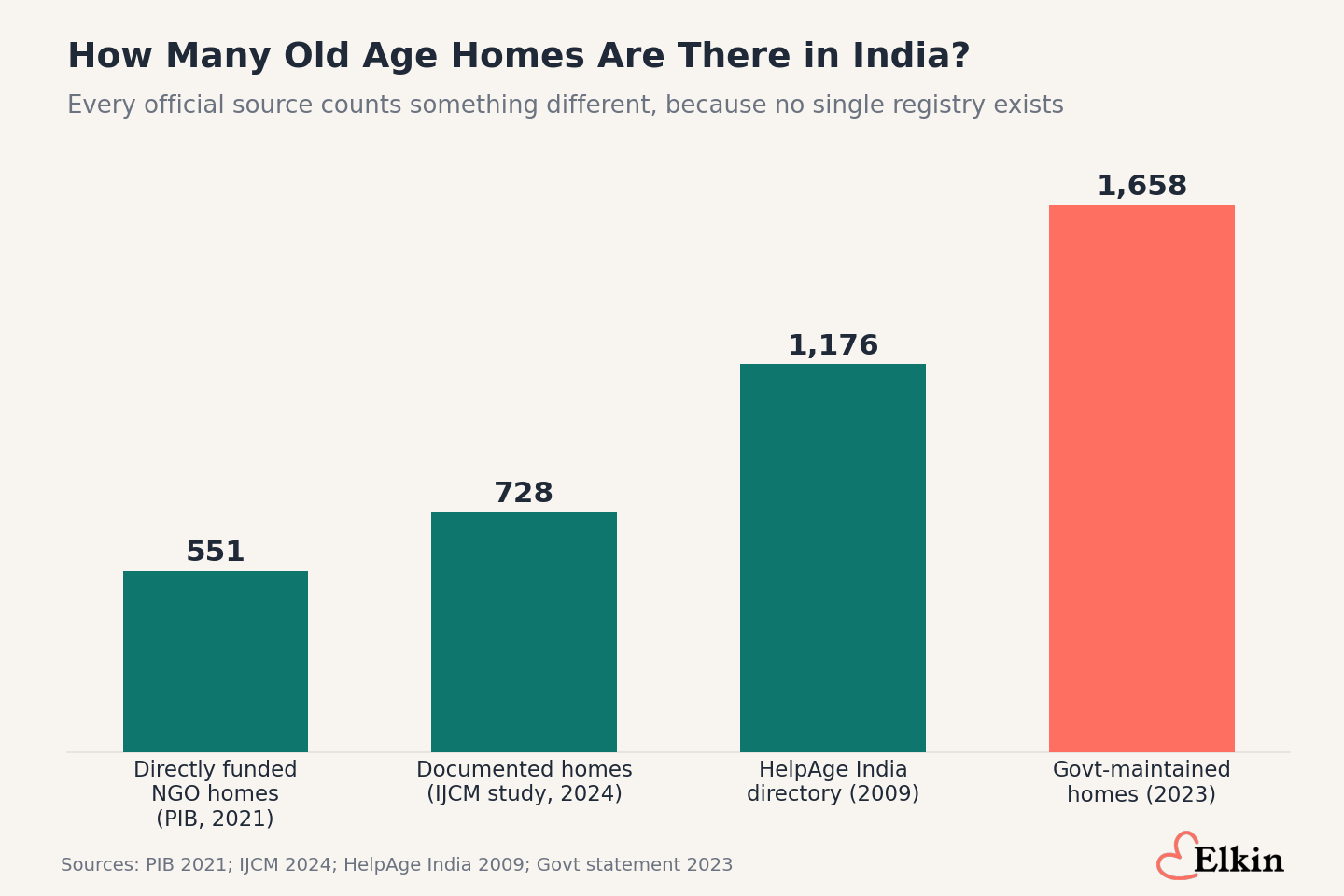
Two caveats matter here. First, the Ministry of Social Justice and Empowerment has stated plainly that it does not maintain data on privately managed old age homes. That single line explains much of the confusion. Second, the HelpAge directory figure is now over a decade old, and the Tata Trusts validation exercise found that many facilities on that list have since closed or operate only in name, even as new private homes have opened elsewhere.
So the honest answer to "how many old age homes in India" is: around 700 to 1,200 in documented directories, roughly 1,658 supported by the central government as of 2023, and likely well above that when you add unregistered charitable homes and new private senior living projects. No agency has counted all of them in one place.
Which state has the most old age homes in India?
Kerala has the most old age homes in India. This has been true across every major study for over a decade.
HelpAge India's 2009 national count recorded 182 senior living facilities in Kerala, the highest in the country. The Indian Journal of Community Medicine (2024) reported 124 old age homes in Kerala, again the maximum among states with detailed data.
This is no coincidence. Kerala is also the state with the highest old age population share in India: close to 14% of its residents are aged 60 or above, against a national average of about 10.5%. Combine that with heavy overseas migration of adult children, and Kerala has both the greatest need for elder care institutions and the longest history of building them. India's first recorded old age home opened in Thrissur, Kerala, back in 1911.
After Kerala, the states with the highest counts in the HelpAge data were:
- Kerala (182), driven by a rapidly ageing population and high migration of adult children abroad.
- West Bengal (164), with high demand in and around Kolkata.
- Tamil Nadu (151), with a strong network of charitable and paid homes, especially around Chennai and Coimbatore.
- Maharashtra (133), with a large number of urban homes in Mumbai, Pune, and Thane.
- Andhra Pradesh (114) and Karnataka (91), reflecting the broader concentration of homes across South India.
Delhi NCR, while not among the top states in older counts, has become a fast-growing cluster of private and premium senior living facilities in recent years. Southern India as a whole stands out, a reflection of higher life expectancy, earlier demographic transition, and more nuclear families in the region.
Number of old age homes in India, state wise
There is no current official state-wise registry of all old age homes. The most complete state-wise breakdown available comes from HelpAge India's national directory, as reproduced in the Tata Trusts report on old age facilities. Here are the leading states from that count:
| State | Number of old age homes (HelpAge count) |
|---|---|
| Kerala | 182 |
| West Bengal | 164 |
| Tamil Nadu | 151 |
| Maharashtra | 133 |
| Andhra Pradesh (undivided) | 114 |
| Karnataka | 91 |
| Gujarat | 77 |
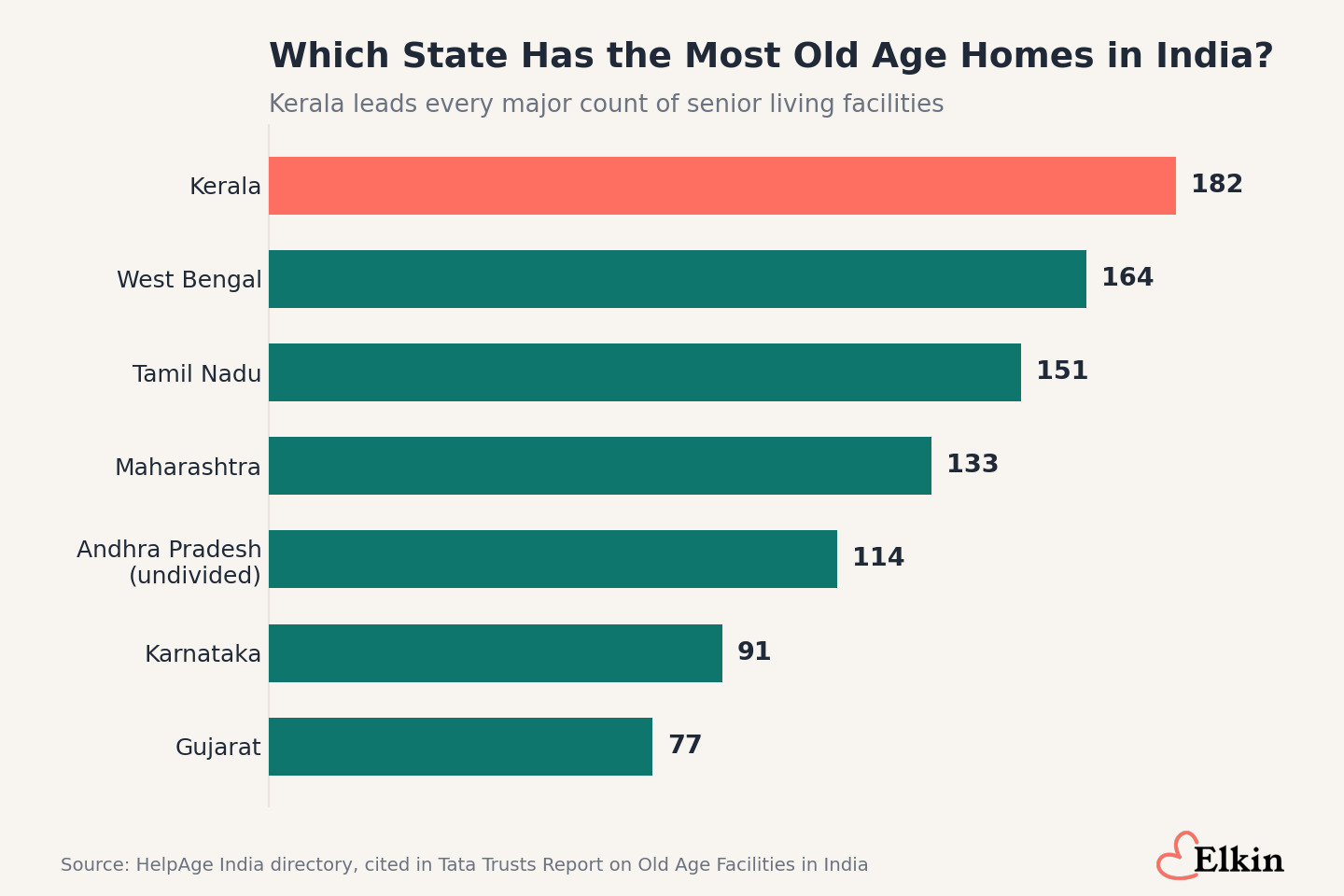
Treat these as indicative rather than current. The directory dates to 2009, some listed homes have since closed, and many new private facilities have opened, especially in metro regions like Delhi NCR, Bengaluru, Pune, and Chennai. For government-supported homes specifically, the Ministry of Social Justice and Empowerment publishes state-wise project lists under its senior citizen schemes, which cover every state and union territory.
Why India does not have one exact number
Four practical reasons explain why the count is an estimate, not a fixed figure.
- Only government-supported homes are tracked. Homes supported under the Integrated Programme for Senior Citizens (IPSrC, now part of the AVYAY umbrella scheme) are recorded. Most others are not.
- Registration is fragmented. Old age homes are registered with different bodies depending on the state, whether social welfare departments, charity commissioners, or bodies like Kerala's Orphanage Control Board. There is no single national registry.
- "Old age home" means different things. A free charitable vridhashram, a paid retirement home, and a modern assisted living residence are all sometimes called "old age homes." Depending on the definition used, the count rises or falls.
- The sector is growing fast. New private senior living projects open every year, so any count is out of date within months.
How many types of old age homes are there in India?
There are four main types of old age homes in India: free charitable homes (vridhashrams), paid old age homes, assisted living facilities, and specialised memory care homes. Some classifications add independent living retirement communities as a fifth category. This distinction matters, because the "old age home" you have in mind may not be what you actually need.
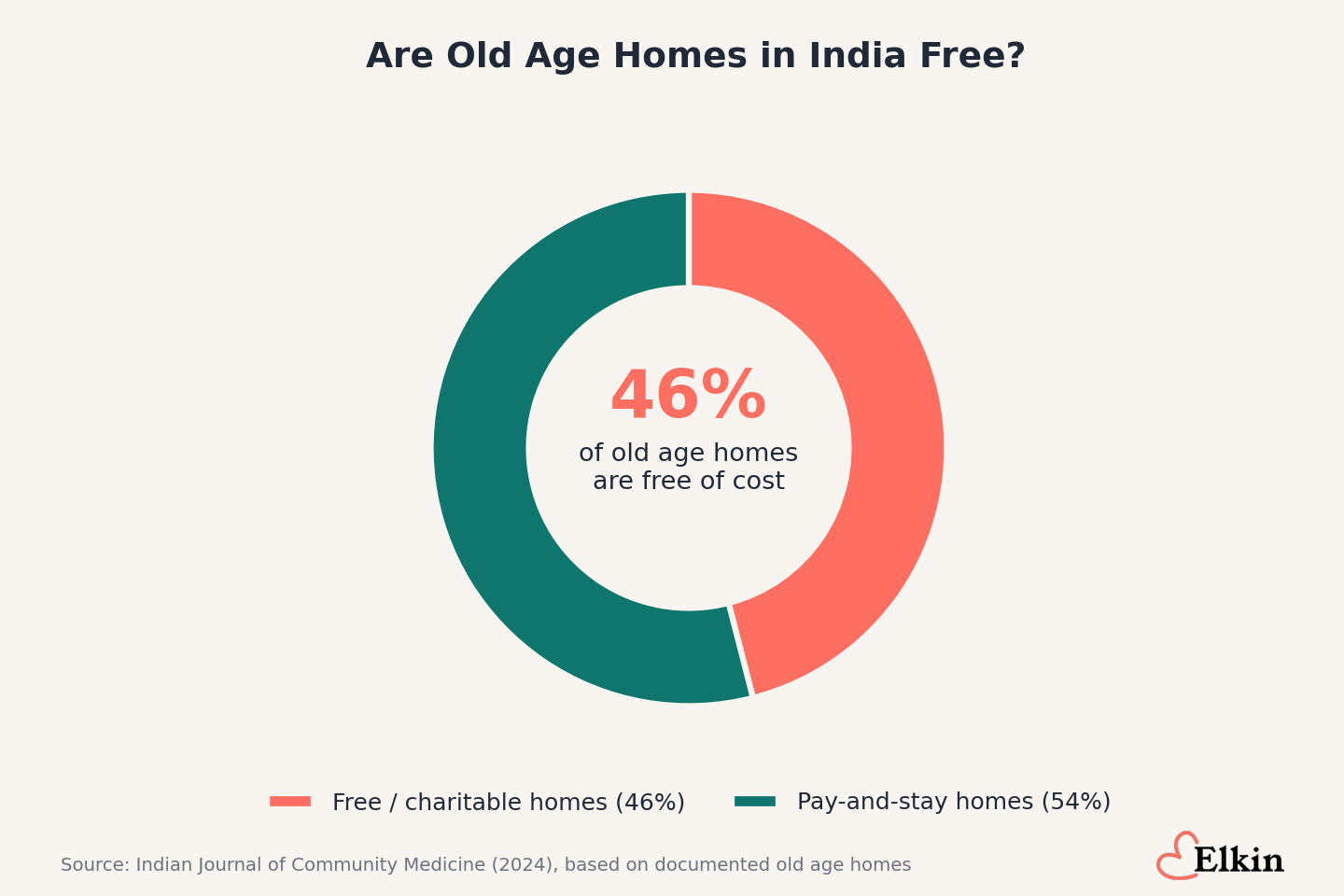
Old age home (vridhashram): Traditionally a charitable or trust-run home for destitute or abandoned elders. According to the Indian Journal of Community Medicine (2024), around 46% of documented old age homes in India are free of cost; the rest run on a pay-and-stay basis.
Independent living: For active, healthy seniors who want a safe, community setting with their own space. Explore independent living retirement communities if the elder can live on their own but wants companionship and security.
Assisted living: For seniors who need daily help with bathing, medication, meals or mobility. See assisted living homes in India for this level of support.
Memory care: Specialised care for elders with dementia or Alzheimer's.
Many families search for an "old age home" when what they really need is assisted living or memory care. Getting the category right saves time and money. You can compare all of these on a single platform and browse verified senior living homes across India by city and care type.
The numbers behind the demand: India's ageing population
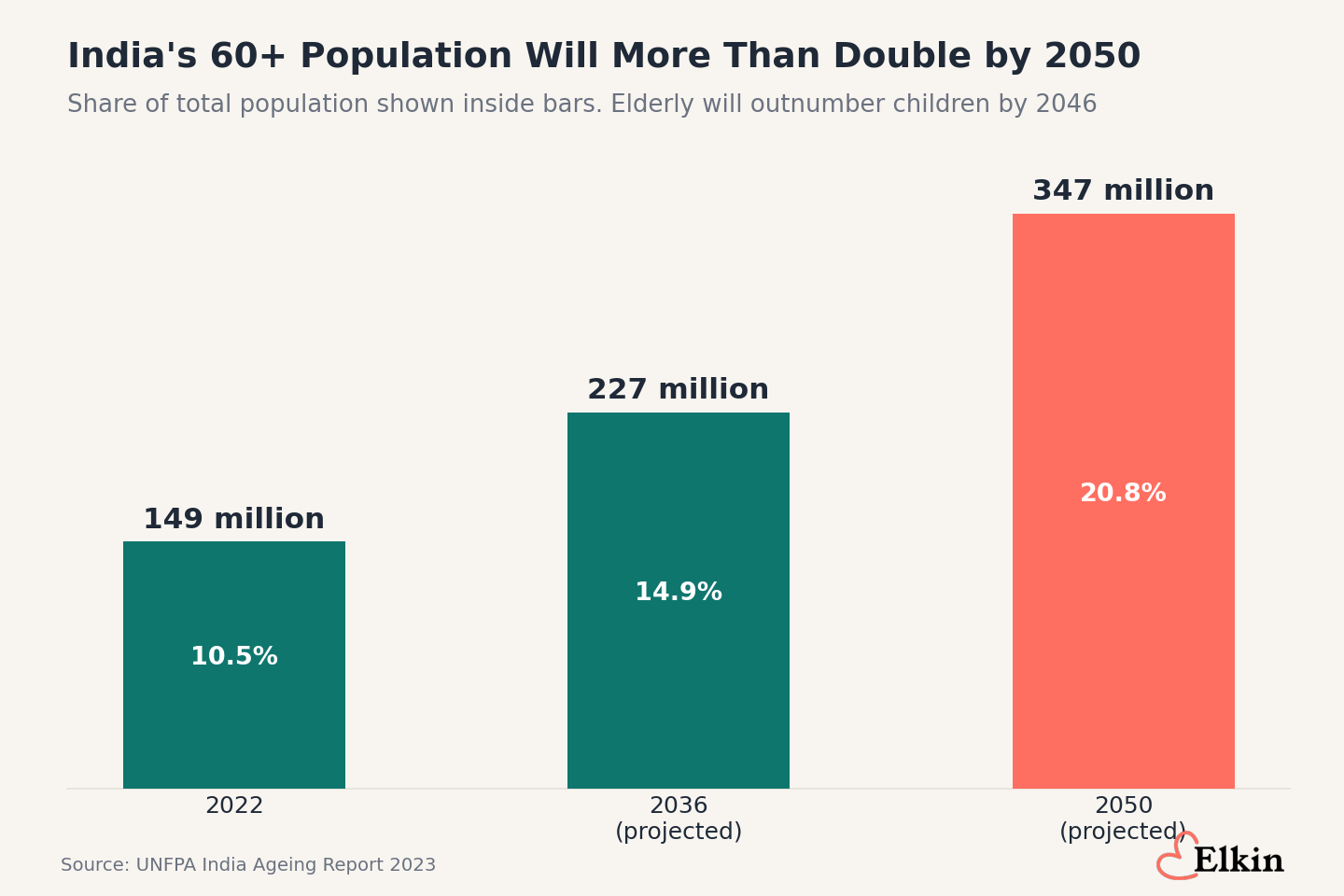
The rise in old age homes is directly linked to India's ageing population. The data here is striking and comes from the UNFPA India Ageing Report 2023, built on the Census, official population projections, and the Longitudinal Ageing Study in India (LASI).
- India had 149 million people aged 60 and above in 2022, about 10.5% of the population.
- This will more than double to 347 million by 2050, or over one in every five Indians.
- By 2046, the elderly are projected to outnumber children aged 0 to 15 for the first time.
- The population aged 80+ will grow by around 279% between 2022 and 2050.
- A 60-year-old man can expect to live another 18.3 years on average; a woman, 19 years.
- More than 40% of India's elderly fall in the poorest wealth quintile, and about 18.7% live with no income at all.
At the same time, joint families are shrinking, adult children are migrating for work, and more elders are living alone. Together, these forces are pushing demand for senior living far beyond the current supply of homes.
How much does an old age home in India cost?
Costs vary widely by type and city:
Free / charitable homes: No fee. Meant for destitute elders without family support or income. These fill up quickly and have waiting lists.
Nominal-fee homes: A small monthly charge to cover food and basics.
Paid old age homes / assisted living: Typically range from a few thousand rupees to Rs 50,000+ per month, depending on the city, room type, and level of medical care.
Premium senior living communities: Charge a one-time deposit plus monthly maintenance, and offer amenities like physiotherapy, 24/7 nursing, and recreation.
Always ask what is included, such as meals, nursing, doctor visits, and emergency response, before comparing prices between two homes.
Are old age homes in India regulated?
Partly. Government-funded homes must follow the norms of the Integrated Programme for Senior Citizens and admit indigent elders free of cost. The government has also introduced monitoring measures for these homes, including mandatory CCTV cameras and a central Project Monitoring Unit.
The broader legal backbone is the Maintenance and Welfare of Parents and Senior Citizens Act, 2007, which places a duty on children to care for elderly parents and empowers states to set up old age homes.
Beyond this, day-to-day regulation of private homes sits with state social welfare departments, and standards can vary from one home to another. This is exactly why families should visit in person and verify facilities before deciding.
Old age homes in India: key statistics at a glance
- Roughly 700 to 1,200 old age homes appear in documented directories; the true total is likely higher once private and unregistered homes are included.
- 1,658 old age homes were being maintained with central government support as of 2023 (up from 551 directly funded homes reported in 2021).
- Kerala has the most old age homes, followed by West Bengal, Tamil Nadu, and Maharashtra; South India has the highest overall concentration.
- Around 46% of documented old age homes are free of cost.
- India's 60+ population will hit 347 million by 2050.
- The sector is one of India's fastest-growing care segments.
Sources: Ministry of Social Justice and Empowerment (PIB, 2021; ministerial statement, July 2023); UNFPA India Ageing Report 2023; Longitudinal Ageing Study in India (LASI); Indian Journal of Community Medicine (2024); Tata Trusts Report on Old Age Facilities in India; HelpAge India (2009 directory).
Frequently Asked Questions
How many old age homes are there in India?
There is no single official count. Documented directories record roughly 700 to 1,200 old age homes, and the central government stated in 2023 that it maintains 1,658 homes under its senior citizen schemes. Including private and unregistered facilities, the true number is likely higher, but no agency tracks them all in one place.
How many elderly people live in old age homes in India?
The Ministry of Social Justice and Empowerment reported in 2021 that about 16,290 destitute elderly live in the 551 homes it directly funds. No national figure exists for residents of private and charitable homes, so the total institutional population is certainly much larger but remains uncounted.
Which state has the most old age homes in India?
Kerala has the most old age homes in India. HelpAge India's national count recorded 182 facilities there, and a 2024 study in the Indian Journal of Community Medicine again found Kerala highest with 124 documented homes. West Bengal, Tamil Nadu, and Maharashtra follow.
Are old age homes in India free?
Some are. Around 46% of documented old age homes are free of cost and meant for destitute elders, and all centrally funded homes must admit indigent seniors free. The rest operate on a pay-and-stay basis, ranging from nominal monthly fees to premium senior living charges.
What is the difference between an old age home and assisted living?
A traditional old age home is usually a charitable or trust-run shelter for elders without family support. Assisted living is a paid residential option for seniors who need daily help with bathing, medication, meals, or mobility, with trained staff and medical support built in. Many families searching for an "old age home" actually need assisted living.
Why is the demand for old age homes rising in India?
India's 60+ population is projected to grow from 149 million in 2022 to 347 million by 2050. At the same time, joint families are shrinking, adult children are migrating for work, and more elders live alone, which pushes demand for institutional and community-based senior care well beyond current supply.
How many old age homes are there in India, state wise?
No current official state-wise registry exists. The best available breakdown, from HelpAge India's directory, put Kerala first with 182 homes, followed by West Bengal (164), Tamil Nadu (151), Maharashtra (133), undivided Andhra Pradesh (114), Karnataka (91), and Gujarat (77). Government-funded homes are listed state-wise by the Ministry of Social Justice and Empowerment under its senior citizen schemes.
Which state of India has the highest old age population?
Kerala has the highest share of elderly people of any Indian state, with close to 14% of its population aged 60 or above compared with a national average of about 10.5%. This is also a key reason Kerala has the most old age homes in the country.
How many 80 year olds are there in India?
The 80+ age group is India's fastest-growing population segment. It grew by 128% between 2000 and 2022, and the UNFPA India Ageing Report projects it will grow by a further 279% between 2022 and 2050, with a predominance of widowed, highly dependent very old women. This "ageing of the aged" is a major driver of demand for assisted living and memory care.
Which is the no. 1 old age home in India?
There is no official ranking of old age homes in India, and the right choice depends on care needs, budget, and location. The oldest recorded home is the Raja Varma old age home, founded in Thrissur, Kerala, in 1911. When comparing homes, look at staffing ratios, medical support, hygiene, resident reviews, and transparency on fees rather than reputation alone.
Are there Muslim old age homes in India?
Yes. Alongside homes run by Hindu, Christian, and secular trusts, several old age homes in India are run by Muslim charitable trusts and community organisations, particularly in cities such as Delhi, Hyderabad, Mumbai, and Lucknow. No separate national count of faith-run homes exists, so families usually find them through state social welfare directories or local community organisations.
Is there a government old age home in India? Yes. Under the Integrated Programme for Senior Citizens (part of the AVYAY scheme), the central government funds NGO-run senior citizen homes that provide free shelter, food, and medical care to indigent elders. As of 2023, the government reported maintaining 1,658 such homes across the country. States also run homes under the Maintenance and Welfare of Parents and Senior Citizens Act, 2007.