

The short answer is 60. But there is no single national admission age for old age homes in India, and the exceptions are the ones that catch families out: Maharashtra admits women at 55, private senior living communities often start at 55, and the Ayushman health cover most families assume comes with old age does not begin until 70.
This guide gives the age rules by type of home, the six different ages Indian law calls "senior", and what actually decides an application once the age box is ticked.
Key takeaways
- 60 is the standard minimum age for admission to a government or charitable old age home in India.
- 60 is also the legal definition of a senior citizen under the Maintenance and Welfare of Parents and Senior Citizens Act, 2007.
- Maharashtra admits women at 55 and men at 60. State rules vary, so check the state, not the country.
- Private senior living communities set their own floor, commonly 55 or 58, because they are commercial businesses with no statutory age.
- There is no upper age limit anywhere. What limits an older applicant is the home's ability to meet their care needs, never their age.
- Age alone rarely decides an application. Residency, income proof, destitution status and a medical fitness certificate do most of the work.
Quick answer: what is the age limit for an old age home in India?
Minimum 60 years for government and charitable old age homes, which follow the statutory definition of a senior citizen. Private old age homes and senior living communities set their own minimum, usually 55 to 60.
There is no maximum age. A 95-year-old is as eligible as a 61-year-old, provided the home can meet their care needs.
The exceptions worth knowing:
Home or scheme | Minimum age |
Government old age homes (most states) | 60 |
Maharashtra government homes, women | 55 |
Maharashtra government homes, men | 60 |
Charitable and trust homes | 60 |
Private old age homes | 60, occasionally 58 |
Private senior living communities | 55 to 60 |
Ayushman Vay Vandana Card | 70 |
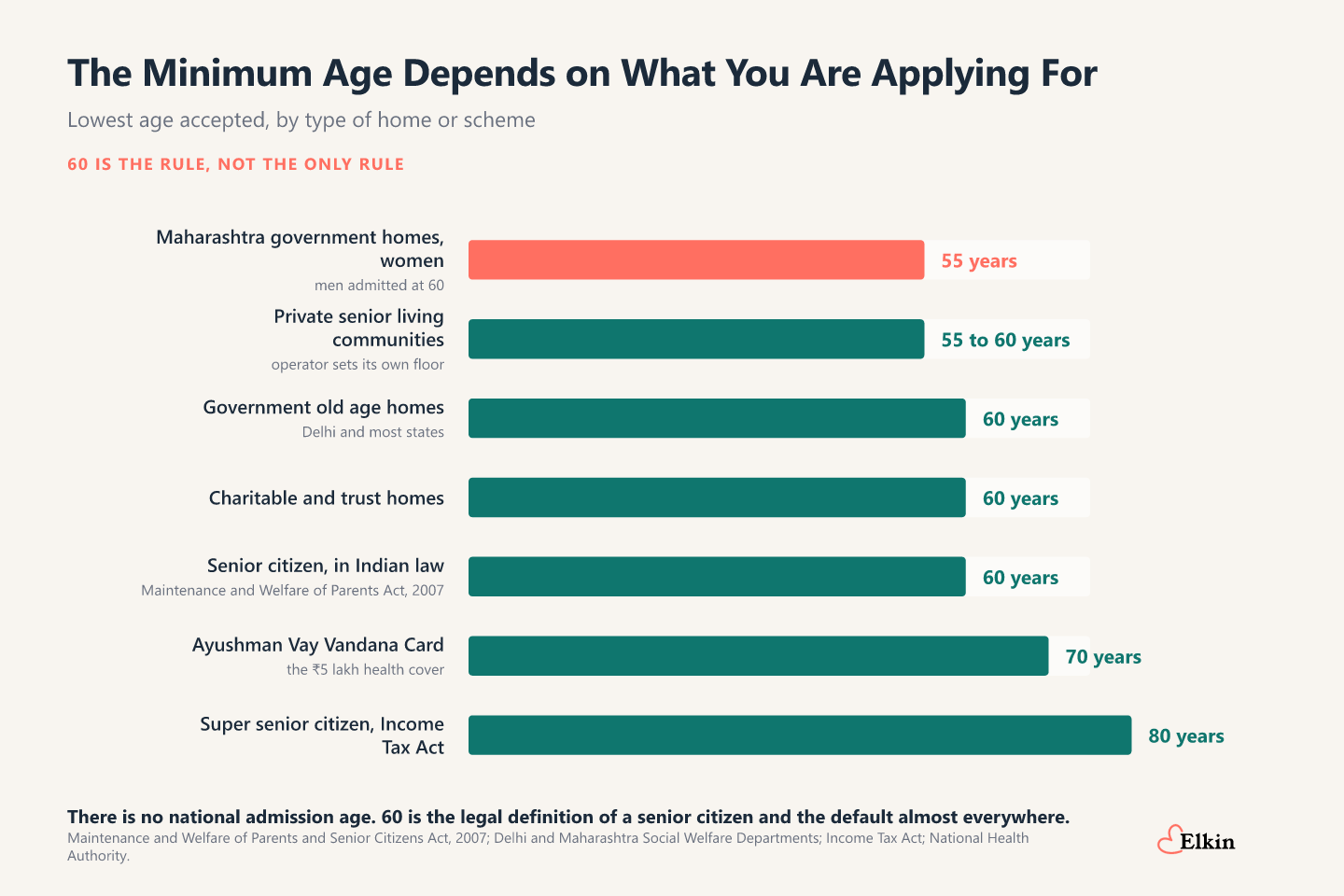
Lowest age accepted, by type of home or scheme.
Why 60 is the number
The Maintenance and Welfare of Parents and Senior Citizens Act, 2007 defines a senior citizen as any Indian aged 60 or above. Every government scheme for older people inherits that definition, and old age homes, being creatures of the state social welfare departments, inherit it too.
That is the whole reason 60 appears everywhere. It is not a clinical threshold or a care judgement. It is a statutory one.
Six different ages called "senior"
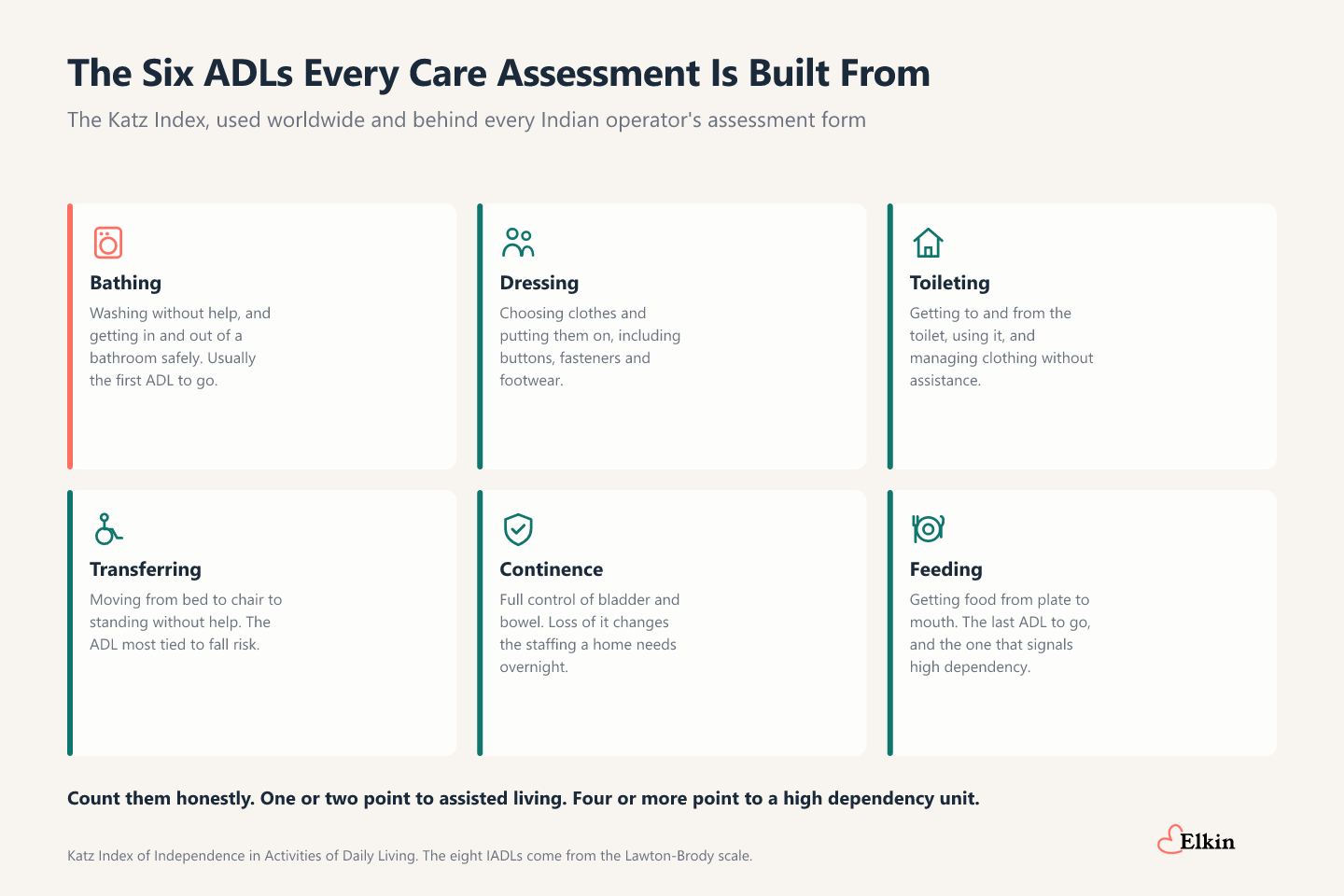
Each threshold belongs to a different law or scheme, and they do not agree.
This is where families get confused, because "senior citizen" means different things in different places:
- 60 makes you a senior citizen under the 2007 Act. This is the one old age homes use.
- 60 also makes you a senior citizen for income tax, unlocking the Section 80D and 80DDB reliefs.
- 80 makes you a super senior citizen for income tax, with a higher exemption limit again.
- 70 is when the Ayushman Vay Vandana Card becomes available, giving ₹5 lakh a year of cashless hospital cover regardless of income.
- 55 to 60 is the range private senior living communities set, because nothing obliges them to use 60.
- 55 admits a woman to a Maharashtra government old age home, against 60 for a man.
When a home advertises "senior citizens only", ask which definition it is applying before assuming 60.
Age by type of home
Government old age homes
Minimum 60, and the age is the easiest condition to satisfy. Delhi's Department of Social Welfare, for example, admits destitute and infirm persons aged 60 and above who are residents of the union territory, have nobody to support them, and are free of infectious disease.
Delhi also runs a means test rather than a flat fee: seniors with an annual income above ₹12,000 pay a nominal ₹500 a month, and those below it pay nothing.
Maharashtra is the notable exception on age, admitting women from 55.
Charitable and trust homes
Minimum 60 in almost all cases. Many follow government criteria voluntarily because they receive grant-in-aid under the Integrated Programme for Senior Citizens, part of Atal Vayo Abhyuday Yojana.
Some religious and community-run homes admit slightly younger applicants in genuine hardship, but this is discretionary rather than a published rule.
Private old age homes and senior living communities
These are commercial businesses. No statute sets their admission age, so they set it themselves, commonly at 55 or 58 for independent living and 60 for assisted living.
A community targeting active retirees has a commercial reason to start at 55: it wants residents who will stay for fifteen years, not two. A home offering assisted living has the opposite incentive and usually sits at 60.
Where couples are involved, most communities require only one partner to meet the age threshold. Our guide to old age homes for couples in India covers how that works in practice.
Is there a maximum age?
No. No Indian old age home publishes an upper age limit, and it would be difficult to justify one.
What does limit an older applicant is care capacity, not age. A home with no nursing staff will decline a 90-year-old who needs help with bathing and transfers, and it will decline a 68-year-old with the same needs. The refusal is about the care, not the birthday.
This is the single most useful thing to understand about admission: homes assess what they can safely provide, then check whether you qualify. Age is a filter, not the decision.
What actually decides an application
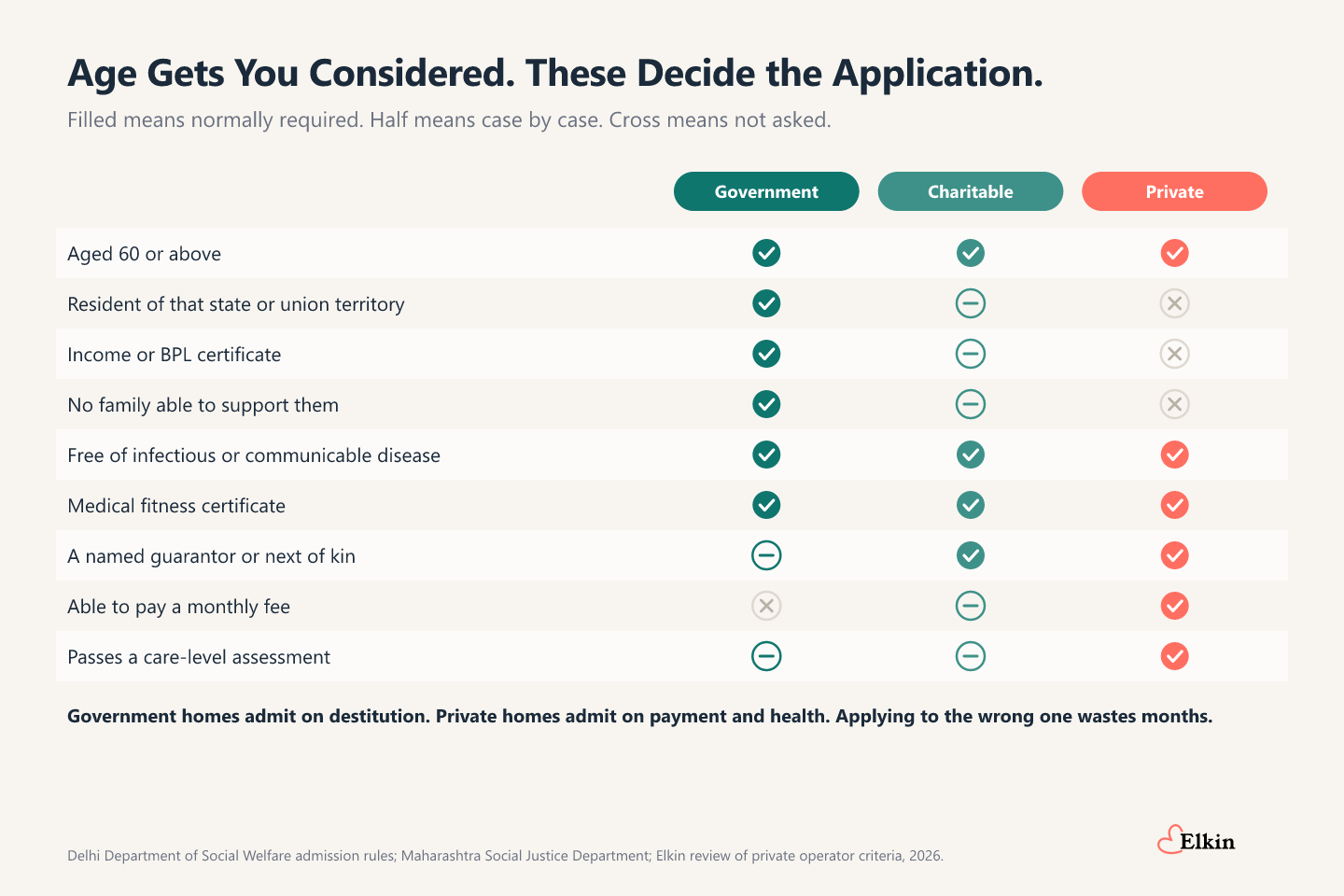
Matrix of old age home eligibility requirements beyond age in India
Filled means normally required. Half means case by case. Cross means not asked.
Requirement | Government | Charitable | Private |
Aged 60 or above | Yes | Yes | Yes |
Resident of that state or union territory | Yes | Sometimes | No |
Income or BPL certificate | Yes | Sometimes | No |
No family able to support them | Yes | Sometimes | No |
Free of infectious or communicable disease | Yes | Yes | Yes |
Medical fitness certificate | Yes | Yes | Yes |
A named guarantor or next of kin | Sometimes | Yes | Yes |
Able to pay a monthly fee | No | Sometimes | Yes |
Passes a care-level assessment | Sometimes | Sometimes | Yes |
The pattern is simple. Government homes admit on destitution. Private homes admit on payment and health. Being 60 gets you considered in both, and decides neither.
The conditions that most often cause a refusal are not about age at all: active infectious disease, severe or unmanaged psychiatric illness, and care needs beyond what the home is staffed for. Advanced dementia is accepted only where there is secure premises and trained staff.
The full eligibility picture is in our guide to old age home eligibility, and the step-by-step process is in how to get admission in an old age home in India.
Documents that prove your age
Whichever route you take, age proof is the first document requested. Any of these is normally accepted:
Aadhaar card
Birth certificate
PAN card
Passport
School leaving certificate
Voter ID
Pension payment order
Government homes additionally require an income or BPL certificate, and that is the document that actually decides eligibility there. Keep originals plus two sets of photocopies.
What if your parent is under 60?
Three routes exist:
Private senior living communities from 55. The most straightforward option if the family can fund it. See what senior living means for how these differ from a traditional old age home.
Maharashtra government homes for women from 55.
Care at home instead. Age limits do not apply to attendants or home nurses. Costs are in how much in-home senior care costs in India.
If the reason for looking early is a health condition rather than age, care level matters far more than the number. A 57-year-old with early-onset dementia needs memory care, and the good memory care units will assess on need, not date of birth.
The bottom line
Take 60 as the working answer and then check two things: the state, because Maharashtra differs for women, and the type of home, because private communities set their own floor.
Then stop thinking about age. Once your parent is over 60, the age box is ticked and the application turns entirely on residency, income proof, health, and whether the home is staffed for the care they need. Those are what get applications refused.
Looking for a home? Elkin helps families across India compare verified old age homes and senior living communities by care type, city and budget.
Frequently asked questions
What is the age limit for admission to an old age home in India?
Minimum 60 years for government and charitable homes, which follow the Maintenance and Welfare of Parents and Senior Citizens Act, 2007 definition of a senior citizen. Private old age homes and senior living communities set their own floor, usually 55 to 60. There is no maximum age anywhere.
Can someone under 60 be admitted to an old age home?
Sometimes. Maharashtra government homes admit women from 55. Private senior living communities commonly start at 55 or 58. Charitable homes occasionally admit younger applicants in genuine hardship, but that is discretionary rather than a published rule.
Is there a maximum age for an old age home in India?
No. No home publishes an upper age limit. What restricts an older applicant is whether the home can meet their care needs, not their age. A home without nursing staff will decline anyone needing nursing, at any age.
What is the minimum age for a senior living community in India?
Usually 55, sometimes 58 or 60. These are commercial businesses with no statutory age, so each operator sets its own. Where a couple applies, most require only one partner to meet the threshold.
Why is 60 the standard age for old age homes?
Because the Maintenance and Welfare of Parents and Senior Citizens Act, 2007 defines a senior citizen as anyone aged 60 or above, and state social welfare departments inherit that definition. It is a statutory threshold, not a clinical one.
Does the age limit differ for men and women?
In most states, no. Maharashtra is the notable exception, admitting women to government old age homes from 55 and men from 60. Always check the rule for the specific state.
What documents prove age for old age home admission?
Aadhaar, birth certificate, PAN card, passport, school leaving certificate, voter ID or a pension payment order. Government homes additionally require an income or BPL certificate, which is usually the document that decides eligibility.
Does age affect the fee?
Not directly. Government homes means test on income, not age. Delhi charges ₹500 a month to seniors with an annual income above ₹12,000 and nothing to those below it. Private homes price on care level and room type. Current pricing is in how much an old age home costs in India.
At what age does Ayushman Bharat cover senior citizens?
The Ayushman Vay Vandana Card gives every Indian aged 70 and above ₹5 lakh a year of cashless hospital cover regardless of income. It pays for hospital admission, not for old age home fees.