

In almost every case, the family does. India has no long-term care insurance, no state subsidy for private residential care, and no health policy that covers a monthly old age home fee. Around 91% of a typical year in assisted living comes straight out of savings, pension or a family contribution.
There are two genuine recovery routes, both partial and both easy to miss. This guide sets out every way an old age home gets paid for, what each one actually covers, and what you can realistically claim back.
Key takeaways
- Roughly 91% of a paid old age home bill is out of pocket. Savings, pension, rental income or a family contribution.
- No Indian health insurance policy covers residential care fees. Policies pay for hospitalisation, not for room and board.
- Ayushman Vay Vandana pays ₹0 towards an old age home. It gives every senior aged 70 and above ₹5 lakh a year, but only for hospital admission.
- Tax relief is the main recovery route. Sections 80D and 80DDB can be worth around ₹45,000 a year at a 30% marginal rate, and only under the old tax regime.
- Tax relief covers the medical portion only, never room and board, so medical invoices must be billed and kept separately.
- Government and charitable homes are free, but they admit on destitution, not on payment, and carry waiting lists.
Quick answer: who pays for an old age home in India?
Payer | What it covers | Realistic share |
The senior's own savings and pension | Everything | The largest single source |
The family | Everything | The second largest |
Tax relief (80D, 80DDB) | Medical expenditure only | Up to about ₹45,000 a year |
Health insurance | Hospitalisation only, not fees | ₹0 towards the monthly fee |
Ayushman Vay Vandana | Hospital admission for 70+ | ₹0 towards the monthly fee |
Government grant-in-aid | Funds homes, not individual fees | ₹0 to a paying family |
Charitable funding | Free and pay-and-stay homes for the destitute | 100% for those who qualify |
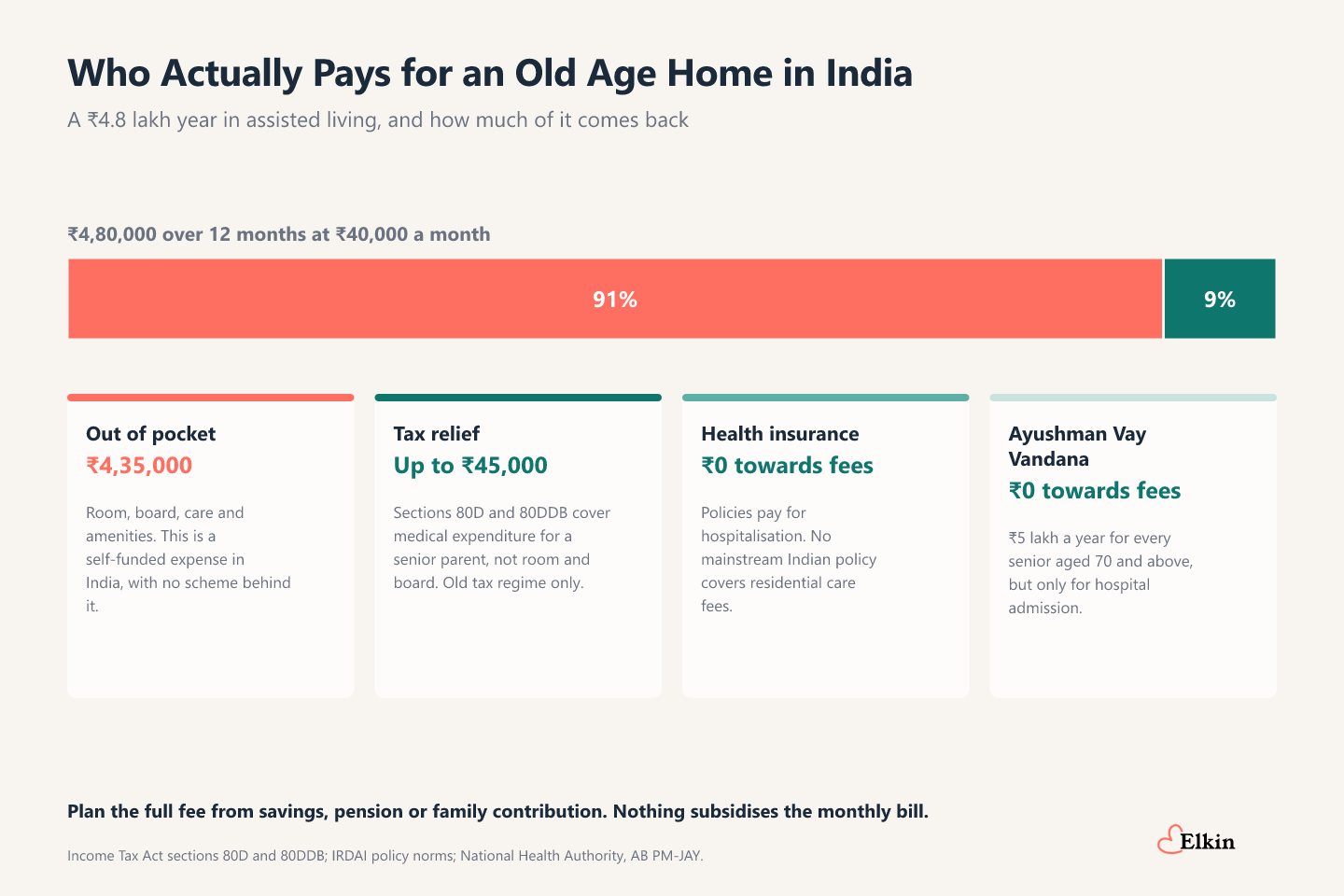
A ₹4.8 lakh year in assisted living, and how much of it comes back.
The six funding routes
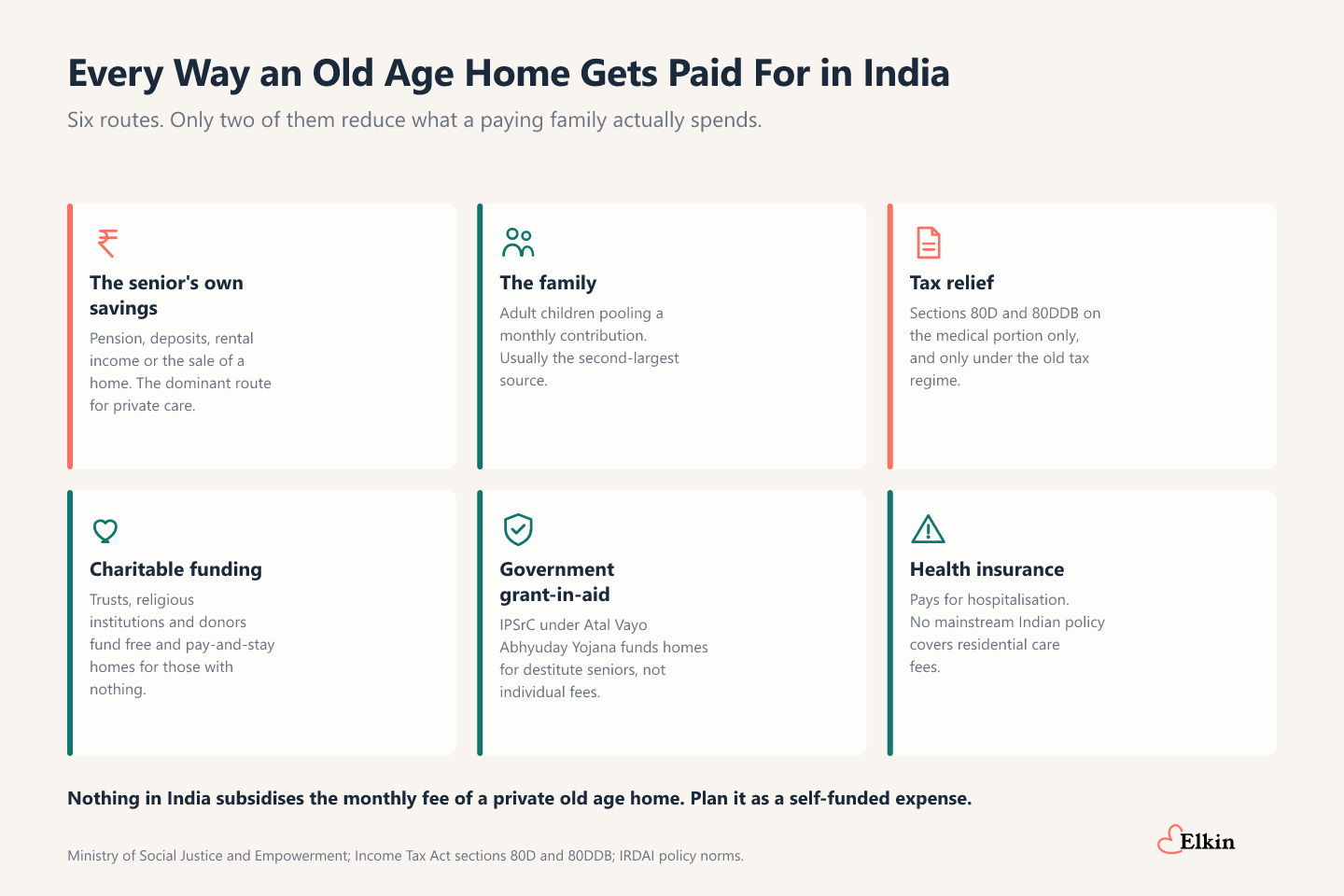 Only two of these reduce what a paying family actually spends.
1. The senior's own savings and pension
The dominant route. Pension income, fixed deposits, rental income from a property, or the proceeds of selling the family home.
For a senior with a government pension, the monthly fee at a basic paid home (₹12,000 to ₹25,000) is often within reach. For assisted living at ₹30,000 to ₹70,000, most seniors need capital as well as income.
2. The family
Adult children pooling a monthly contribution is the second-largest source, and the one most likely to create friction. Two things prevent that:
Agree the split in writing before admission, including who covers the annual increment of 8% to 12% and who covers medical extras.
Agree who holds the paperwork. Only one person can claim the tax relief below, and it has to be the one whose name is on the payments.
3. Tax relief under Sections 80D and 80DDB
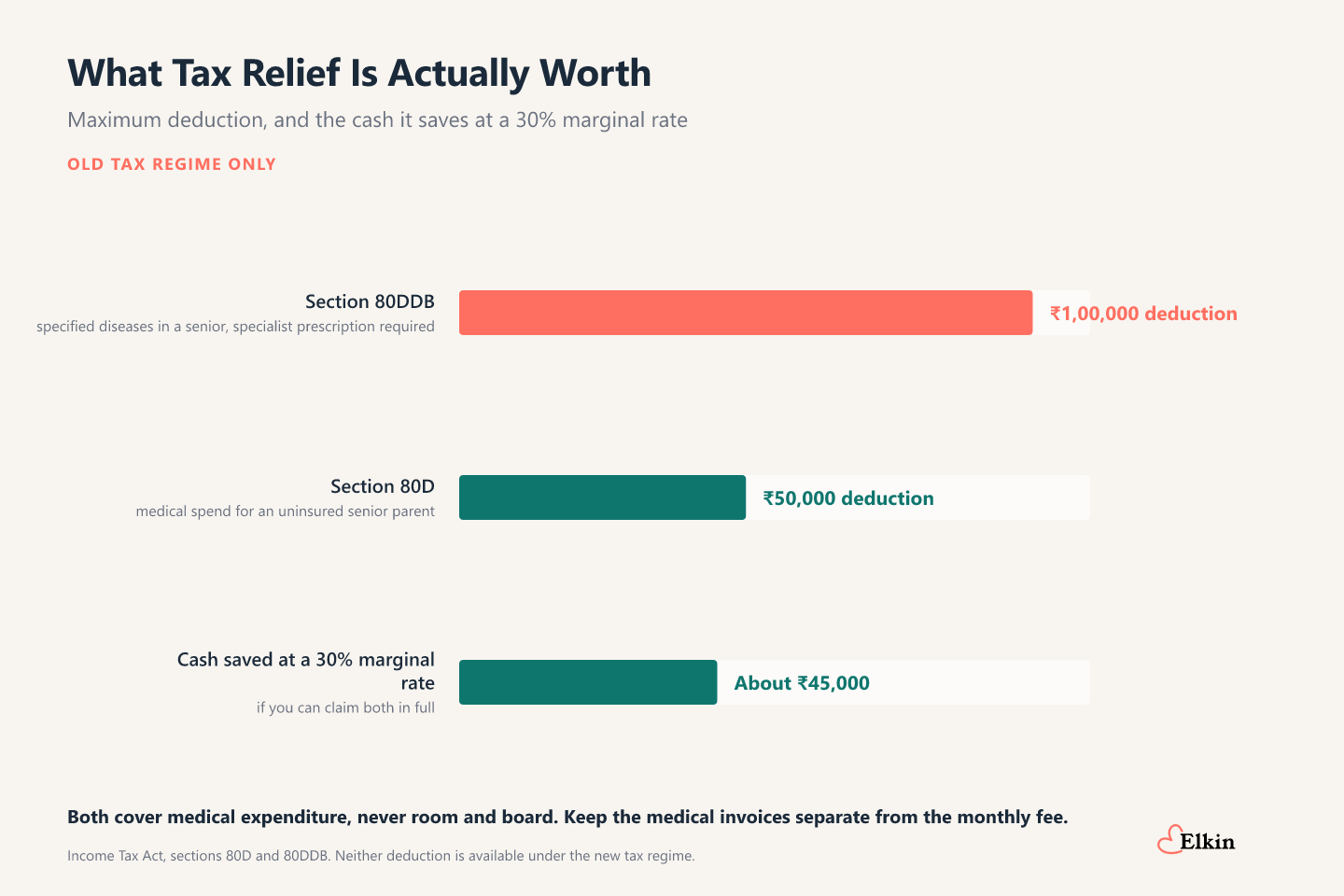
Maximum deduction, and the cash it saves at a 30% marginal rate.
This is the main recovery route and the most commonly missed.
Section 80D allows up to ₹50,000 a year for a senior citizen parent. If the parent has health insurance, it covers the premium. If the parent has no health insurance at all, it covers actual medical expenditure, which is the more useful case here.
Section 80DDB allows up to ₹1,00,000 a year for the treatment of specified diseases in a senior citizen. It requires a prescription from a specialist. Several conditions common in high-dependency residential care qualify.
Claimed in full at a 30% marginal rate, the two are worth around ₹45,000 a year in cash.
Three conditions that catch people out:
- Old tax regime only. Neither deduction exists under the new regime. If your parent's care costs have jumped, redo the comparison, because the old regime may now be cheaper for you.
- Medical expenditure only. Room, board and amenities are not deductible. The home must bill medical items separately, and you must keep those invoices.
- Payment must not be in cash for the 80D medical expenditure route.
The equivalent question for facility fees is worked through in is assisted living tax deductible in India.
4. Charitable and trust funding
Trusts, religious institutions, NGOs and individual donors fund free and pay-and-stay homes. For a senior who qualifies, this covers 100% of the cost.
The catch is the admission basis. These homes admit on need, usually means tested, and popular ones carry long waiting lists. They are not an option a paying family can choose into.
5. Government grant-in-aid
The Integrated Programme for Senior Citizens, under Atal Vayo Abhyuday Yojana and run by the Ministry of Social Justice and Empowerment, funds Senior Citizen Homes and related projects. As of early 2024, 639 projects were receiving grant-in-aid.
Note what this does and does not do. It funds homes, not individual residents. No family receives a payment or a voucher. The benefit reaches you only if your parent is admitted to a funded home, which again requires qualifying on destitution.
6. Health insurance
No mainstream Indian health policy covers old age home fees. Health insurance pays for hospitalisation. Residential care is not hospitalisation.
What insurance does cover for a senior is worth knowing, because it reduces the medical costs that sit alongside the fee: inpatient hospitalisation, day care procedures, pre and post hospitalisation, and domiciliary hospitalisation where treatment at home runs 72 hours or more on a doctor's written advice.
The full picture is in does insurance cover assisted living in India.
What Ayushman Bharat does and does not pay
The Ayushman Vay Vandana Card gives every Indian aged 70 and above ₹5 lakh a year of cashless cover, regardless of income, with no premium, no waiting period and pre-existing conditions covered from day one.
It is genuinely valuable, and it pays ₹0 towards an old age home fee. It covers hospital admission and treatment.
Think of it as protection against the hospitalisation that good residential care is designed to prevent, not as a subsidy for the care itself.
A worked example
A ₹40,000 a month assisted living place, over one year:
Item | Amount |
Annual fee (₹40,000 x 12) | ₹4,80,000 |
Less: tax relief at a 30% marginal rate, both sections claimed in full | ₹45,000 |
Net cost to the family | ₹4,35,000 |
Plus, in year one only, an admission fee of ₹10,000 to ₹50,000 and a security deposit of ₹10,000 to ₹4,00,000. A ₹40,000 place commonly needs around ₹1,65,000 up front before the first night. Full pricing is in how much an old age home costs in India.
How to fund it well
Plan the full fee as self-funded. Treat tax relief as a rebate you claim later, never as a discount you can count on.
Ask the home to bill medical items separately from room and board, from day one. Without that split, the 80D and 80DDB claims are not possible.
Keep every receipt and avoid cash payments.
Budget the annual increment, typically 8% to 12%. Over a five-year stay it compounds significantly.
Decide who claims before the first payment. The relief goes to the person whose name is on the payments.
Check the old versus new tax regime in the year care starts. A large jump in medical spend can flip the answer.
Compare against care at home once round-the-clock nursing enters the picture, because the arithmetic often turns. See how much in-home senior care costs in India.
If cost is the binding constraint, charitable and government homes remain the honest answer, and the route in is set out in how to get admission in an old age home in India.
The bottom line
Nothing in India subsidises the monthly fee of a private old age home. Budget the full amount from savings, pension and family contribution, and treat the roughly ₹45,000 of annual tax relief as money you go and reclaim afterwards.
The one decision that actually affects what you recover is administrative: get the home to bill medical items separately from room and board on day one. Families who do not do that lose the deduction entirely, and it is not recoverable in hindsight.
Comparing options? Elkin helps families across India find and compare verified old age homes and senior living communities by care type, city and budget.
Frequently asked questions
Who pays for old age homes in India?
The senior and their family, in almost every paid case. Roughly 91% of a typical assisted living year is out of pocket from savings, pension or a family contribution. Government and charitable homes are free but admit on destitution rather than payment.
Does the government pay for old age homes in India?
Not for individual residents. The Ministry of Social Justice and Empowerment funds homes through the Integrated Programme for Senior Citizens under Atal Vayo Abhyuday Yojana, with 639 projects receiving grant-in-aid as of early 2024. That reduces the cost of running qualifying homes; no family receives a payment or voucher.
Does health insurance cover old age home fees in India?
No. No mainstream Indian policy covers residential care fees. Health insurance pays for hospitalisation, day care procedures, and domiciliary hospitalisation where home treatment runs 72 hours or more on a doctor's written advice. Room and board is excluded.
Does Ayushman Bharat cover old age homes?
No. The Ayushman Vay Vandana Card gives every senior aged 70 and above ₹5 lakh a year of cashless cover regardless of income, but only for hospital admission and treatment. It contributes nothing towards a monthly old age home fee.
Can I claim tax relief on my parent's old age home fees?
On the medical portion only, and only under the old tax regime. Section 80D allows up to ₹50,000 a year for an uninsured senior parent's medical expenditure. Section 80DDB allows up to ₹1,00,000 for specified diseases with a specialist's prescription. Together they are worth about ₹45,000 in cash at a 30% marginal rate. Room and board is not deductible.
Are old age homes free in India?
Some are. Government homes run by state social welfare departments and charitable homes run by trusts and NGOs are free or charge a nominal amount up to about ₹10,000. They are means tested, admit on need, and usually have waiting lists.
What happens if a family cannot afford an old age home?
Apply to a government home through the District Social Welfare Office, or to charitable and trust homes directly. Both routes require proof of low income or destitution. The Maintenance and Welfare of Parents and Senior Citizens Act, 2007 also gives parents a legal right to claim maintenance from their children.
Who pays if the senior has no family?
Government and charitable homes exist precisely for this case and admit on destitution. Applications go through the District Social Welfare Office or the state Directorate of Social Justice. Elder Line, on the toll-free number 14567, can point you to the right office.
Can siblings split the cost and both claim tax relief?
They can split the cost, but only the person whose name is on the payments can claim the deduction, and the limits apply per taxpayer, not per parent. Agree who pays and who claims before the first invoice.