

Some are excellent. Some are not. The uncomfortable fact behind the question is that no national licensing regime exists for private old age homes in India, so nobody has inspected the home on your behalf. Whether a given home is safe is something you have to establish yourself.
That sounds alarming, and it should be taken seriously. But the data points somewhere most families do not expect: the Longitudinal Ageing Study in India found 5.2% of seniors reported ill-treatment, and since under 0.1% of Indian seniors live in a facility, almost all of that is happening in family homes.
This guide covers who regulates what, what the evidence actually shows, and the six checks that separate a safe home from a risky one.
Key takeaways
There is no national licensing regime for private old age homes in India. Registration proves the entity exists; it does not certify care standards.
Regulation depends entirely on how the home is constituted. Government homes are run and inspected by the state. Charitable homes register under trust law. Private homes operate as ordinary businesses.
LASI found 5.2% of Indians aged 60 and above reported ill-treatment. With under 0.1% living in facilities, the overwhelming majority of that occurs at home.
The Maintenance and Welfare of Parents and Senior Citizens Act, 2007 gives seniors rights, including a legal right to maintenance, but it does not license private homes.
Elder Line, 14567, is the national toll-free helpline for reporting neglect, abuse or a concern about a facility.
Six checks do most of the work: registration, an unannounced visit, night staffing, talking to residents, the emergency route, and a written agreement.
Quick answer: are old age homes in India safe?
Quality varies enormously and there is no regulator guaranteeing a floor. Government-run homes operate under departmental rules. Registered charitable homes have some oversight through trust registration and, in Kerala, the Orphanage Control Board. Private paid homes have no senior-care-specific licence at all.
Good homes in India are genuinely good: trained staff, night nursing, secure premises, medical tie-ups and open visiting. Poor ones exist too, and the difference is not visible from a website.
The practical answer is that safety is verifiable, not assumable. The checks below take an afternoon and settle it.
Who actually regulates an old age home
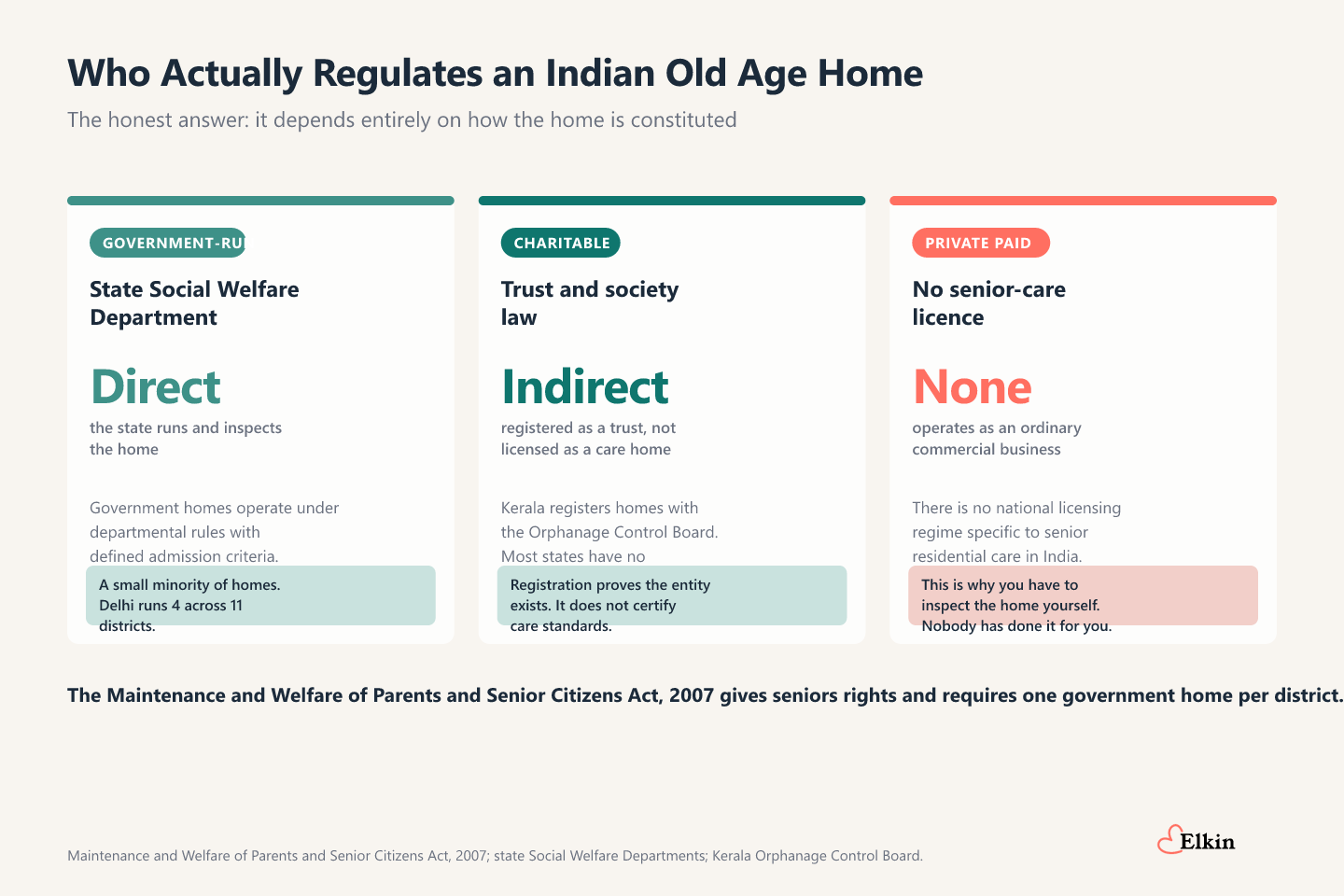
The honest answer depends entirely on how the home is constituted.
Government-run homes. Operated and inspected directly by the state Social Welfare Department, with defined admission criteria and staffing. A small minority of homes: Delhi runs four across eleven districts.
Charitable and trust homes. Registered as trusts or societies under general law. Kerala is unusual in registering homes with the Orphanage Control Board and publishing the register annually. Most states have no equivalent. Registration confirms the organisation exists and is accountable for its finances. It says nothing about care quality.
Private paid homes. No senior-care licence exists. They operate as ordinary commercial businesses, subject to the same rules as any other company and no more.
The Maintenance and Welfare of Parents and Senior Citizens Act, 2007 is the closest thing to a governing statute. It gives parents a legal right to claim maintenance from children, requires every state to maintain at least one old age home per district under Section 19(1), and creates tribunals to hear complaints. What it does not do is license or inspect private facilities.
The registration process such as it is, is covered in the old age home registration process.
What the evidence actually shows
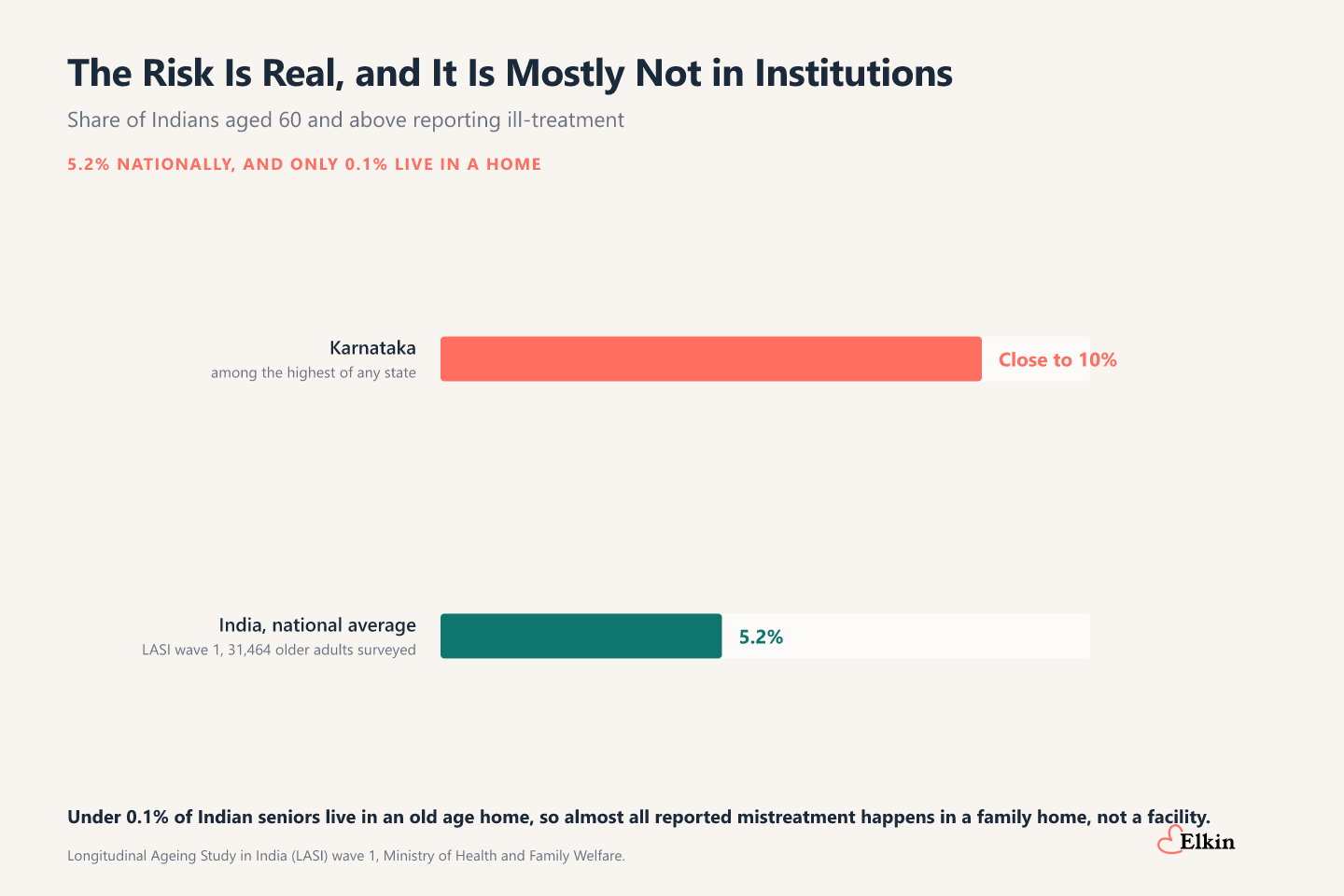
Share of Indians aged 60 and above reporting ill-treatment.
The Longitudinal Ageing Study in India, a nationally representative survey covering 31,464 adults aged 60 and above, found that 5.2% reported ill-treatment or abuse. Karnataka was among the highest at close to 10%.
Set that against the fact that under 0.1% of Indian seniors live in an old age home. Arithmetically, almost all reported mistreatment of older people in India happens in a family home, not in a facility.
That does not make facilities safe by default, and it is not an argument for moving anyone. It does mean the framing of the question deserves challenging. The relevant comparison is not "is an old age home safe in the abstract" but "is this specific home safer than my parent's current situation", and for a senior living alone with occasional help, the answer is sometimes yes.
We work through the wider version of that question in is it wrong to send parents to an old age home.
The six checks that settle it
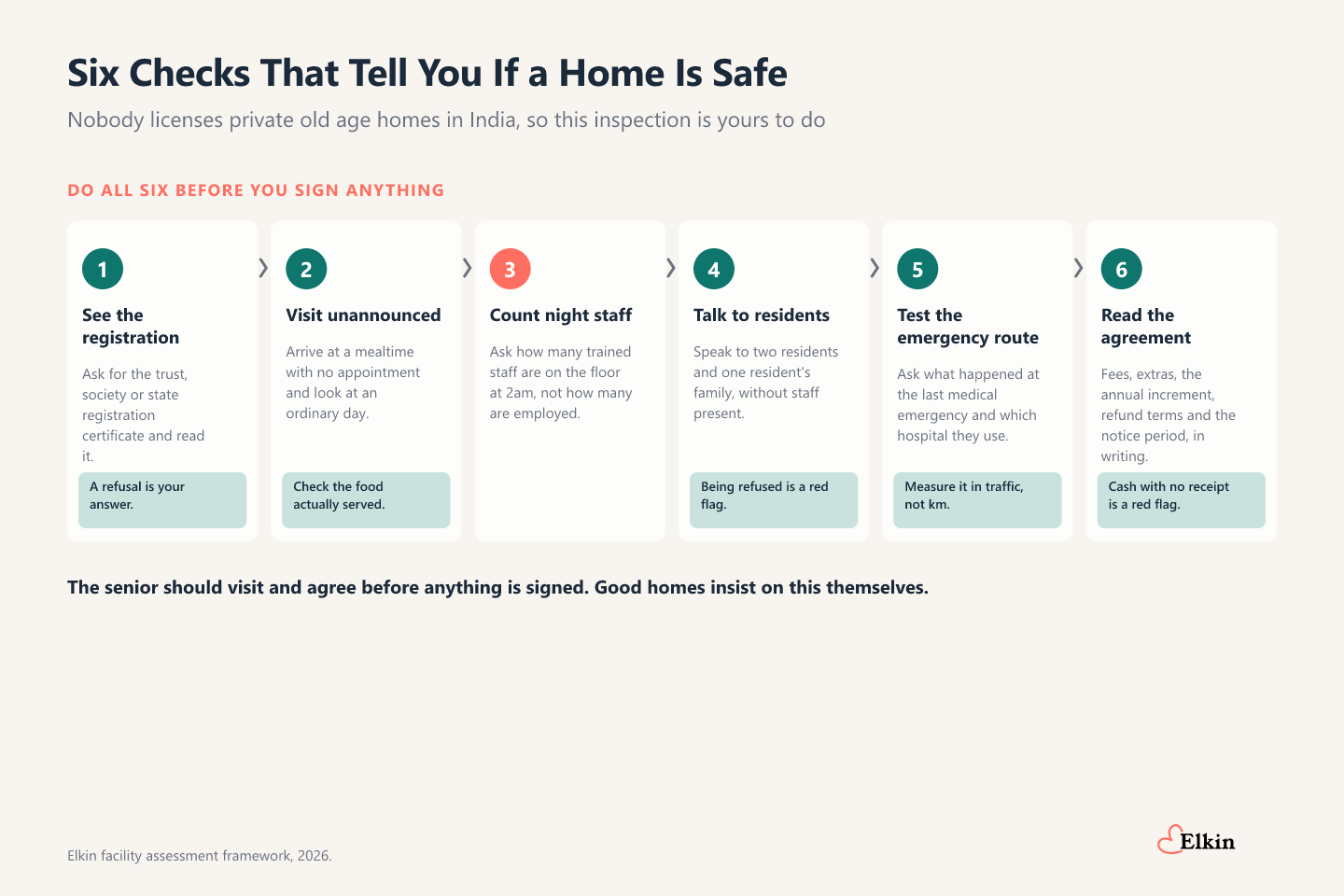 Nobody licenses private old age homes in India, so this inspection is yours to do.
1. See the registration. Ask for the trust, society or state registration certificate and read it. A home that will not show you its paperwork has told you something. Confirm the name on the certificate matches the name on the door.
2. Visit unannounced, at a mealtime. Every home shows you its best room on a scheduled tour. You are checking an ordinary Tuesday. Look at the food actually being served, not the sample menu on the wall.
3. Count the staff on duty at 2am. Not the number employed, the number physically on the floor overnight. This is the single most revealing question you can ask, and vagueness in the answer is itself the answer.
4. Talk to residents and their families. Speak to two residents and one resident's family member without staff present. If that is refused, walk away.
5. Test the emergency route. Ask what happened at the most recent medical emergency, which hospital they tie up with, how far it is in traffic rather than kilometres, and whether an ambulance is on site or called.
6. Read the agreement. Fees, what is extra, the annual increment, refund terms, notice period, and what happens if your parent's care needs increase. Cash payments with no receipt are a red flag, and they also make any tax claim impossible later.
Red flags
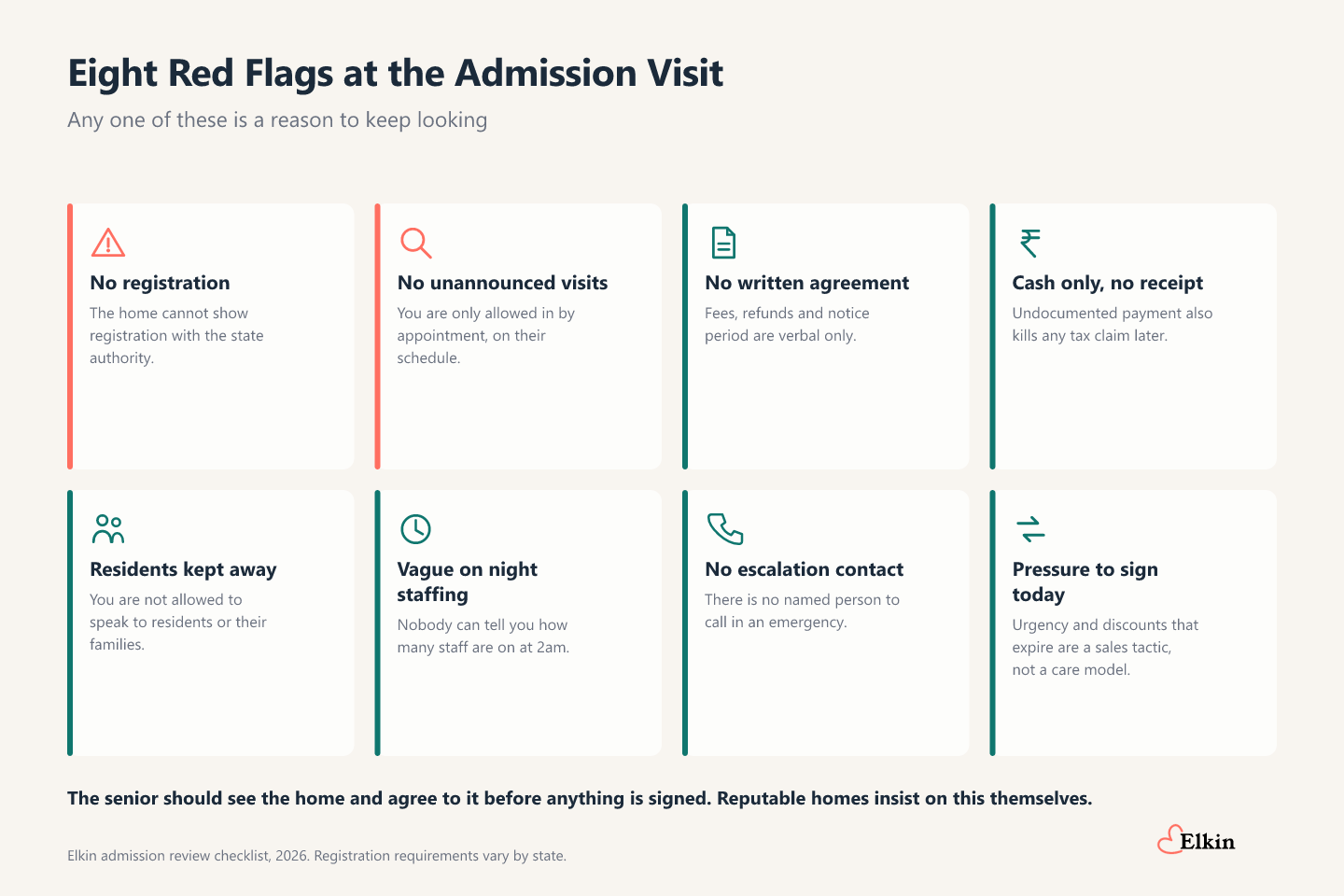 Eight red flags to watch for when visiting an old age home in India
Any one of these is a reason to keep looking.
- No registration, or a refusal to show it
- Visits only by appointment, on their schedule
- No written agreement, with fees described verbally
- Cash only, no receipts
- Residents kept away from you
- Vague answers on overnight staffing
- No named escalation contact for emergencies
- Pressure to sign today, with discounts that expire
What a safe home looks like
The features that genuinely correlate with safety, as opposed to the ones that photograph well:
Named night staff with clinical qualifications, and a stated ratio
A doctor on a fixed schedule, not merely "on call"
Emergency call buttons in rooms and bathrooms, tested, not just installed
Fall prevention throughout: grab bars, ramps, non-slip flooring, lighting on the routes to the bathroom
A named tie-up hospital within a realistic travel time
A medication management protocol with a record you are allowed to see
An incident log that exists and that they will show you
Open visiting, not restricted hours designed to control what you see
The full facilities picture is in what are the facilities at old age homes, and the shortlisting process in how to choose a senior living home.
If something goes wrong
Elder Line, 14567. The national toll-free helpline for senior citizens, for reporting neglect, abuse or a concern about a facility.
The Maintenance Tribunal in your district, established under the 2007 Act, hears maintenance and welfare complaints.
The District Social Welfare Office for government and government-aided homes.
The police, where there is any suspicion of physical abuse or financial exploitation.
Document everything. Dates, names, photographs, and written communication with the home.
Stay involved after admission. Regular unannounced visits are the most effective safeguard there is, and reputable homes welcome them.
The bottom line
The honest answer is that India has good old age homes and poor ones, and no regulator standing between you and the difference. That is a real gap, and it puts the burden of inspection on the family.
The good news is that the inspection is not difficult. Registration, an unannounced mealtime visit, the 2am staffing question, a conversation with a resident's family, the emergency route, and a written agreement. Six things, one afternoon, and you will know.
Comparing homes? Elkin verifies registration, care levels and staffing before listing, so you can compare old age homes and senior living communities that have already been checked.
Frequently asked questions
Are old age homes safe in India?
Quality varies widely, and there is no national licensing regime for private homes, so no regulator guarantees a minimum standard. Government homes are inspected by state social welfare departments and registered charitable homes have some trust-law oversight. Private homes operate as ordinary businesses. Safety has to be verified home by home.
Who regulates old age homes in India?
It depends on the home. State Social Welfare Departments run and inspect government homes. Charitable homes register as trusts or societies, and in Kerala with the Orphanage Control Board. Private paid homes have no senior-care-specific licence. The Maintenance and Welfare of Parents and Senior Citizens Act, 2007 gives seniors rights but does not license facilities.
How common is elder abuse in India?
The Longitudinal Ageing Study in India found 5.2% of adults aged 60 and above reported ill-treatment, from a nationally representative sample of 31,464 older adults. Karnataka was among the highest at close to 10%. Since under 0.1% of Indian seniors live in a facility, the great majority of reported mistreatment occurs in family homes.
How do I check if an old age home is safe?
Ask to see the registration certificate, visit unannounced at a mealtime, ask how many trained staff are on the floor at 2am, talk to residents and a resident's family without staff present, ask what happened at the last medical emergency, and read the full written agreement before signing.
What are the warning signs of an unsafe old age home?
No registration or refusal to show it, visits only by appointment, no written agreement, cash payments without receipts, residents kept away from visitors, vague answers about overnight staffing, no named emergency contact, and pressure to sign immediately.
Where do I report a problem with an old age home in India?
Elder Line on the toll-free number 14567 is the national helpline. You can also approach the District Maintenance Tribunal established under the 2007 Act, the District Social Welfare Office for government-aided homes, or the police where abuse or financial exploitation is suspected.
Are government old age homes safer than private ones?
They are more consistently overseen, because state social welfare departments run and inspect them. That does not automatically make them better: facilities are usually basic and they admit only destitute seniors. A well-run private home often provides better care. Oversight and quality are different things.
Is my parent safer at home or in an old age home?
It depends on the specific home and the specific situation at home. For a senior living alone with occasional help, a good facility with night staff and emergency response can be materially safer, particularly where falls are a risk. For a senior in an engaged multigenerational household, home is usually better. Compare the two honestly rather than assuming.
Do old age homes in India have to be registered?
Charitable homes must be registered as trusts or societies under general law, and some states add their own register. There is no national requirement for a private old age home to hold a senior-care licence, because no such licence exists. Always ask what registration a home actually holds.