

Under 0.1%. That is roughly one residential care place for every 1,500 Indians aged 60 and above, and it is the honest answer to the question most people are asking.
You will see three other percentages quoted, and all three are measuring something different. This guide gives the real number, explains what the other figures actually count, and puts India next to the countries it is usually compared with.
Key takeaways
- Under 0.1% of India's seniors live in an old age home. About 97,000 residential care places against 149 million people aged 60 and above.
- That is roughly one place per 1,500 seniors. China has about 26 beds per 1,000, some 40 times India's capacity per senior.
- "Under 5% have access to institutional care" is a different measure. It counts reach, not residency, and is frequently misquoted as the share who live in one.
- "1.3% senior living penetration" is different again. It counts organised senior housing units against age and income-qualified households, not against all seniors.
- 26.7% of urban seniors live alone, with only a spouse, or with someone other than their children, according to LASI. Still at home, but with no adult child in the house.
- The share will rise, but slowly. ASLI and JLL project senior living penetration to reach 2.5% by 2030, against above 6% in the United States and Australia.
Quick answer
Under 0.1% of Indians aged 60 and above live in an old age home or residential care facility.
The calculation: the Tata Trusts, Samarth and UNFPA Report on Old Age Facilities in India estimated roughly 1,150 facilities with capacity for about 97,000 residents. The UNFPA and IIPS India Ageing Report 2023 puts the 60+ population at 149 million in 2022.
97,000 divided by 149 million is 0.065%, or about one place per 1,500 older Indians.
Even that overstates occupancy, because capacity is not the same as people actually resident.
Three numbers, three different questions
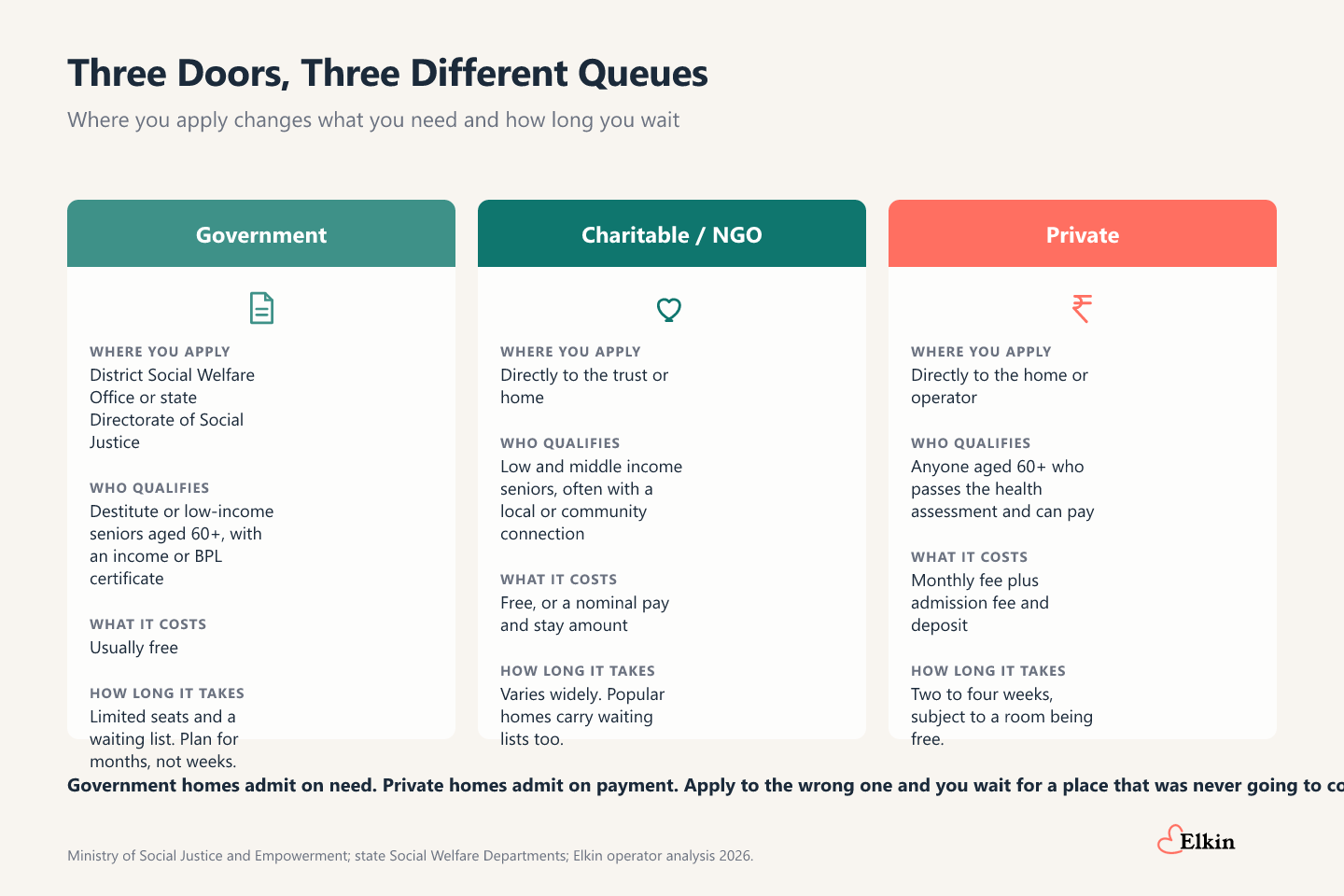 Three measures circulate. They answer different questions.
Measure | Figure | What it actually counts |
Residential care share | Under 0.1% | Seniors who live in an old age home. The answer to the question as most people mean it. |
Access to institutional care | Under 5% | Seniors who could reach a facility if they wanted one. A measure of reach, not residency. |
Senior living penetration | 1.3% | Organised senior housing units against age and income-qualified households. A market metric. |
The "under 5%" figure gets misquoted constantly. It describes how many seniors have institutional care available to them, not how many use it. Most who have access never take it up.
The 1.3% penetration figure comes from the senior housing industry and uses a completely different denominator: qualified households, meaning those in the right age and income bracket for a paid community, not all 149 million seniors.
If an article quotes one percentage without saying which of the three it is, treat it with suspicion. Our guide to how many old age homes there are in India explains the same problem on the supply side, where three different counting systems produce three different national totals.
Where India's seniors actually live
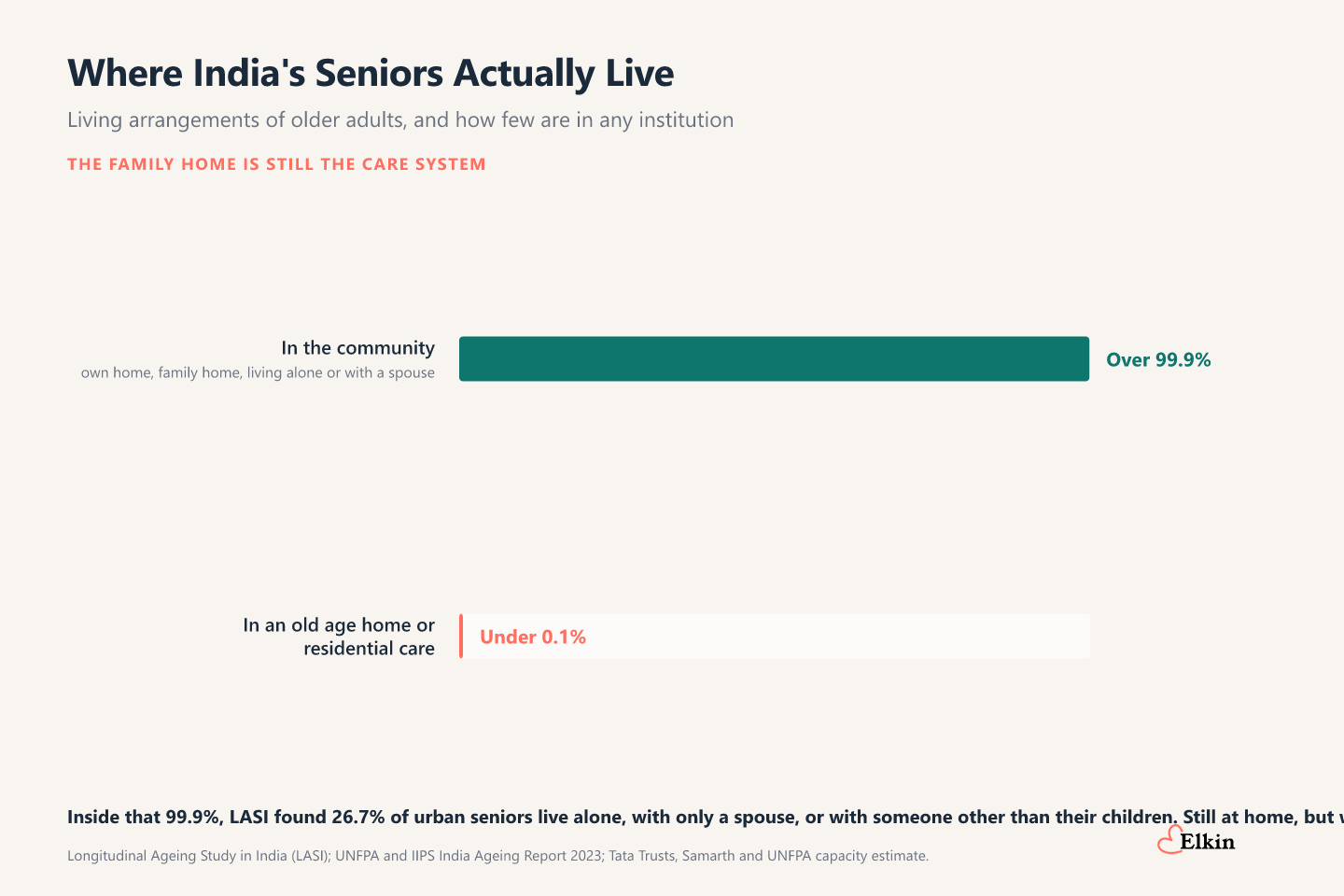 Living arrangements of older adults in India.
Over 99.9% of India's seniors live in the community: in their own home, a family home, alone or with a spouse.
Inside that number is the statistic that matters more than the institutional one. The Longitudinal Ageing Study in India found that 26.7% of urban elderly live alone, with only their spouse, or with someone other than their children.
Those seniors are not in an institution. They are also not in the multigenerational household that India's care model assumes. That gap, not the old age home population, is where the country's real elder care problem sits.
The drivers behind it are covered in why old age homes are increasing nowadays.
How India compares
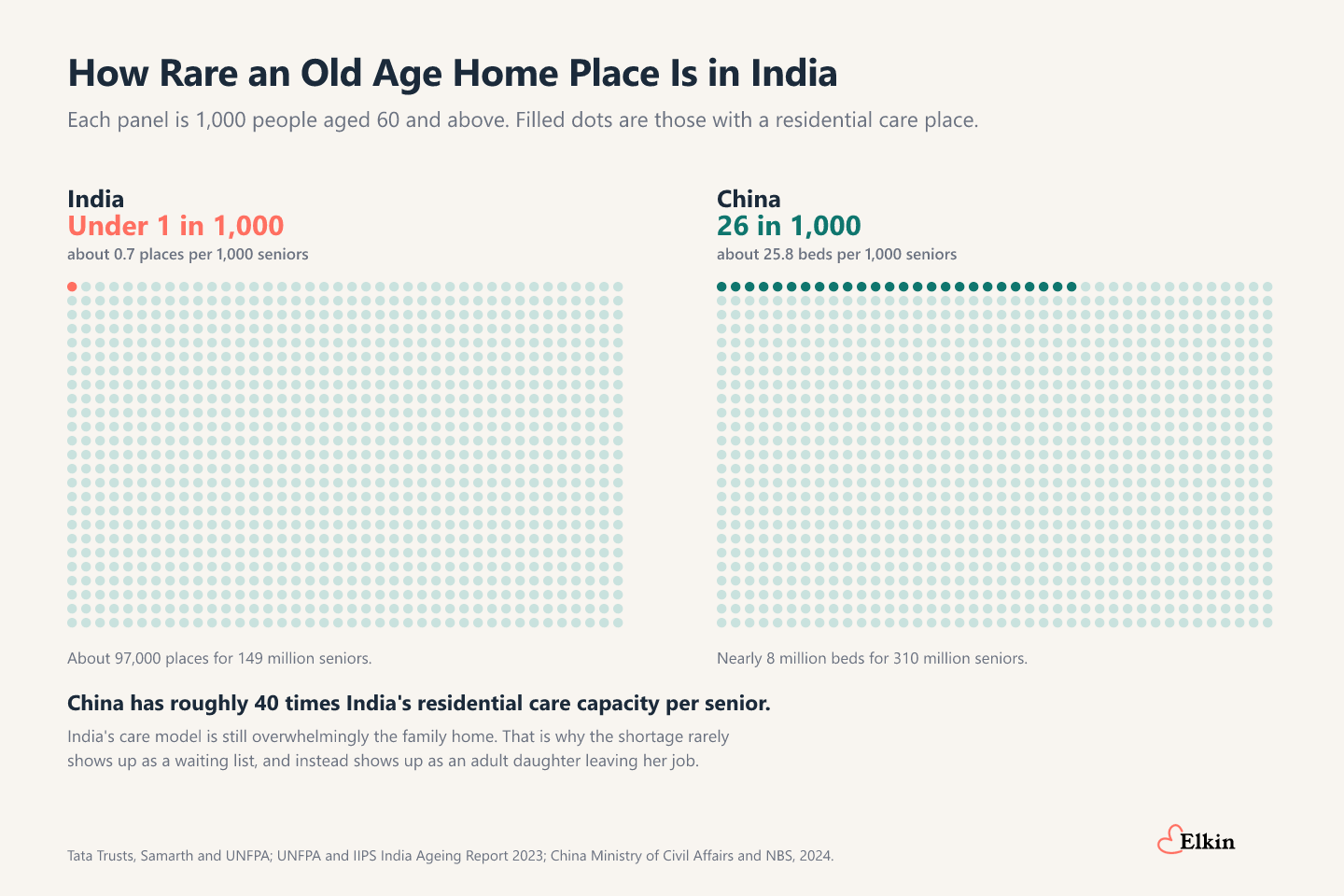
Each panel is 1,000 people aged 60 and above.
India has roughly 0.7 residential care places per 1,000 seniors. China has about 25.8 beds per 1,000, from nearly 8 million beds across 406,000 facilities for 310 million seniors. That is around 40 times India's capacity per senior.
Against the countries usually cited in this discussion:
Country | Share of seniors in residential or nursing care |
Iceland | Above 12% |
Denmark | Above 12% |
Netherlands | Around 9% |
Typical developed nation | 2% to 5% |
China | About 2.6% |
India | Under 0.1% |
India is not merely at the bottom of this table, it is an order of magnitude below it. The full global picture is in which country has the most old age homes.
Why the share is so low
Family care is the default. India's elder care model has always been the multigenerational household, and it still is for the overwhelming majority.
Supply barely exists. Even families who want residential care often cannot find it. The country has roughly 1,150 facilities for a population of 149 million seniors.
Stigma, though it is fading. Placing a parent in a home still carries social cost in much of India, which suppresses demand independently of supply.
Cost. Private residential care is a self-funded expense. Nothing subsidises the monthly fee, as set out in who pays for old age homes in India.
Where the number is heading
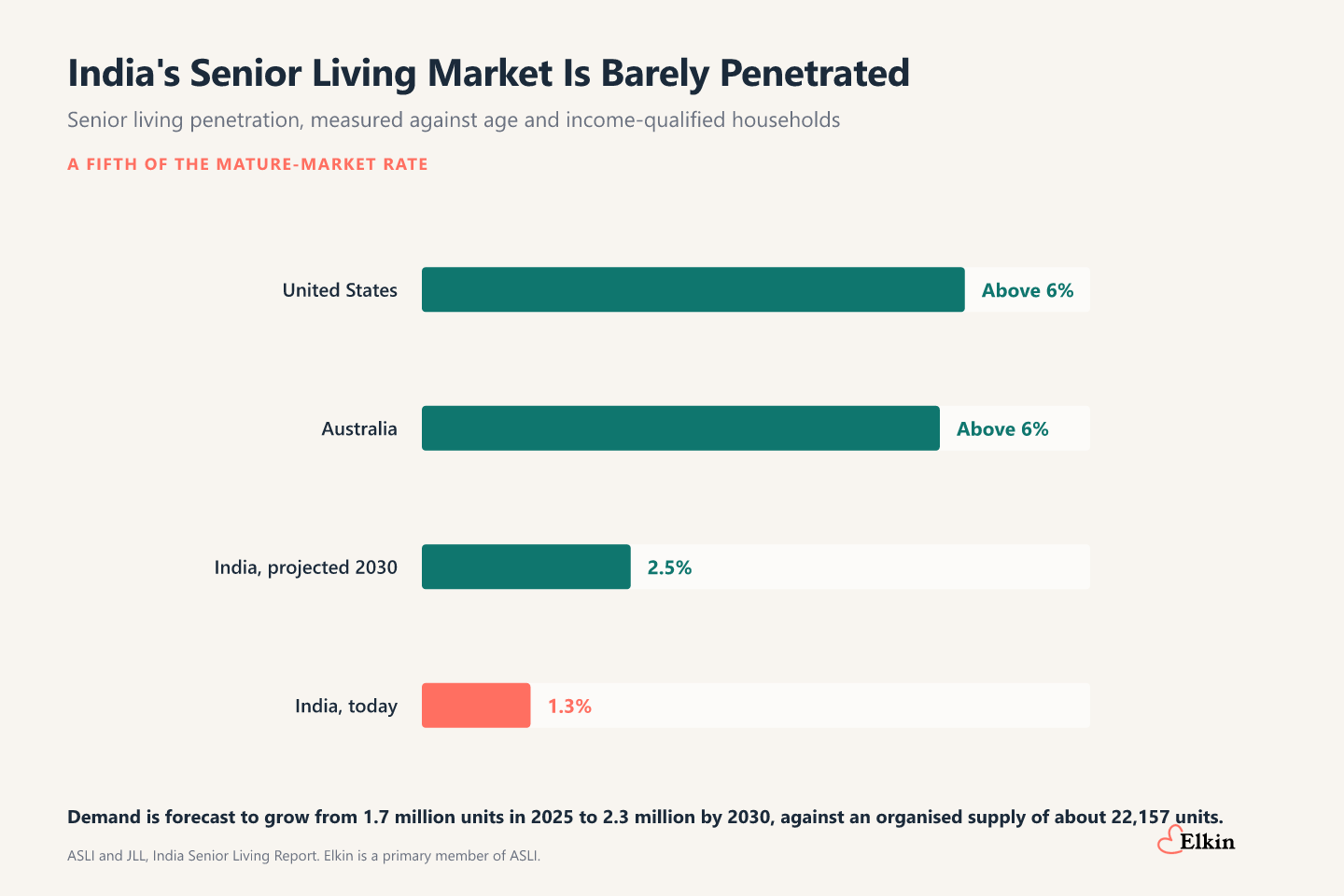 Senior living penetration against age and income-qualified households.
The Association of Senior Living India and JLL project that senior living penetration will roughly double, from 1.3% to 2.5% by 2030. Demand is forecast to grow from about 1.7 million units in 2025 to 2.3 million by 2030, against an organised supply of roughly 22,157 units as of mid-2025.
Mature markets sit above 6%. India will not approach that in this decade, and arguably should not: a care model built around home and community is a legitimate choice, not a failure, provided the support exists.
What is not sustainable is the current position, where the family home carries almost the entire load while 26.7% of urban seniors no longer have an adult child living in it.
Kerala shows what happens when the pressure arrives early. Its registered homes grew from about 500 in 2015 to 680 by 2024, and residents grew faster still, up 67% in seven years. The detail is in how many old age homes there are in Kerala.
The bottom line
Under 0.1% is the number, and the gap between it and every other figure you will see quoted comes down to what is being counted: residency, access, or market penetration.
The more useful statistic is the 26.7%. India's elder care question is not really about who lives in an old age home. It is about the quarter of urban seniors who live at home without an adult child there, and what support reaches them.
Exploring options for a parent? Elkin helps families across India compare verified old age homes and senior living communities by care type, city and budget.
Frequently asked questions
What percentage of elderly live in old age homes in India?
Under 0.1%. About 97,000 residential care places against 149 million people aged 60 and above, which is roughly one place per 1,500 seniors. Figures of 1.3% or 5% that circulate are measuring senior living market penetration and access to institutional care, not residency.
How many elderly people live in old age homes in India?
Capacity is around 97,000 across roughly 1,150 facilities, according to the Tata Trusts, Samarth and UNFPA report. Actual occupancy is lower than capacity, and no agency publishes a live national resident count.
Is 1.3% the percentage of elderly in old age homes?
No. The 1.3% figure is senior living market penetration from the ASLI and JLL report, measured as organised senior housing units against age and income-qualified households. It uses a different and much smaller denominator than the full 149 million senior population.
How does India compare with other countries?
India is under 0.1%, against roughly 2% to 5% across developed nations, about 2.6% in China, and above 12% in Iceland and Denmark. Per senior, China has around 40 times India's residential care capacity.
Why do so few Indian seniors live in old age homes?
Family care remains the default, supply barely exists at roughly 1,150 facilities nationally, stigma persists though it is fading, and private residential care is entirely self-funded with no scheme reducing the monthly fee.
Is the percentage rising?
Yes, but from a very low base. ASLI and JLL project senior living penetration to rise from 1.3% to 2.5% by 2030, with demand growing from 1.7 million to 2.3 million units. Kerala, which aged earliest, saw care home residents rise 67% between 2016-17 and 2023-24.
How many Indian seniors live alone?
The Longitudinal Ageing Study in India found 26.7% of urban elderly live alone, with only their spouse, or with someone other than their children. They are still in the community, but without an adult child in the household.
What is India's total elderly population?
149 million aged 60 and above in 2022, projected to reach 347 million by 2050, or one in five Indians, according to the UNFPA and IIPS India Ageing Report 2023. The 80+ group, which needs the most care, grows 279% over that period.