
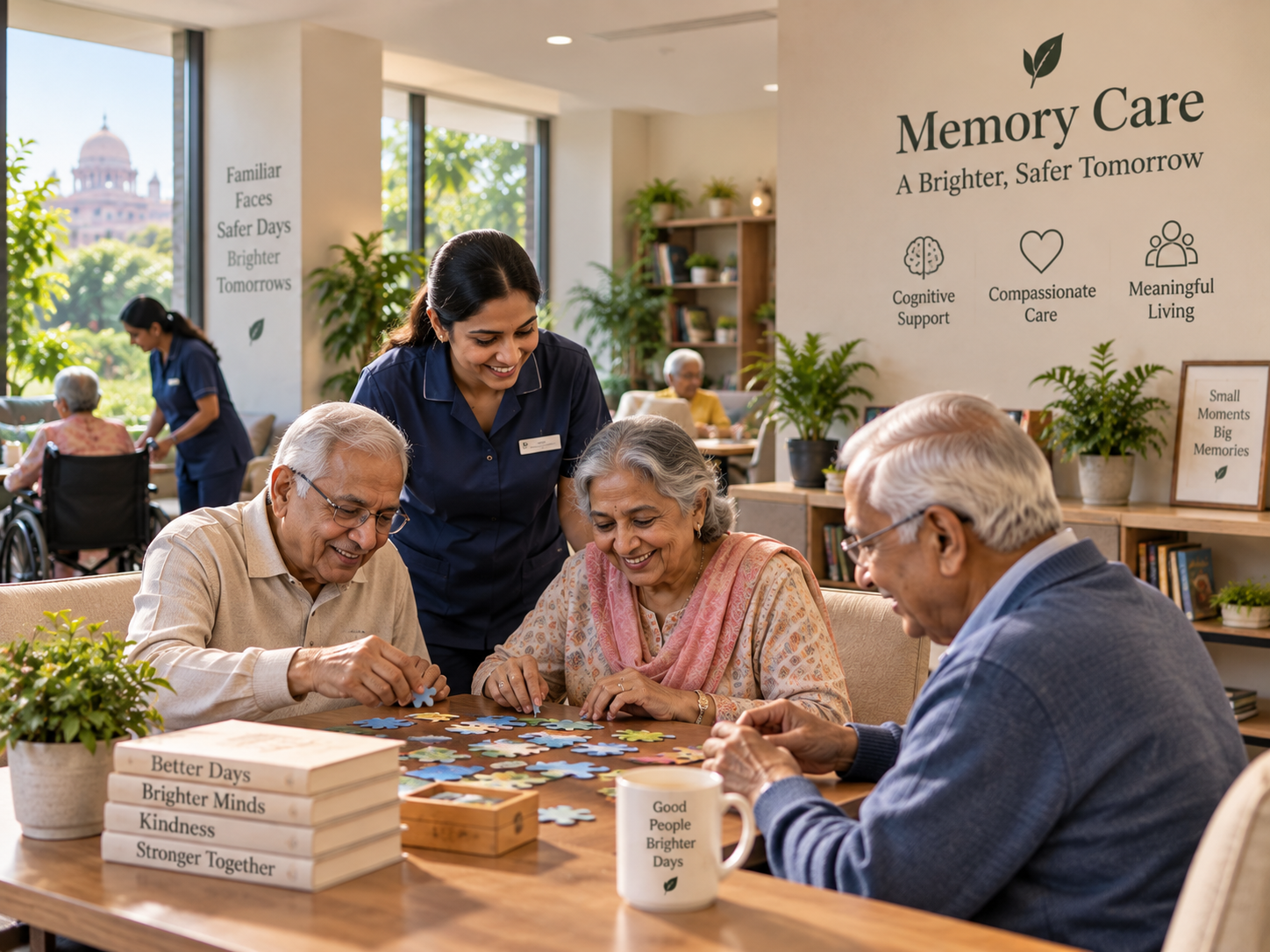


Memory care in New Delhi: what exists
Memory care is residential care built specifically for people living with dementia — a secured environment, staff trained in dementia rather than general caregiving, structured daily routine, and a way of responding to distress and agitation that does not rely on sedation.
In Delhi and the wider capital region, this is provided in three broad ways. Specialist dementia care operators, including organisations such as Epoch Elder Care and Samvedna Senior Care, work across Delhi NCR with residential, day-care and home-based models. Larger senior care providers including Antara Care Homes and Archon run memory care alongside assisted living. And a number of smaller residences accept people with dementia within general assisted living, which is a different thing and should be assessed as such.
Clinical support sits separately from residential care. AIIMS New Delhi and the Institute of Human Behaviour and Allied Sciences have long-standing work in geriatric and neuropsychiatric care, and several private hospitals run neurology and memory clinics. The Alzheimer's and Related Disorders Society of India has a Delhi chapter providing information and family support.
This page covers how to judge memory care and, first, how to be sure it is what your parent needs.
Before you place anyone: get the diagnosis right
This is the most important section on this page, and it is the step families under pressure most often skip.
Memory loss and confusion in an older person are not automatically dementia. Several conditions produce very similar symptoms and some of them are treatable or reversible:
- Delirium from an infection — a urinary tract infection in particular — which comes on over hours or days and often clears when the infection is treated
- Medication effects, including from sedatives, some bladder and allergy medications, and combinations that interact
- Vitamin B12 deficiency and thyroid dysfunction, both common and both correctable
- Depression, which in older adults can present as memory difficulty and withdrawal
- Normal pressure hydrocephalus, which classically causes gait disturbance, urinary symptoms and cognitive change, and which is sometimes treatable
- Untreated hearing or vision loss, which produces confusion and social withdrawal that can look like cognitive decline
- Subdural haematoma after a fall, which can present slowly and subtly
Even where dementia is confirmed, the type matters for care. Alzheimer's disease, vascular dementia, dementia with Lewy bodies and frontotemporal dementia progress differently and need different handling. People with Lewy body dementia, for instance, can react badly to certain antipsychotic medications, which is exactly the kind of thing a care facility needs to know at admission.
What to do: obtain a formal assessment from a geriatrician, neurologist or psychiatrist with dementia experience — a memory clinic assessment rather than a passing opinion — including cognitive testing, blood work and imaging where indicated. Get the diagnosis, the type where it can be determined, and a written medication list.
A family that places a parent without this may be paying for residential dementia care for a B12 deficiency. It happens more often than anyone in this sector says.
What memory care is, and how it differs from assisted living
Assisted living provides help with daily activities — bathing, dressing, mobility, medication — for residents who need hands-on support but can be safely accommodated in an ordinary residential setting.
Memory care adds four things:
- A secured environment designed so that a resident who walks cannot leave unsupervised, without the place feeling like a locked ward.
- Dementia-specific staff training, which is different from general nursing or caregiving. It covers how to respond to repetition, refusal, accusation, distress and aggression without escalating them.
- Structured routine, because predictability reduces anxiety, and unstructured days increase it.
- Environmental design — clear sightlines, simple layouts, visual cues to the bathroom, and somewhere safe to walk, since walking is a need rather than a problem to be stopped.
A facility that accepts a resident with dementia into a general wing, with the same staff and the same building, is offering assisted living to someone who needs memory care. That is workable in early stages and unsafe later.
For the assisted living category, see assisted living in Delhi.
When memory care becomes necessary
There is no fixed point, but these are the thresholds families and clinicians generally use.
Walking out. A person who leaves the house and cannot reliably find their way back is the clearest single trigger. In a city this size, at Delhi's summer and winter temperature extremes, this is a serious safety risk. Once it has happened once, it will happen again.
Night-time disturbance. Waking, dressing, trying to leave, or being awake and distressed for much of the night. This is also the point at which a family carer's own health typically starts to fail.
Risks that cannot be managed by supervision alone. Gas left on, medications taken twice or not at all, letting strangers in, wandering onto a road.
Behaviour that the current setting cannot hold. Aggression, severe agitation, or distress that existing carers are not equipped to respond to.
Care needs beyond one person. Where transfers, continence care and constant supervision together exceed what the household can sustain.
The carer. When the main family carer's physical or mental health is deteriorating, that is a legitimate reason in itself, and families should stop treating it as a failure. An exhausted carer provides worse care and then becomes a second patient.
The wandering question, and the building
Most memory care in Delhi operates from converted residential buildings, independent houses and farmhouse properties rather than purpose-built facilities. That makes the physical security question concrete rather than theoretical.
Ask, and look for yourself:
- Can a resident leave the property unsupervised? Walk to the gate. Is it manned continuously, or only when someone remembers? A gate that is open for deliveries is an open gate.
- Is there a safe place to walk inside the boundary? A loop, a garden, a corridor. Facilities without one tend to manage walking by preventing it, which means restraint of some form.
- Are stairs, balconies, terraces and the kitchen secured, given a resident who may not judge risk reliably?
- Is the layout simple and legible? Repetitive corridors and identical doors increase disorientation; clear sightlines and visual cues reduce it.
- Is the bathroom findable at night? Visible from the bed, lit, clearly marked.
- What happens when someone does get out? Every good facility has had a close call. Ask what their protocol is and whether they will tell you.
Security in dementia care is not about locking people in. A well-designed environment lets a resident walk as much as they want, safely, which removes most of the reason they try to leave.
How is agitation managed? The question nobody asks
This may be the single most useful question a family can put to a memory care facility, and almost nobody asks it.
Distress, agitation, aggression and sleeplessness are part of dementia. They can be managed two ways: by trained staff using non-pharmacological approaches — identifying the trigger, adjusting routine, redirection, addressing pain, hunger, constipation or infection that the person cannot articulate — or by medication that sedates.
The second is easier and cheaper, needs less training, and is not a neutral choice. Antipsychotic medications used for behavioural symptoms in older people with dementia are associated with increased risk of serious adverse outcomes including death, which is why clinical guidance internationally recommends non-drug approaches first and drug treatment only where there is a specific indication, at the lowest effective dose, reviewed regularly. Sedation also accelerates functional decline — a resident who is drowsy falls more, eats less, and loses mobility faster.
What to ask:
- What is your approach when a resident becomes agitated or aggressive? Listen for whether the first answer involves a person or a tablet.
- Who prescribes psychiatric medication, and how often is it reviewed?
- How many current residents are on regular sedative or antipsychotic medication?
- Will you tell us before starting or increasing any such medication?
- How do you identify pain or infection in a resident who cannot describe it?
A facility that answers these openly is running proper dementia care. Evasiveness here matters more than anything you will see on the tour.
Discuss any medication question with your parent's treating physician. This is general information, not clinical advice.
What else to verify
- Dementia-specific staff training — what it consists of, how long it takes, who delivers it, and whether refresher training happens. General nursing qualification is not dementia training.
- Night-shift staffing ratio — how many staff are physically present between 10 p.m. and 6 a.m., for how many residents. Nights are when dementia care is hardest and thinnest.
- Staff continuity. High turnover matters more here than in any other care category, because a resident who cannot form new memories relies on familiarity. Ask how long current care staff have been in post.
- The care ceiling. Many facilities accept early and middle-stage residents and discharge in late stage, which forces a move at the worst possible time. Get the ceiling and the notice period in writing.
- Medical oversight — which physician visits, how often, which hospital the facility escalates to, and whether the arrangement is documented.
- Family involvement — visiting without appointment, whether you can join at mealtimes, how you will be told about incidents and falls.
- Fire safety and evacuation planning for residents who cannot follow instructions, which is a specific and serious problem in converted buildings.
- Meaningful activity, not just a television. Music, familiar tasks, movement, time outdoors.
Visit unannounced, mid-week, and in the late afternoon — see the point below on sundowning.
Delhi-specific considerations
Winter air quality. From late October to January, high pollution days confine residents indoors. For most people that is unpleasant; for someone with dementia, losing the outdoor part of a daily routine removes structure, reduces exercise and increases agitation. Ask what a facility does on those days — indoor walking space, purification in resident areas and not just the lobby, and an adjusted activity programme rather than simply keeping everyone in.
Detailed air quality guidance is on the Aya Nagar page.
Early winter darkness. Sundowning — agitation and confusion increasing in the late afternoon and evening — is common in dementia, and Delhi's early winter sunset shifts it earlier in the day. Ask how the facility handles late-afternoon routine and whether lighting is adjusted. Visiting at that hour tells you a great deal.
Summer heat. People with dementia may not recognise thirst or communicate it, which makes hydration monitoring a clinical task during Delhi's summer rather than a comfort measure.
Not every family needs residential memory care
Two alternatives are under-used in Delhi and worth considering before a residential move.
Dementia day care. The person spends part of the day in a structured setting with trained staff and activity, and returns home. It maintains routine, provides stimulation, and gives the family carer predictable relief. Several providers in Delhi NCR run this model.
Trained home-based dementia care. A dementia-trained attendant at home, alongside adapting the home itself — simplified layout, removing hazards, clear signage, secure exits, safe walking space.
For early and some middle-stage dementia, either can work well, and both preserve the familiarity that a move disrupts. Relocation itself can worsen confusion, which is a real argument for delaying it where it is safe to do so.
For home-based options, see home care in Delhi.
Support for the family carer
Dementia caregiving is heavier than other elder care and lasts longer. The carer is usually one person, usually unsupported, and their own health is the thing that most often determines when a placement happens.
The Alzheimer's and Related Disorders Society of India has a Delhi chapter offering information and family support, and caregiver support groups operate in the city. Talking to families further along the same path is the intervention carers consistently describe as most useful, and it costs nothing.
Practical relief — respite care for a week or two, scheduled day care, an attendant for fixed hours — is worth arranging before the carer reaches crisis, not after.
Rules and protections in Delhi
Memory care facilities are not licensed as clinical establishments the way hospitals are, and there is no dementia-specific registration category. The framework is the Maintenance and Welfare of Parents and Senior Citizens Act, 2007, implemented in the capital through Delhi's rules made under it, with maintenance tribunals established across the city's districts.
Because there is no dementia-specific licence, verification falls to families. Check registration type, building and fire safety approvals, the land-use position of the property, staff qualifications and training records, and a written admission agreement setting out the care ceiling, the discharge policy, the medication consent position and how incidents are reported to family.
Where a person with dementia can no longer make decisions, questions of legal capacity, financial authority and consent arise. These are genuinely complex and worth taking local legal advice on early, while the person can still participate.