
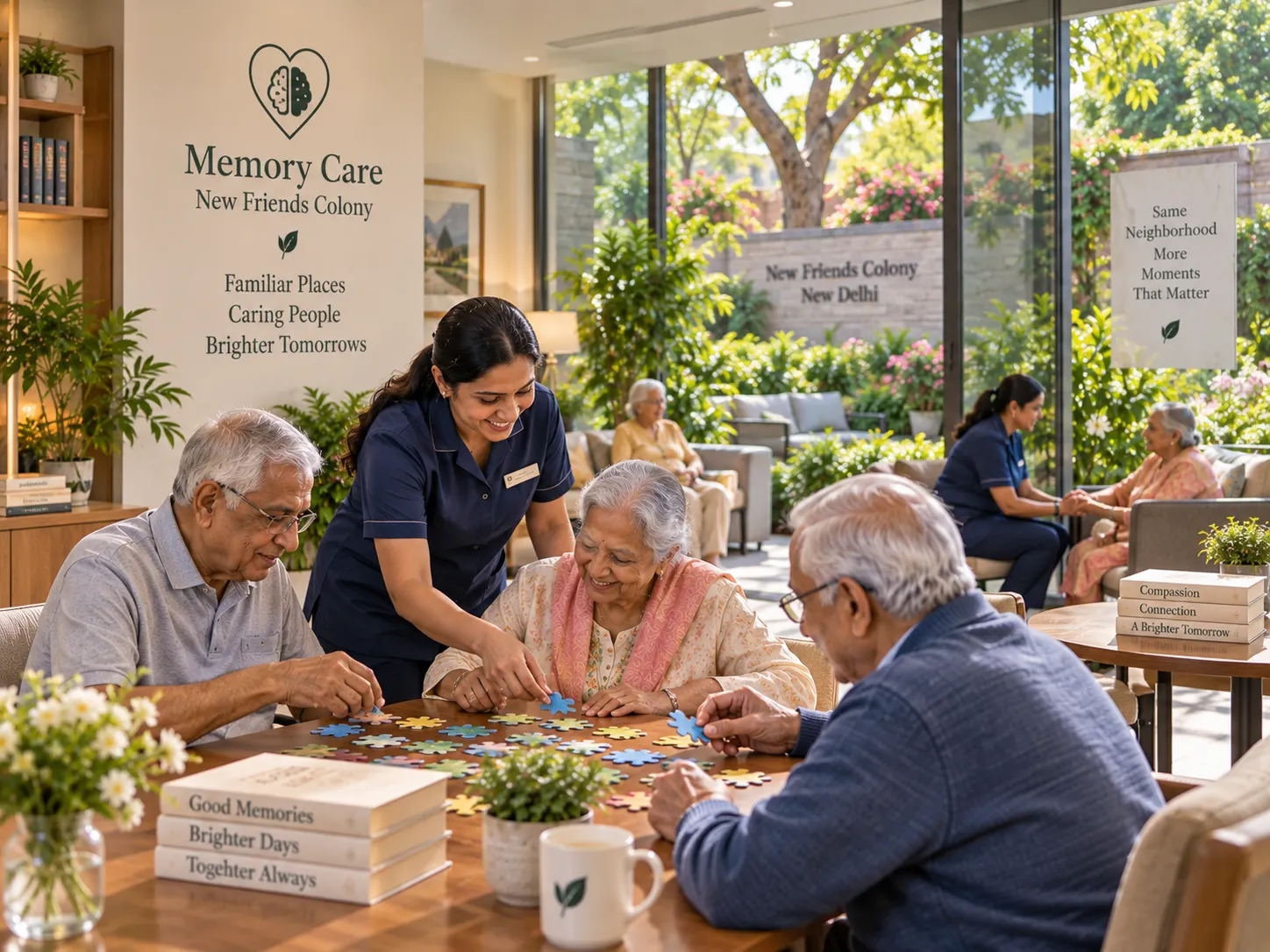


Memory care in New Friends Colony: what's actually here
There are no residential memory care facilities in New Friends Colony, and there cannot be. The colony is plotted residential and fully built out, so a dementia care home cannot operate within it.
What reaches this locality is services: dementia-trained attendants, visiting nurses, physiotherapy, doctor home visits and medicine delivery. Specialist dementia care providers working across Delhi NCR offer home-based and day-care models alongside their residential ones. Residential memory care, where a family eventually needs it, is elsewhere in South Delhi and the wider capital region.
So for a New Friends Colony family, the practical question is not which local facility to choose. It is whether dementia care can be delivered well in the house your parent already lives in — and for a good number of families here, the answer is yes, for longer than they expect.
For what memory care is, when it becomes necessary, and how to assess a facility, see memory care in New Delhi. That page also covers the assessment to obtain before arranging any care, which should come first.
Why a plotted house can work well for dementia
Relocation is hard for someone with dementia. A new building, new routes, new faces and a new routine remove exactly the familiarity the person is relying on, and confusion often increases after a move. Where it is safe to stay, staying is usually better.
New Friends Colony houses have three things that make this achievable, and that a flat generally does not:
A ground floor that can become the whole world. Bedroom, bathroom, sitting and dining on one level, with the staircase closed off. A person with dementia living entirely on one floor of a house they know is in a far better position than the same person in an unfamiliar facility room.
Private outdoor space. A garden or courtyard within the boundary wall means walking — which is a need, not a behaviour to be stopped — can happen freely and safely. Facilities charge for exactly this and many do not have it.
The means to employ properly trained care. A dementia-trained live-in or day attendant, a visiting nurse, and a named physician holding the overall picture. In this locality that arrangement is realistic rather than aspirational.
What has to change is the house itself. Most families here move a parent out of a home that could have been adapted, because nobody proposed adapting it.
Securing a bungalow for someone who may walk out
This is the concrete work, and a plotted house is harder to secure than a flat. A flat has one door. A house has a gate, a front door, a back door, a kitchen door, a driveway onto a public street, stairs, a terrace and staff coming and going all day.
Work through it physically:
- The gate is the main risk, and household routine is why. It opens for deliveries, drivers, visitors and staff, many times a day. Establish a rule that it is never left open and that one person is responsible each time it is used. This is a habit change, not a hardware change, and it is the one that matters most.
- Fit chimes or simple alarms on the gate and every external door, so that anyone in the house hears it open. Inexpensive and effective.
- Gate the staircase at the bottom, and secure terrace and balcony access entirely.
- Isolate the kitchen where judgement is affected — gas cut-off at the mains when unattended, and hot surfaces and sharp implements out of casual reach.
- Create a safe walking loop inside the boundary, level, well-lit and free of steps and obstacles. Somewhere to walk reduces the impulse to leave far more than any lock.
- Light the route the parent takes at night, particularly bed to bathroom, and make the bathroom visible and clearly marked from the bed.
- Put identification on the person — a card in a pocket, a bracelet, something with a name and two phone numbers — before it is needed rather than after.
- Keep a current photograph and a written description of what they usually wear, accessible to everyone in the household.
- Convert the bathroom, where most falls happen: walk-in shower, grab bars, raised seat, non-slip flooring, and a door that opens outward so it can be opened if someone falls against it.
None of this is about confinement. A person who can walk safely, find the bathroom, and move around familiar space tends to be calmer and to try to leave less.
Household staff and dementia
In this locality, day-to-day care is usually delivered by long-serving household staff. With dementia, that arrangement needs something it rarely gets: training.
Staff untrained in dementia do what most untrained people do — correct the person, argue with a false belief, insist on a fact, or physically stop them doing something. Each of those escalates distress, because the person cannot be reasoned out of what they are experiencing. Trained carers do the opposite: they let go of the disagreement, redirect, and look for the cause underneath the behaviour.
What to put in place, without displacing people who have been with the family for years:
- Bring in dementia-trained capability alongside existing staff — a trained attendant for part of the day, or a visiting nurse on a fixed schedule. This is the highest-value single change.
- Train the household. Dementia orientation for cooks, drivers and housekeepers is available through specialist providers and takes very little time. It changes daily interactions immediately.
- Brief everyone on the gate protocol and the night routine, including drivers and anyone who visits regularly.
- Take medication out of informal hands. A written chart, a weekly organiser filled by a nurse or pharmacist, and one named person responsible for reconciliation after every prescription change.
- Protect continuity. Staff turnover is disorienting for someone who cannot form new memories. Where a change is unavoidable, overlap the handover by days rather than hours.
The sibling page on senior living in New Friends Colony covers the wider household-staff arrangement, including verification and emergency protocols.
Use the neighbourhood
This is an asset New Friends Colony has and most localities do not, and it costs nothing.
The colony has wide, level, tree-lined streets, a community centre with shops and clinics, and — crucially — the same faces in the same places over many years. For someone in early or middle-stage dementia, that is a genuine safety net if you activate it.
Tell people. The chemist, the shopkeepers your parent visits, the RWA, the security guards on the street, the immediate neighbours. Give two phone numbers. Say plainly that your parent has memory difficulty and may become disoriented, and ask that someone call rather than send them home alone.
Families hesitate at this, usually out of a wish to protect the parent's dignity. In practice the opposite happens: a neighbourhood that knows lets a person keep walking their usual route safely for far longer than one that does not, and a parent found quickly by someone who recognises them is spared the distress of being lost.
Hospital access, and the emergency department problem
New Friends Colony is well served — Indraprastha Apollo at Sarita Vihar, Fortis Escorts Heart Institute on Okhla Road, Holy Family Hospital in Okhla, Max Saket and Batra Hospital are all reachable.
For dementia specifically, two things matter more than distance.
Most dementia emergencies are not neurological. They are falls, dehydration, and sudden confusion caused by infection — a urinary tract infection in particular. A sharp change in confusion over hours or days is a medical event needing assessment, not a step in the dementia itself.
Emergency departments are difficult environments for someone with dementia. Noise, bright light, strangers, long waits and unfamiliar surroundings reliably worsen agitation, and staff under pressure may not know the person has dementia at all.
So prepare in advance:
- Decide which hospital you would use, and tell the household
- Keep a one-page summary ready: dementia diagnosis and type, current medications, allergies, the treating physician's number, how the person communicates, and what calms them
- Say clearly at reception and to each clinician that the person has dementia
- Arrange for someone familiar to stay with them throughout, rather than leaving them alone in the department
- Ask about anything sedating before it is given, and mention the diagnosis type, since some medications interact badly with certain forms of dementia
The parent page covers the medication question in full — see memory care in New Delhi.
When home stops working
It usually does, eventually, and recognising that is not a failure. The parent page sets out the thresholds — walking out repeatedly, night-time distress, risks that supervision cannot manage, behaviour the household cannot hold, and the main carer's own health declining.
When that point comes, residential memory care for a New Friends Colony family means looking elsewhere in South Delhi, the Chhatarpur and Asola belt where properties with grounds allow secured outdoor space, and across the capital region. Two intermediate steps are worth using first: dementia day care, where the parent spends part of the day in a structured setting and returns home, and respite care of a week or two, which gives the household relief and tests how the parent responds to a different setting.
See memory care in New Delhi for how to assess a facility, and respite care for short stays.
Seasonal notes
Winter air quality. High-pollution days from late October to January confine people indoors. For someone with dementia, losing the outdoor part of a daily routine removes structure and can increase agitation. Plan an indoor walking route inside the house for those days, and keep the rest of the routine — meals, activity, bedtime — unchanged.
Early winter darkness. Where late-afternoon agitation occurs, Delhi's early winter sunset can shift it earlier. Bringing lights on before dusk rather than after, and keeping the late afternoon structured, often helps.
Summer heat. Someone with dementia may not recognise or communicate thirst, so hydration during Delhi's summer becomes something the household monitors actively rather than leaves to the person.
Fuller air quality guidance is on the Aya Nagar page.

