

Most assisted living homes run three levels of care, priced separately, based on how many activities of daily living a resident needs help with. Level 1 is light support for someone needing help with none or one. Level 2 is hands-on daily help with two or three. Level 3 is high dependency, with help needed for four or more.
There is one thing you have to know before using any of that, and no article that ranks for this question in India says it: no Indian law defines a care level. The Level 1, 2 and 3 framework comes from the United States, where state licensing sets the definitions. In India each operator invents its own, so a Level 2 at one home can be a Level 1 at another.
Compare the scope. Never the number.
Key takeaways
- Three levels is the standard, set by how many ADLs a resident needs help with: 0 to 1, 2 to 3, and 4 to 6.
- No Indian statute defines a level. Operators set their own tiers and their own names, so the label is not comparable between homes.
- The level sets the price. Care level charges are typically 10% to 30% of an Indian assisted living bill, on top of the base stay.
- Cost tracks staffing. Roughly 1 carer to 10 residents at Level 1, 1 to 6 at Level 2, and 1 to 3 at Level 3.
- Assisted living is one rung on a six-rung ladder running from independent living to palliative care.
- The question that matters is not which level your parent is in today. It is which rungs the home can hold them through, and where it will ask you to move.
Quick answer: what are the levels of care in assisted living?
Level | ADLs needing help | What it means | Typical monthly fee |
Level 1, low or light care | 0 to 1 | Prompting, medication reminders, meals, housekeeping, someone on call | ₹25,000 to ₹45,000 |
Level 2, moderate or intermediate care | 2 to 3 | Hands-on daily help with bathing, dressing or mobility. Medication administered | ₹30,000 to ₹70,000 |
Level 3, high dependency care | 4 to 6 | Help with most or all ADLs, often two carers for a transfer. Continence and bedridden care | ₹50,000 to ₹90,000 |
Some Indian operators run four or five tiers, splitting Level 3 or adding a memory care tier. The three-level structure is the most common and the easiest to compare against.
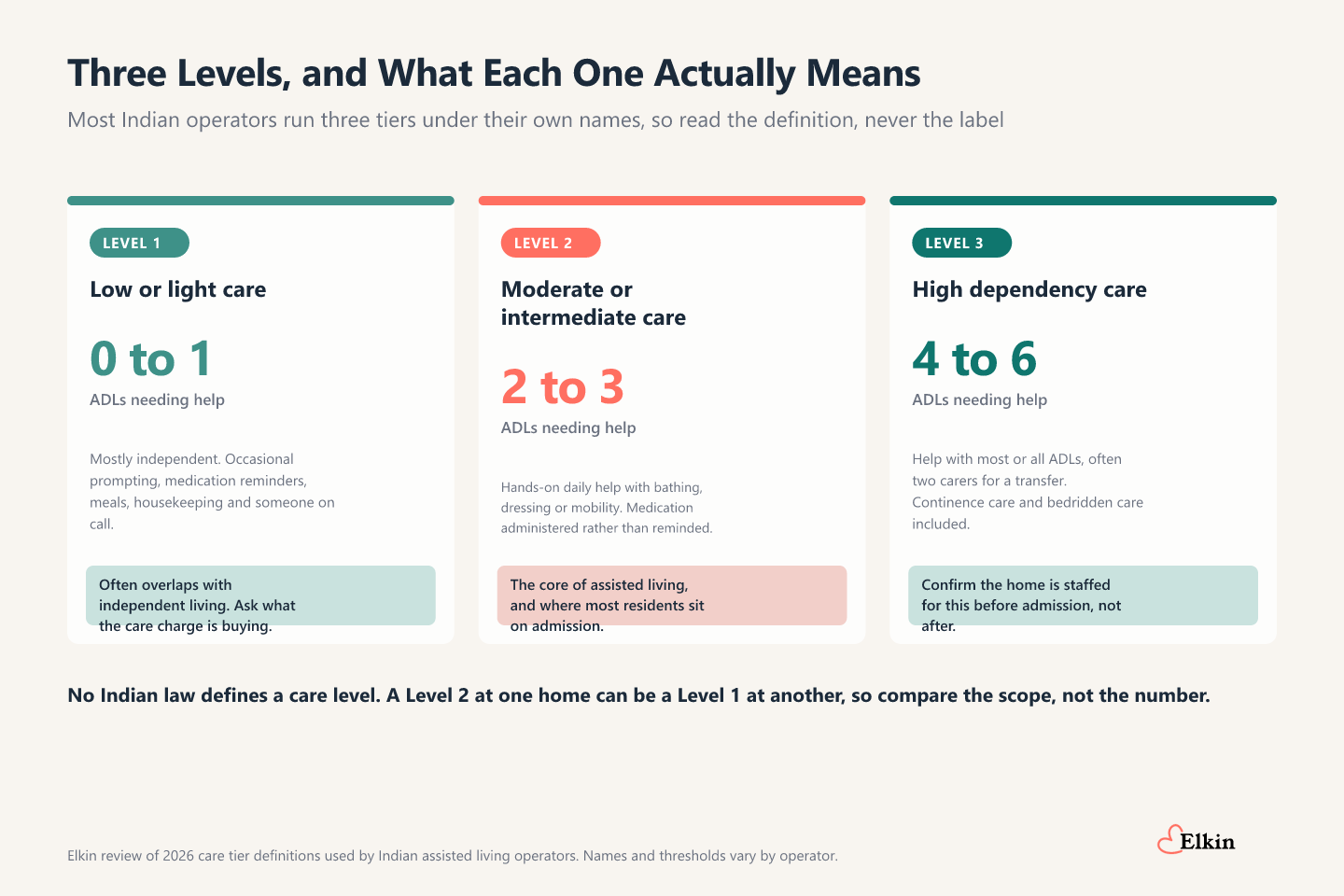
Most Indian operators run three tiers under their own names.
The three levels in detail
Level 1: low or light care
Who it fits. A resident who is mostly independent. They dress and bathe themselves, walk unaided or with a stick, and manage their own day. What they need is prompting, safety and someone there.
What it includes. Medication reminders, meals, housekeeping, laundry, activities, and a call button answered around the clock. Occasional help rather than daily hands-on care.
The catch. Level 1 overlaps heavily with independent living, and the care charge can buy very little beyond what an independent living community already provides. Ask specifically what the charge is paying for. If the answer is "we check on them", compare it against independent living before paying the difference. The distinction is worked through in independent living vs assisted living.
Level 2: moderate or intermediate care
Who it fits. The core of assisted living, and where most residents sit on admission. Hands-on help with two or three ADLs, most commonly bathing, dressing and transferring.
What it includes. Daily physical assistance from a caregiver, medication administered rather than reminded, mobility support, escorting to meals and activities, and closer monitoring.
The catch. This is where the care level charge becomes real money, typically ₹8,000 to ₹15,000 a month above base stay. Ask what specifically triggers a move from Level 1 to Level 2, and how much notice you get before the charge changes.
Level 3: high dependency care
Who it fits. A resident needing help with most or all ADLs. Often two carers for a single transfer. Continence care is included, and so is care of a resident who is bedridden.
What it includes. Full personal care, continence management, a turning schedule to prevent bed sores as India's 2024 minimum standards require, closer nursing supervision, and a much heavier staffing ratio.
The catch. Confirm the home is staffed for Level 3 before admission, not after your parent needs it. Many Indian homes will keep a resident who becomes bedridden but will not admit one, and some will ask you to move at exactly the point a move is hardest.
The critical question: what happens when needs change
Almost every family gets this wrong, and it is the difference between one move and three.
Ask each home:
- How many levels do you run, and what is the highest?
- Will you keep my parent if they become bedridden?
- Will you keep my parent if they develop dementia?
- What triggers a level change, and who decides?
- How much notice do I get before the fee changes?
- At what point would you ask us to move?
A home that stops at Level 2 means a second admission at the worst possible moment, with a frailer parent and less time to choose. A home that runs through high dependency and memory care on one campus does not.
Where assisted living sits on the wider ladder
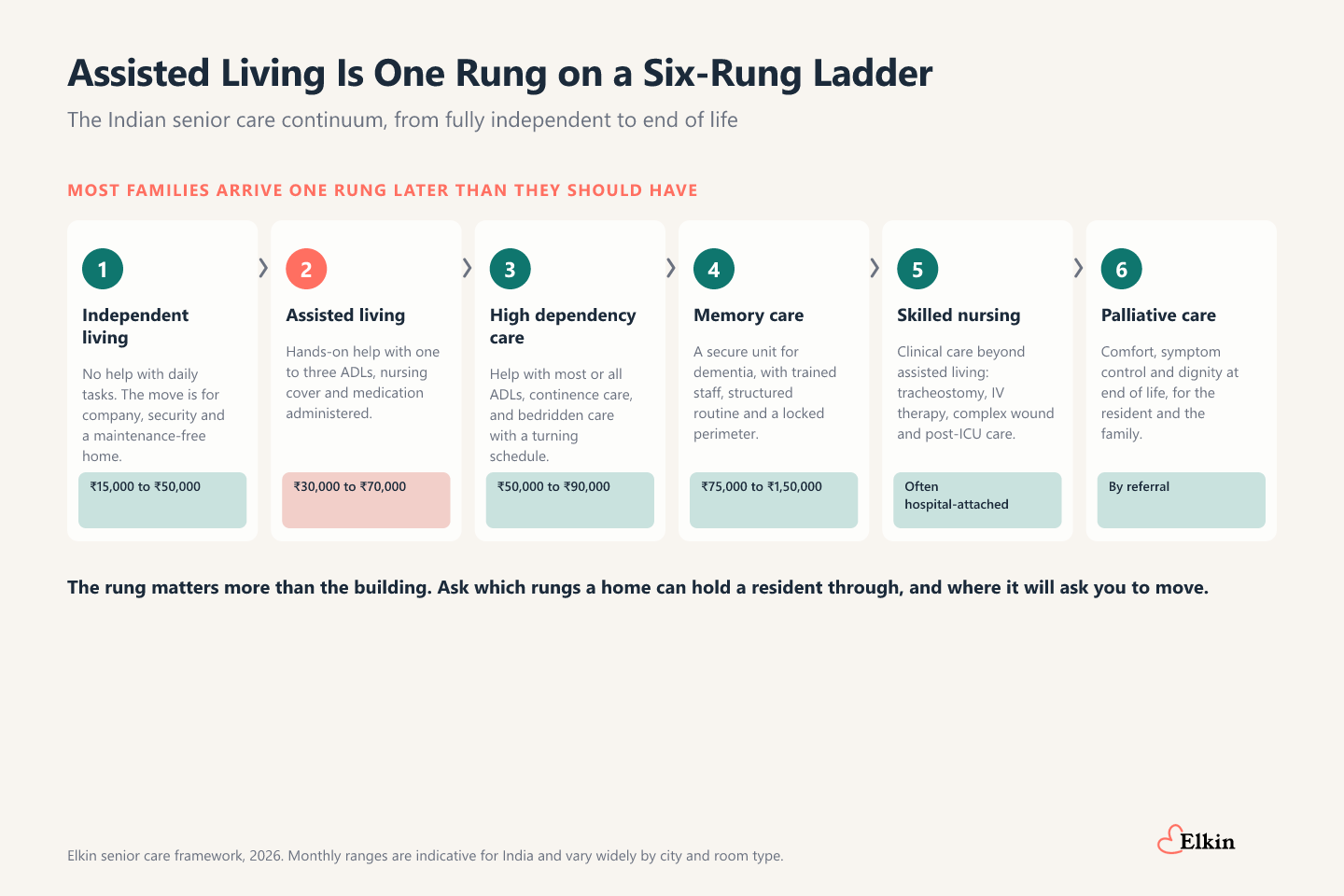
The Indian senior care continuum.
Assisted living is one rung of six, and the rung matters more than the building.
1. Independent living. No help with daily tasks. The move is for company, security and a maintenance-free home. ₹15,000 to ₹50,000 a month. See what senior living means.
2. Assisted living. Hands-on help with one to three ADLs, nursing cover, medication administered. ₹30,000 to ₹70,000.
3. High dependency care. Help with most or all ADLs, continence care, bedridden care. ₹50,000 to ₹90,000.
4. Memory care. A secure unit for dementia, with trained staff, structured routine and a locked perimeter. ₹75,000 to ₹1,50,000. See memory care.
5. Skilled nursing. Clinical care beyond assisted living: tracheostomy, IV therapy, complex wound and post-ICU care, often hospital-attached. The boundary is set out in assisted living vs nursing home.
6. Palliative care. Comfort, symptom control and dignity at end of life, for the resident and the family. Covered in hospice vs assisted living.
Most Indian operators cover rungs one to three. Fewer run memory care on the same campus. Very few run skilled nursing.
Why the level sets the price
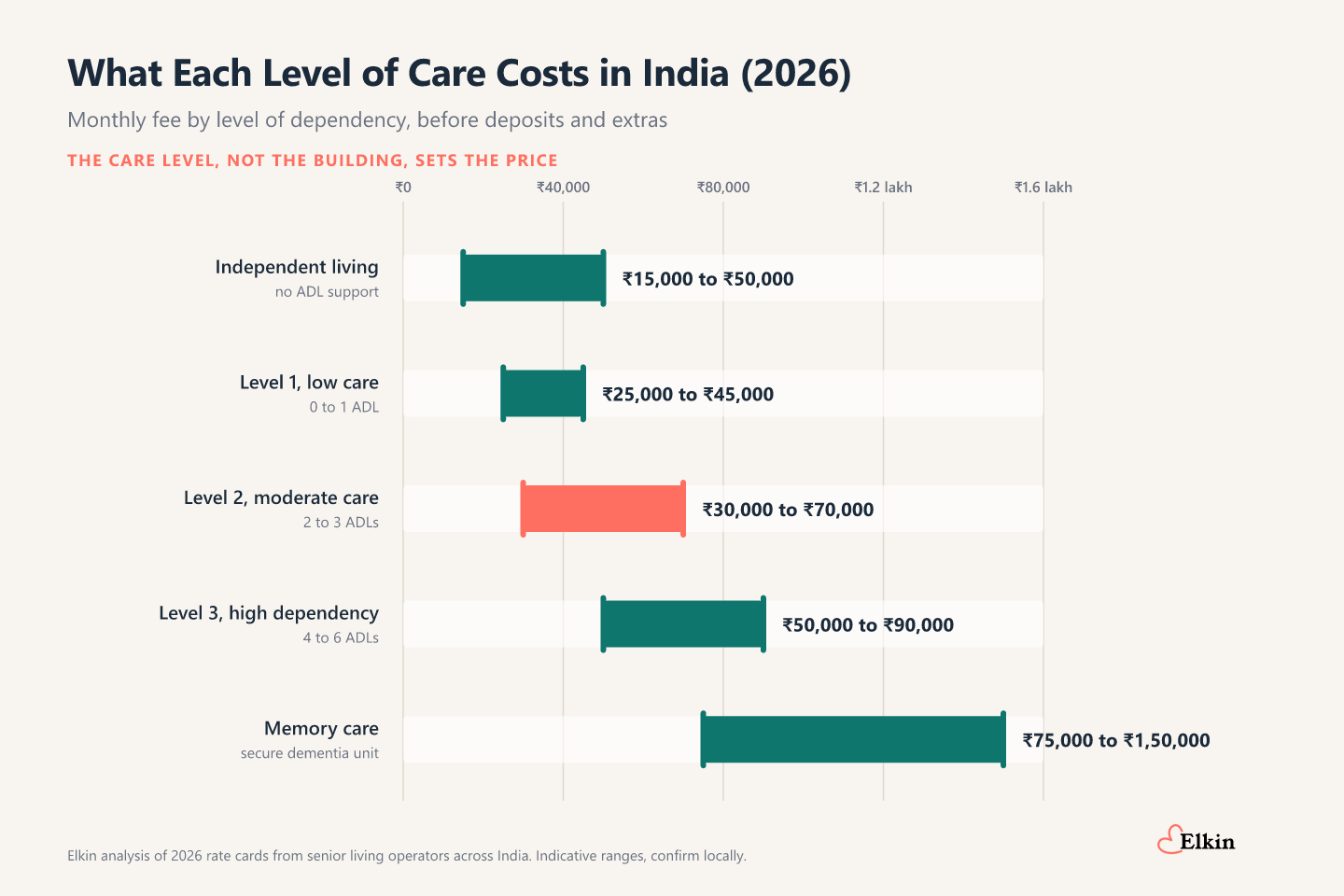
Monthly fee by level of dependency, before deposits and extras.
An Indian assisted living bill has four layers, and the care level charge is the second:
- Base stay, 60% to 75% of the total. Room, meals, housekeeping and basic care.
- Care level charge, 10% to 30%. This is the levels in action.
- Add-ons, up to 40%. Consumables, medicines, extra therapy, escorts.
- One-time charges. Admission fee of ₹10,000 to ₹50,000 and a security deposit of ₹10,000 to ₹4,00,000.
The building barely moves the number. The care level does. A ₹35,000 place and a ₹75,000 place in the same city are usually the same building at two different levels of dependency.
Full pricing is in how much assisted living costs in India, and the full service breakdown in what services are included in assisted living.
It is staffing you are paying for
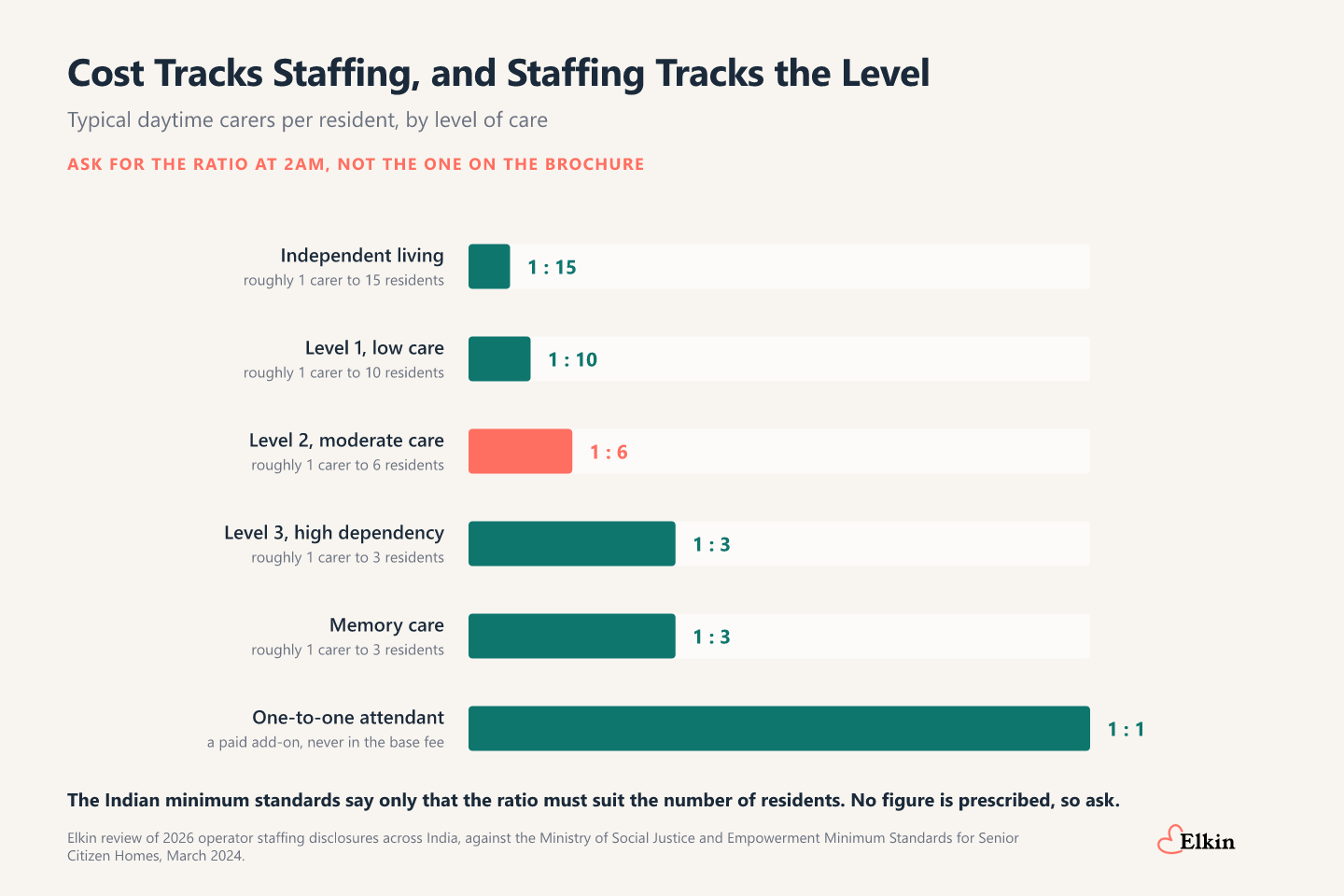
Typical daytime carers per resident, by level of care.
Setting | Typical daytime ratio |
Independent living | about 1 carer to 15 residents |
Level 1, low care | about 1 to 10 |
Level 2, moderate care | about 1 to 6 |
Level 3, high dependency | about 1 to 3 |
Memory care | about 1 to 3 |
One-to-one attendant | 1 to 1, billed as an add-on at ₹15,000 to ₹40,000 a month |
India's Minimum Standards for Senior Citizen Homes, issued by the Ministry of Social Justice and Empowerment in March 2024, say only that the staff-to-resident ratio "shall be set as per the number of residents". No figure is prescribed. So you have to ask, and you should ask for the ratio at 2am rather than the one on the brochure.
How to compare levels between two homes
Because the labels are not standardised, compare on these five things instead:
The ADL definition. How many ADLs, and which ones, put a resident in each tier?
The staffing ratio, in the day and overnight.
What is included at that level and what is billed extra.
The trigger and the notice period for a level change.
The ceiling. The highest level the home runs, and what happens beyond it.
Two homes both quoting "Level 2 at ₹48,000" can differ by a factor of two on what that actually buys. The number on the brochure tells you nothing on its own.
The one thing families get wrong
Understating need to get an admission.
It is a completely understandable instinct: the assessment is happening, Level 3 costs more, and your parent has good days. So the medication is described as "she just needs reminding", the bathing help gets left out, and the home places them in Level 1.
Six weeks later the home reassesses, moves them to Level 2 or Level 3, and the fee jumps. Worse, the home may have been staffed for the wrong resident all along.
How to count the ADLs honestly before the assessment is in who needs assisted living, and what the home will require of you is in assisted living eligibility criteria.
Describe the worst ordinary week, not the best day. The assessment exists to work out what staffing your parent needs. Getting it wrong does not save money, it just moves the correction later and makes the care unsafe in the meantime.
The bottom line
The three-level structure is a genuinely useful way to think about assisted living, and in India it is a description rather than a standard. Nobody defines it, nobody enforces it, and the label on the brochure is whatever the operator chose to call it.
So use the framework to understand what your parent needs, then throw the labels away and compare on scope: ADL definition, staffing ratio, inclusions, and what happens when needs rise.
And be honest in the assessment. A level assigned to the parent you wish they were is not a saving, it is a placement that fails in six weeks.
Comparing care levels? Elkin verifies care levels, staffing and registration before listing, so you can compare assisted living communities across India by level of care, city and budget.
Frequently asked questions
What are the levels of care in assisted living?
Three, in most homes. Level 1 is low or light care for a resident needing help with none or one activity of daily living. Level 2 is moderate care for two to three ADLs, with hands-on daily help. Level 3 is high dependency care for four to six ADLs, including continence and bedridden care. Some operators split these into four or five tiers.
Are assisted living care levels regulated in India?
No. No Indian law defines a care level. The Ministry of Social Justice and Empowerment issued Minimum Standards for Senior Citizen Homes in March 2024, but it prescribes no levels and no staffing ratio. Each operator sets its own tiers and names, so a Level 2 at one home may not match a Level 2 at another.
How is the level of care decided?
By the home's own care assessment, usually in person before admission. It covers the six ADLs, mobility and fall history, cognition, continence, medication complexity and comorbidities. The output should be an assigned level and a written care plan. Ask for both.
How much does each level of care cost in India?
Roughly ₹25,000 to ₹45,000 a month at Level 1, ₹30,000 to ₹70,000 at Level 2, and ₹50,000 to ₹90,000 at Level 3. Memory care runs ₹75,000 to ₹1,50,000. Care level charges typically account for 10% to 30% of the total bill, on top of the base stay.
What is the staff to resident ratio at each level?
Typically about 1 carer to 10 residents at Level 1, 1 to 6 at Level 2, and 1 to 3 at Level 3 and in memory care. India prescribes no minimum ratio, so ask each home directly, and ask for the overnight figure rather than the daytime one.
What happens when my parent needs a higher level of care?
The home reassesses, assigns a higher level and raises the fee. If the new need is above what the home is staffed for, it will ask you to move. Ask before admission which is the highest level the home runs, and whether it keeps residents who become bedridden or develop dementia.
What is the difference between assisted living and high dependency care?
Assisted living covers help with one to three ADLs. High dependency care covers most or all six, often needing two carers for a single transfer, plus continence management and care of a bedridden resident. Many Indian homes run both, some only run assisted living.
Is memory care a level of assisted living?
It is a separate setting rather than a tier, because it needs a secure unit with a locked perimeter and staff trained in dementia care. Some assisted living communities run a memory care wing on the same campus, which avoids a second move later.
How do I compare care levels between two homes?
Ignore the label and compare five things: how many ADLs define each tier, the staffing ratio in the day and overnight, what is included at that level and what is billed extra, what triggers a level change and how much notice you get, and the highest level the home runs.