

Someone needs assisted living when they can still make their own decisions but can no longer manage one to three activities of daily living on their own. Bathing, dressing, toileting, moving from bed to chair. That is the threshold, and it is more specific than "getting older" or "struggling a bit".
Two thirds of the families who ask this question are asking too late, and a smaller group is asking too early. The difference between the two is measurable, and this guide sets out how to measure it.
Key takeaways
- The threshold is one to three ADLs. Consistent difficulty with one to three activities of daily living is what assisted living is designed for.
- 52% of Indians aged 60 and above already report a functional difficulty, according to the Longitudinal Ageing Study in India. Difficulty is normal. Needing assisted living is not.
- About 3% report severe ADL disability. That is the group assisted living genuinely exists for.
- IADL difficulty comes first, years earlier. Trouble with money, cooking, shopping and medication is the early warning, and 48.4% of Indian seniors report it.
- Indian women reach this point sooner. 60.0% of women report at least one difficulty against 43.2% of men.
- Two or more consistent signals over several weeks is the point at which most families should start looking, not the point at which they should move.
- Cognitive symptoms change the answer. Wandering or unsafe confusion points to memory care, not general assisted living.
Quick answer: who needs assisted living?
An older adult needs assisted living when all four of these are true:
- They need hands-on help with one to three ADLs, consistently, not on one bad day.
- They do not need skilled nursing, meaning no ventilator, tracheostomy, dialysis or IV therapy.
- They can participate in their own daily life, even if they need prompting.
- Home care is no longer enough, either because 24-hour cover has become necessary or because nobody is there to arrange it.
If they need help with four or more ADLs, that is a high dependency unit, and the tiers are set out in levels of care in assisted living. If the driving problem is memory and safety, that is memory care. If they manage everything but are lonely and unsafe alone, that is independent living.
The signals, and what they actually point to
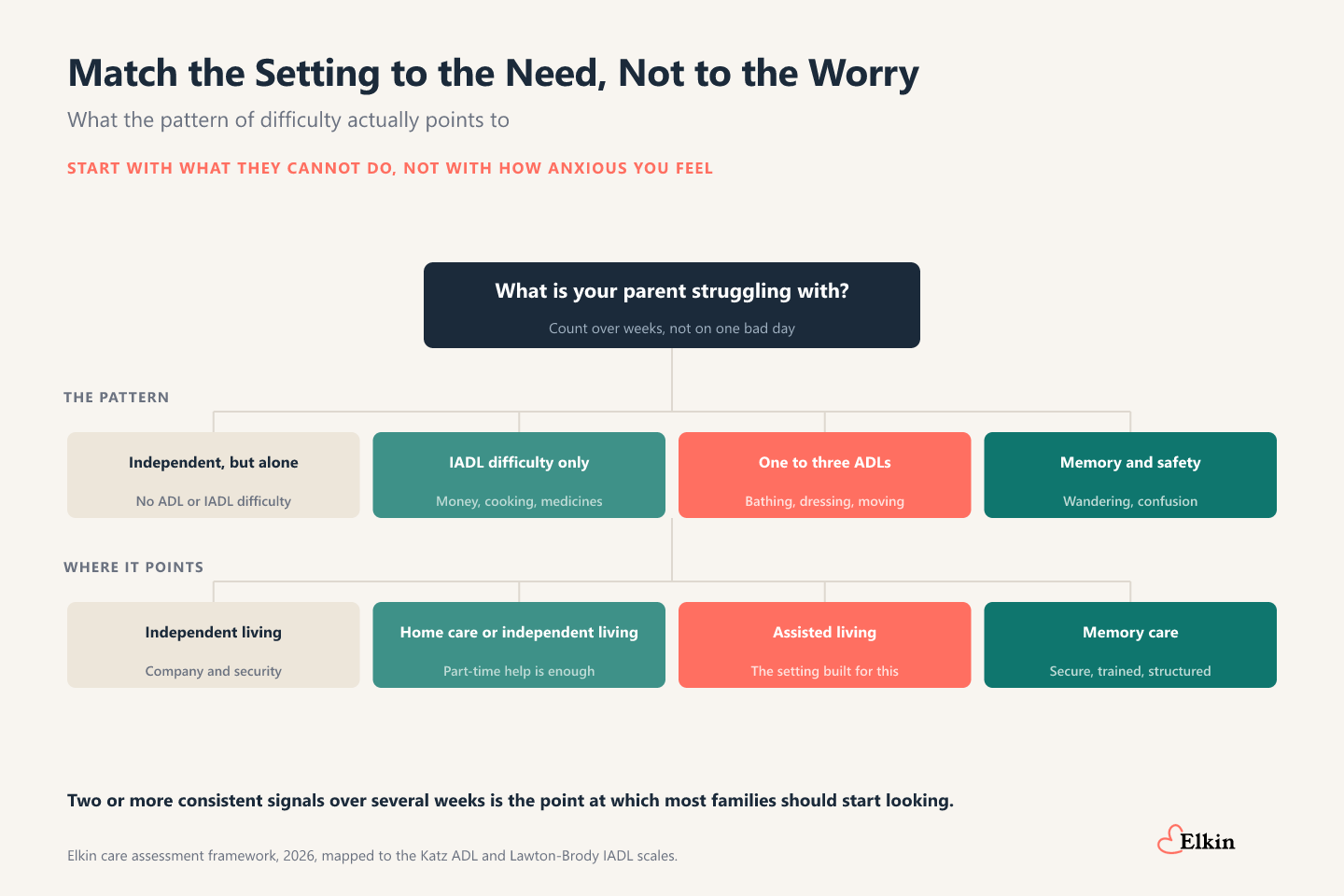
Start with what they cannot do, not with how anxious you feel.
No ADL or IADL difficulty, but living alone. Independent living. The move is for company, security and a maintenance-free home, not for care.
IADL difficulty only. Trouble with money, cooking, shopping, transport or medication. Home care or independent living. Part-time help usually covers this, and moving now is premature.
One to three ADLs. Bathing, dressing, transferring. This is assisted living, and it is the setting built for exactly this.
Memory and safety. Wandering, leaving the gas on, not recognising family, getting lost on a familiar route. Memory care, with a secure perimeter and trained staff, regardless of how many ADLs are affected.
The six ADLs, honestly counted
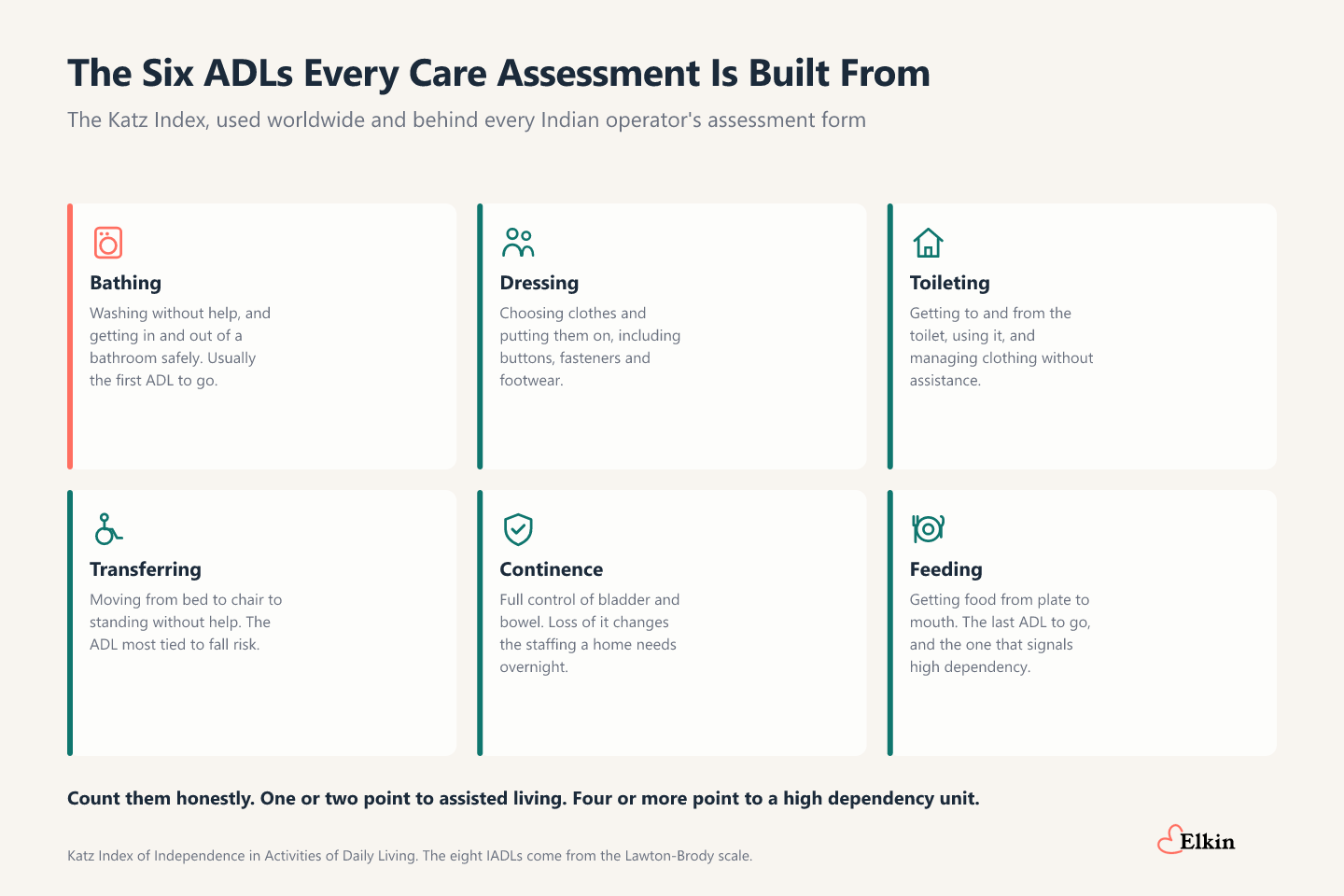
The Katz Index, behind every Indian operator's assessment form.
Every care assessment in the world is built from the same six. Go through them for your parent and answer for an ordinary week, not their best day or their worst:
- Bathing. Washing without help, and getting in and out of a bathroom safely. Usually the first to go.
- Dressing. Choosing clothes and putting them on, including buttons, fasteners and footwear.
- Toileting. Getting to and from the toilet, using it, managing clothing.
- Transferring. Bed to chair to standing without help. The ADL most tied to fall risk.
- Continence. Full control of bladder and bowel. Losing it changes the staffing a home needs overnight.
- Feeding. Getting food from plate to mouth. The last to go, and a signal of high dependency.
Count how many need another person's hands. One to three points to assisted living. Four or more points to a high dependency unit.
The eight IADLs, which fail first
The Lawton-Brody scale covers the tasks that keep an independent life running: using the telephone, shopping, preparing food, housekeeping, laundry, transport, managing medication and managing finances.
These fail years before ADLs do, and that gap is the most useful thing a family can know. IADL difficulty is the window in which a decision can be made calmly, with the senior involved and with time to visit homes properly. Once ADL difficulty arrives, families usually decide in a fortnight, under pressure, after a fall.
If your parent has started missing medication doses, paying a bill twice, or living on tea and biscuits because cooking has become too much, you are in that window now.
What the Indian data says
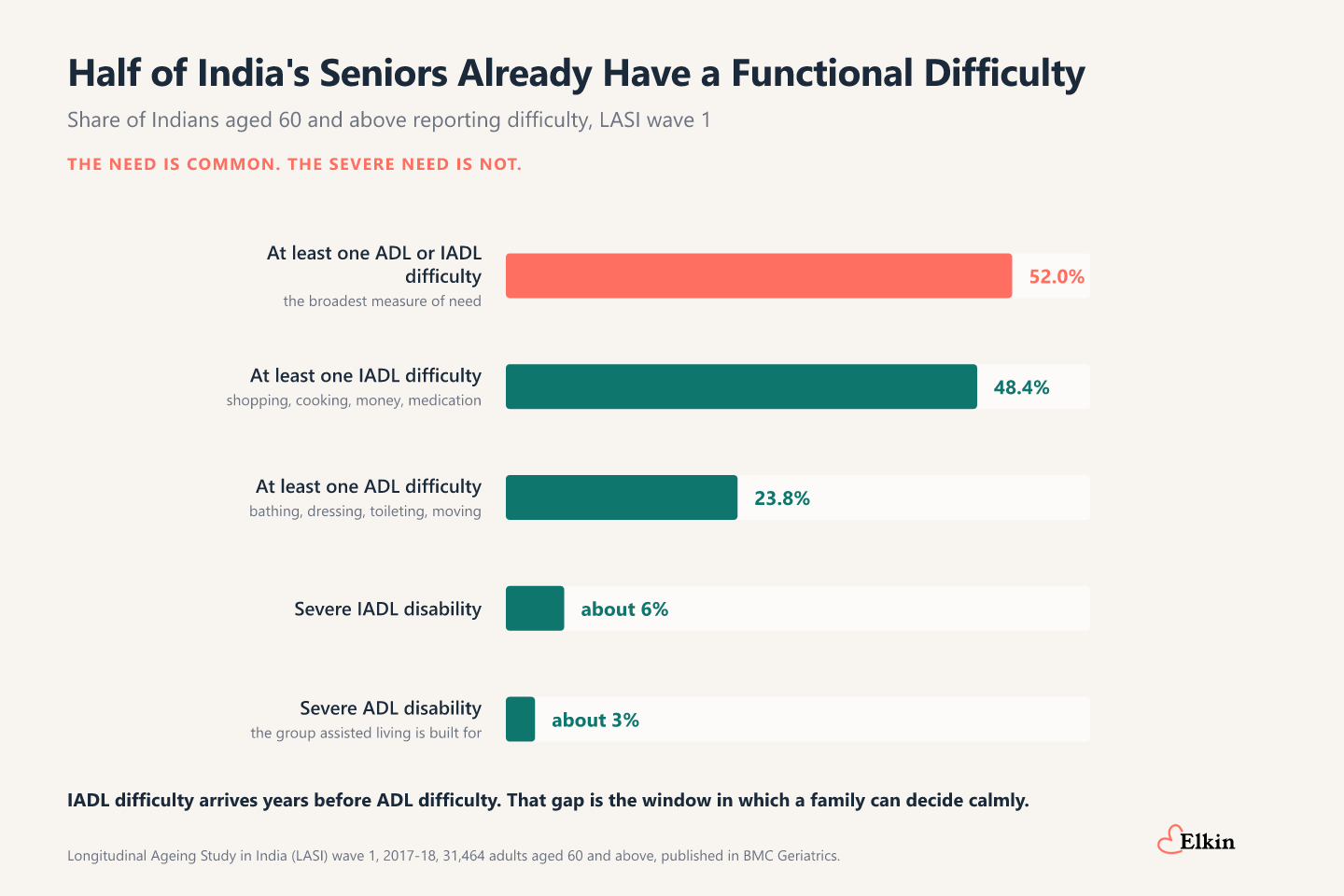
Share of Indians aged 60 and above reporting difficulty.
The Longitudinal Ageing Study in India surveyed 31,464 adults aged 60 and above. Its findings put the question in proportion:
Measure | Share of Indians aged 60+ |
At least one ADL or IADL difficulty | 52.0% |
At least one IADL difficulty | 48.4% |
At least one ADL difficulty | 23.8% |
Severe IADL disability | about 6% |
Severe ADL disability | about 3% |
Read that carefully, because it cuts both ways.
Half of India's seniors have a functional difficulty. So difficulty on its own is not a reason to move anyone. It is the ordinary experience of ageing.
About 3% have severe ADL disability. That is the group assisted living genuinely exists for, and it is a small fraction of the people whose families are worrying.
Set against this, only about 0.1% of Indian seniors live in residential care of any kind, which is worked through in what percentage of elderly live in old age homes in India. The gap between 3% and 0.1% is the real unmet need in this country, and it sits overwhelmingly in family homes.
Women reach this point sooner
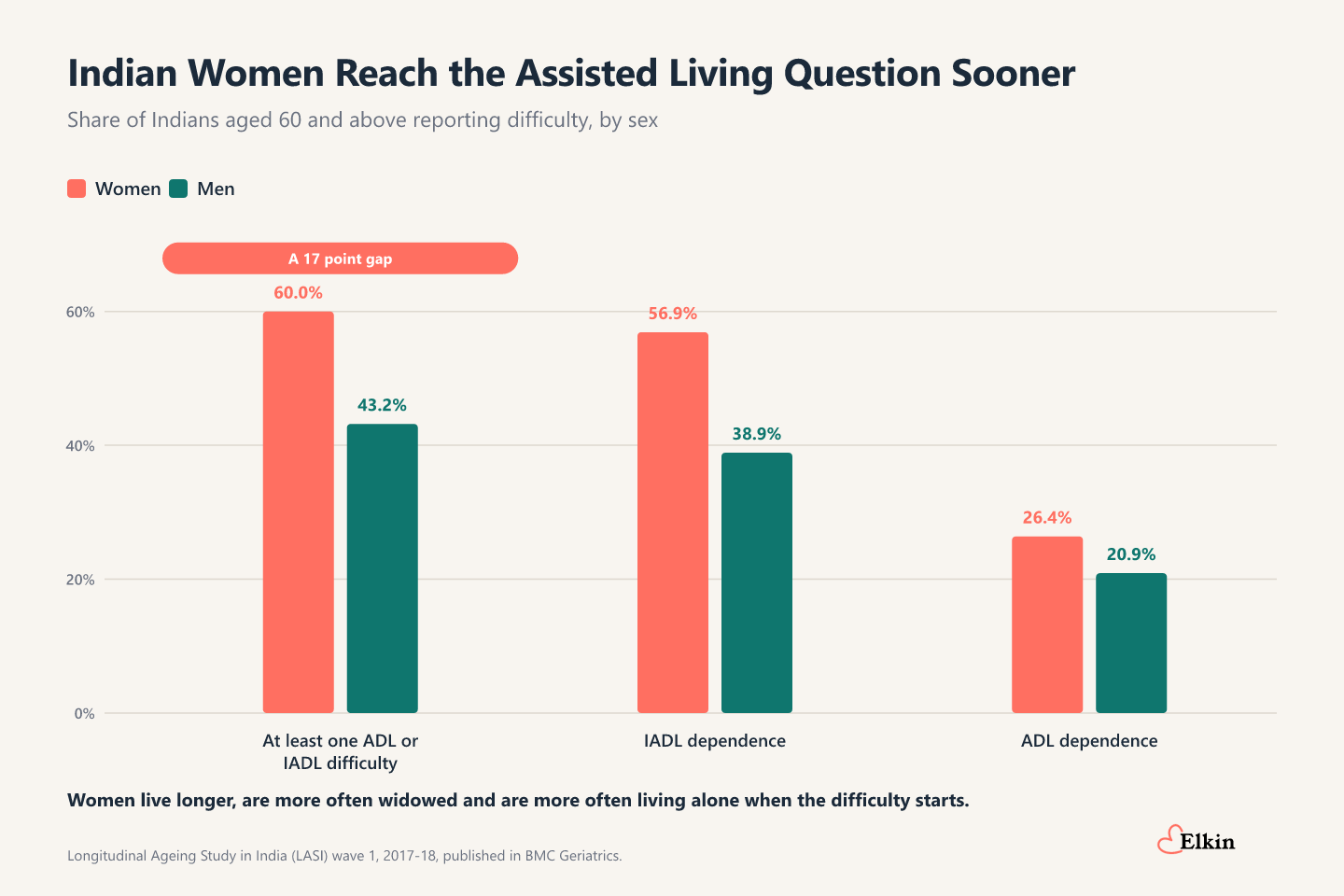
Share of Indians aged 60 and above reporting difficulty, by sex.
60.0% of Indian women aged 60 and above report at least one ADL or IADL difficulty, against 43.2% of men. On IADLs specifically the gap is wider still, 56.9% against 38.9%.
Women live longer, are more often widowed, and are more often the one living alone when the difficulty arrives. In practice this means a mother's care question usually arrives before a father's, and often when there is no spouse left to compensate.
Ten signs it is time to start looking
Not one bad week. A pattern over several weeks.
- A fall, or a near fall. Especially in the bathroom, and especially if they did not mention it.
- Personal hygiene has slipped. Unwashed hair, the same clothes, a smell in the room. Almost always a bathing ADL problem, not a motivation problem.
- Weight loss. Cooking has become too hard, or they are forgetting to eat.
- Medication errors. Doses missed, doubled, or the box untouched since last week.
- The house has changed. Unopened post, an unclean kitchen, spoiled food in the fridge.
- Money mistakes. Bills unpaid or paid twice, unusual withdrawals, susceptibility to a caller.
- Withdrawal. They have stopped going out, stopped calling people, stopped things they enjoyed.
- More hospital visits. Two or more admissions in a year, or a discharge they could not manage alone.
- The caregiver is failing. A spouse or adult child is exhausted, unwell, or has stopped their own life. This counts.
- They are frightened at night. Often said indirectly. Take it at face value.
What a home will then require of you is a separate question, answered in assisted living eligibility criteria, and what your money buys is in what services are included in assisted living.
Two or more of these, consistently, is the point to start looking. Not to move, to look. Visiting homes takes six to ten weeks done properly, and doing it before a crisis is the whole difference between choosing a home and taking whatever has a bed.
When assisted living is not the answer
They only have IADL difficulty. Part-time home help, a cook, or a family member managing medication solves this at a fraction of the cost. See how much in-home senior care costs in India.
They need skilled nursing. Ventilator support, tracheostomy care, dialysis or IV therapy sit above assisted living. The distinction is in assisted living vs nursing home.
They have advanced dementia. A general assisted living home is not equipped, and admitting a resident it cannot manage is the more dangerous outcome. Memory care exists for this.
They are fully independent and lonely. Independent living, or a senior living community. The comparison is in independent living vs assisted living.
They are at end of life. Palliative or hospice care, covered in hospice vs assisted living.
Assisted living or care at home?
For one to three ADLs, both work. The arithmetic decides it, and it turns at a predictable point.
A 12-hour attendant at home costs less than assisted living. A 24-hour attendant costs about the same. Round-the-clock qualified nursing at home costs more, because you are paying for a nurse, a room, food and coordination that a facility spreads across forty residents.
The other half of the decision is not financial. Care at home means your parent stays in their own house, with their own things, and is alone most of the time. Assisted living means giving that up and getting company, structure and someone on the floor at 3am. Families weigh those differently and both answers are legitimate.
The full comparison is in assisted living vs home care.
How to have the conversation
The commonest mistake is presenting a decision instead of a problem.
- Start from a specific difficulty, not from "we're worried about you". "You've stopped using the shower" is a conversation. "You can't cope" is an argument.
- Give them the decision. Shortlist three homes and let them choose. A senior who chooses the home settles; one who is placed in it usually does not.
- Visit together, unannounced, at a mealtime.
- Frame it as adding help, not removing independence. It is a truthful framing, and it is also the one that works.
- Expect to raise it more than once. Most families take three or four conversations across several months.
There is a longer guide to this in how to talk about senior living in India, and the guilt question, which is the real obstacle for most Indian families, in is it wrong to send parents to an old age home.
The bottom line
Stop asking whether your parent is old enough or struggling enough. Go through the six ADLs and count how many need another person's hands.
One to three, consistently, over several weeks, with no need for skilled nursing: that is assisted living, and looking now rather than after the next fall is the single decision that most improves the outcome. Zero ADLs with only IADL difficulty: get help at home and revisit in six months.
The families who do well are the ones who start looking during the IADL window, while there is time to visit properly and while the senior can still choose for themselves.
Starting to look? Elkin helps families across India compare verified assisted living communities by care level, city and budget.
Frequently asked questions
Who needs assisted living?
An older adult who needs hands-on help with one to three activities of daily living, such as bathing, dressing or moving from bed to chair, but does not need skilled nursing. They can still take part in their own daily life, and home care is either no longer enough or no longer arrangeable.
What are the signs it is time for assisted living?
A fall or near fall, slipping personal hygiene, weight loss, medication errors, an unmanaged house, money mistakes, social withdrawal, repeat hospital visits, an exhausted family caregiver, and fear at night. Two or more of these consistently over several weeks is the point to start looking at homes.
How many ADLs mean assisted living?
One to three. Zero ADLs with only IADL difficulty usually means home care or independent living is enough. Four or more ADLs means a high dependency unit rather than general assisted living.
What is the difference between ADLs and IADLs?
ADLs are the six basic self-care tasks: bathing, dressing, toileting, transferring, continence and feeding. IADLs are the eight tasks that keep an independent household running: telephone, shopping, cooking, housekeeping, laundry, transport, medication and finances. IADL difficulty appears years before ADL difficulty.
How common is functional difficulty among Indian seniors?
The Longitudinal Ageing Study in India, covering 31,464 adults aged 60 and above, found 52.0% reported at least one ADL or IADL difficulty, 48.4% reported IADL difficulty and 23.8% reported ADL difficulty. About 3% reported severe ADL disability.
Do women need assisted living earlier than men in India?
They report the difficulty earlier. 60.0% of Indian women aged 60 and above report at least one ADL or IADL difficulty against 43.2% of men, and 56.9% report IADL dependence against 38.9%. Women also live longer and are more often widowed, so there is more often no spouse to compensate.
Does my parent need assisted living or memory care?
If the driving problem is memory and safety, wandering, unsafe confusion or not recognising familiar places, that is memory care, whatever the ADL count. A general assisted living home without a secure unit and trained staff will usually decline the admission, and should.
Is assisted living cheaper than care at home?
It depends on the hours. A 12-hour attendant at home costs less. A 24-hour attendant costs roughly the same. Round-the-clock qualified nursing at home usually costs more than an assisted living place, because a facility spreads staffing across many residents.
At what age do people move into assisted living?
Age is not the trigger, function is. Most Indian homes set a minimum of 60, with private senior living communities from 55, and there is no maximum age anywhere. The age limits by type of home are set out in the old age home admission age limit.