

Assisted living includes eight groups of service: personal care, nursing and medical support, medication management, dining, housekeeping and laundry, emergency response, wellness and therapy, and social activities. One of those eight is the reason assisted living exists. The other seven are available in cheaper settings too.
That one is personal care: hands-on help with bathing, dressing, toileting and moving about. A retirement community will feed your parent and clean their room. Only assisted living will help them into the shower.
This guide sets out what is actually included, what the government says must be there, and, more usefully, which of these services arrive as a separate bill at the end of the month.
Key takeaways
- Personal care is the defining service. Help with the activities of daily living is what separates assisted living from independent living or a basic old age home.
- Eight service groups make up a full assisted living package. Personal care, nursing, medication management, dining, housekeeping, emergency response, therapy and social activities.
- The advertised fee usually covers five of them. Medicines, consumables, therapy beyond a monthly quota and a one-to-one attendant are almost always billed on top.
- India has minimum standards, not a licence. The Ministry of Social Justice and Empowerment issued Minimum Standards for Senior Citizen Homes in March 2024, with checkable numbers, but no inspector enforces them before a home opens.
- A ₹45,000 quoted fee commonly becomes ₹65,000 to ₹75,000 once care level charges, consumables and medicines are added.
- Ask for the exclusions list in writing. It is a more revealing document than the brochure.
Quick answer: what does assisted living include?
Service group | What it covers | Normally in the fee |
Personal care | Bathing, dressing, toileting, transferring, mobility | Yes |
Nursing and medical | Nursing staff on site, scheduled doctor visits, vitals monitoring | Yes |
Medication management | Storing, dispensing and recording every dose | Yes |
Dining | Three meals and snacks, adjusted for medical diets | Yes |
Housekeeping and laundry | Room cleaning, linen, personal laundry, maintenance | Yes |
Emergency response | Call buttons, overnight staff, a tested ambulance route | Yes |
Wellness and therapy | Physiotherapy, guided exercise, yoga, fall prevention | Up to a monthly quota |
Social and recreational | Group activities, festivals, outings, library | Yes |
Medicines and consumables | The drugs and the diapers themselves | No |
One-to-one attendant | A dedicated carer beyond the standard ratio | No |
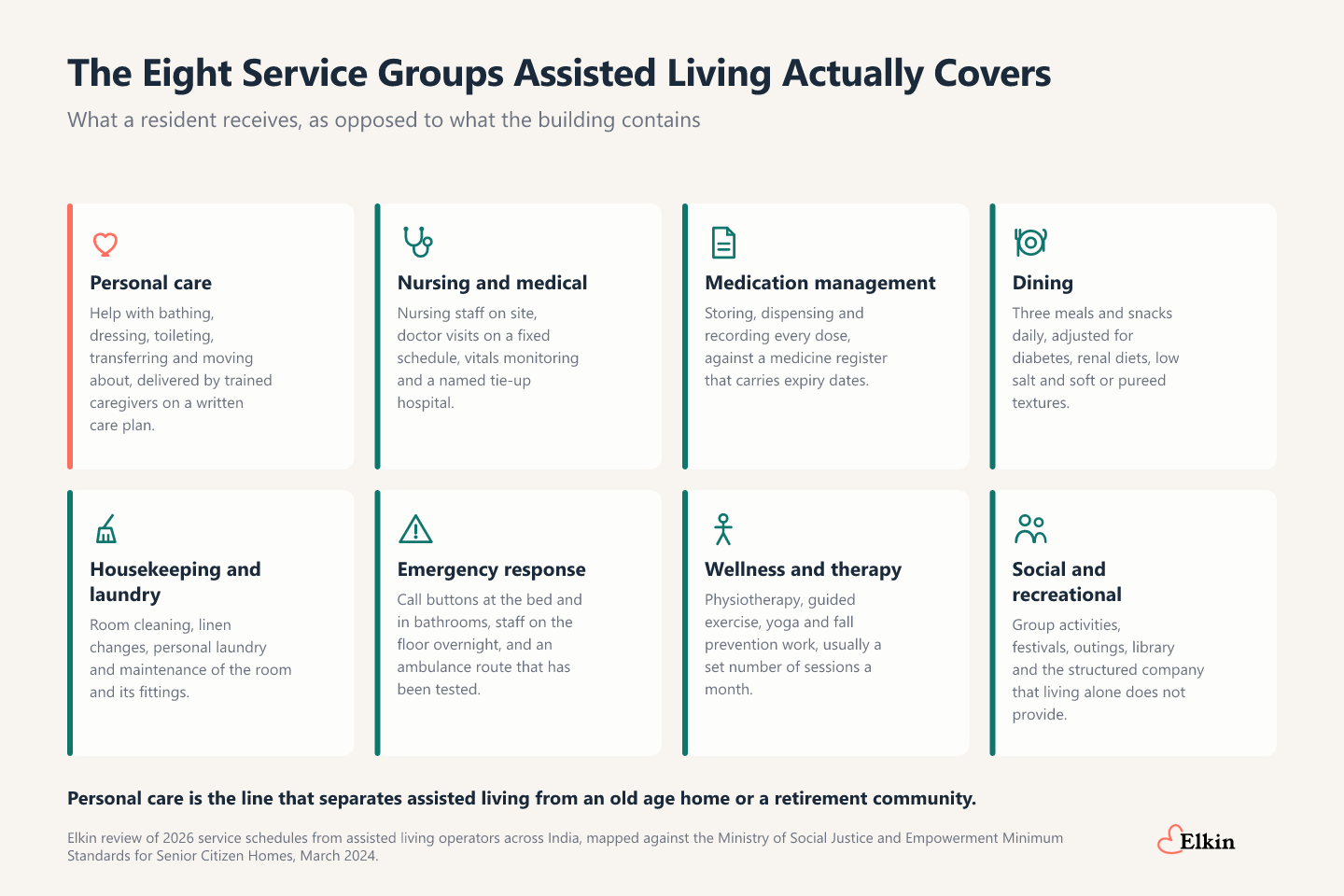
What a resident receives, as opposed to what the building contains.
The eight service groups in detail
1. Personal care
The service the whole category is built around. Trained caregivers help with the six activities of daily living: bathing, dressing, toileting, transferring, continence and feeding.
Good homes work from a written care plan that names which of these your parent needs help with, how often, and who is responsible. Ask to see it before admission and ask for it to be reviewed in writing every quarter.
This is the line that separates assisted living from an ordinary old age home, and it is worked through in assisted living vs old age home. Whether your parent has reached that threshold is covered in who needs assisted living.
2. Nursing and medical support
Nursing staff on site, a doctor visiting on a fixed schedule rather than "on call", vitals monitoring, wound care, and a named tie-up hospital with a route that has been tested in traffic.
What assisted living does not include is skilled nursing: ventilator support, tracheostomy care, dialysis or IV therapy. Those sit a rung higher, and the difference is set out in assisted living vs nursing home.
3. Medication management
Underrated and, for most families, the single service that changes daily life most. The home stores the medicines, dispenses each dose at the right time, and records it against a register that carries expiry dates.
The March 2024 minimum standards go further and ask for a medication time chart displayed in the resident's room and the supervisor's room, with daily monitoring by staff.
Note that the *service* is included. The medicines themselves are not, and they are billed at cost every month.
4. Dining
Three meals and snacks daily, prepared for the medical realities of an older resident: diabetic, renal, low salt, low oil, and soft or pureed textures where swallowing is a problem.
The standards ask for a dietician, even on online consultation, a menu that changes daily and is displayed, and a kitchen kept free of pests with refrigeration for dairy.
5. Housekeeping and laundry
Daily room cleaning, linen changes, personal laundry, and maintenance of the room and its fittings. Straightforward, and the service most commonly used to pad a brochure.
6. Emergency response
Call buttons at the bed and in the bathroom, staff physically on the floor overnight, a documented protocol for informing the family, and an ambulance route that someone has actually driven.
Ask how many trained staff are on the floor at 2am, not how many are employed. It is the most revealing question in the whole visit, and vagueness in the answer is itself the answer.
7. Wellness and therapy
Physiotherapy, guided exercise, yoga and fall prevention work. Almost always capped at a set number of sessions a month, with anything beyond that billed separately. Confirm the quota, because it is where a lot of unexpected spending starts.
8. Social and recreational
Group activities, festivals, outings, a library, and the ordinary daily company that a senior living alone does not get. Easy to dismiss as a nice-to-have, and it is the part residents themselves rate highest.
What the fee covers, and what arrives separately
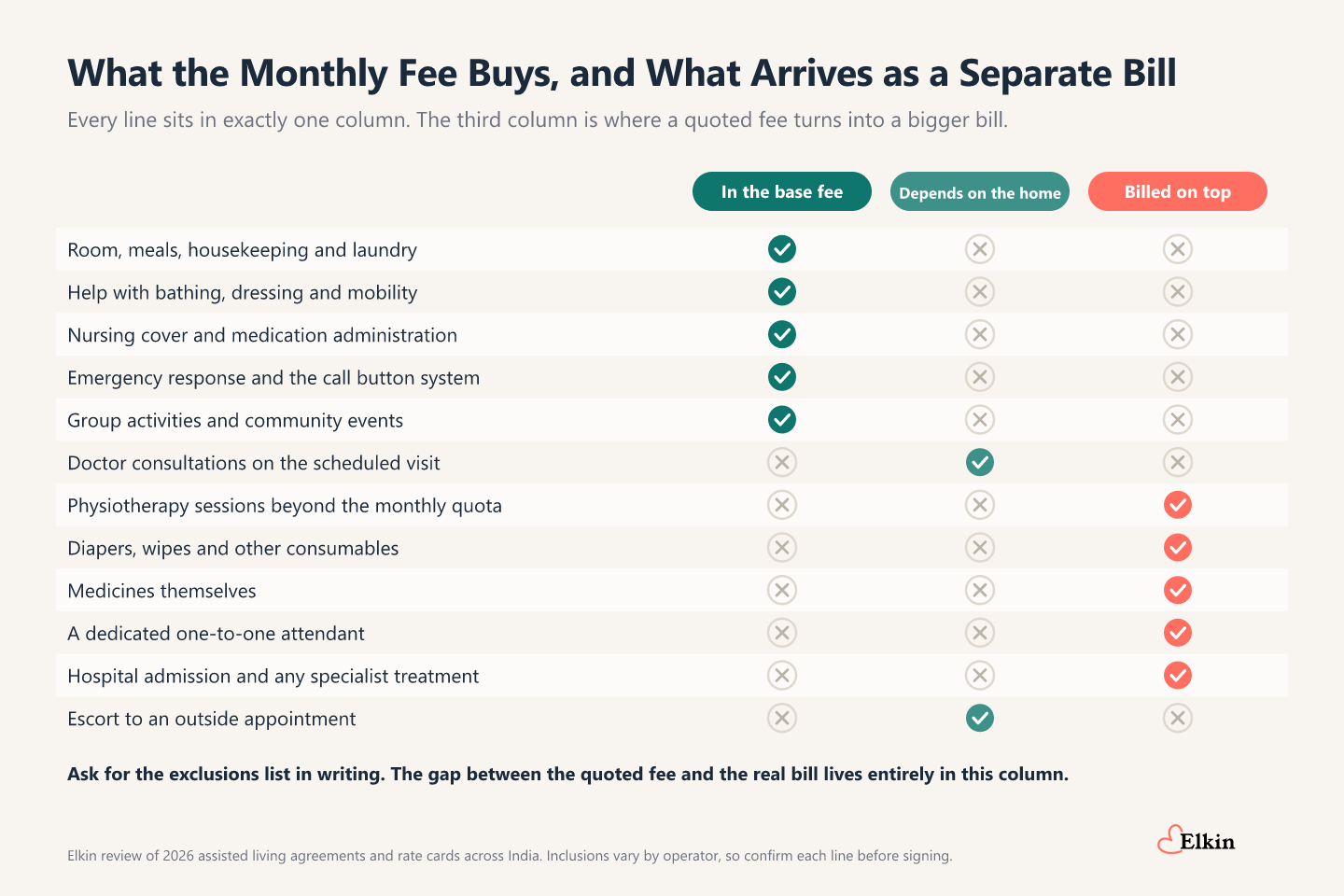
Every line sits in exactly one column.
This is the table families most need and operators least advertise. The pattern across Indian homes in 2026:
In the base fee: room, meals, housekeeping, laundry, personal care, nursing cover, medication administration, emergency response and community activities.
Depends on the home: doctor consultations on the scheduled visit, and escorting a resident to an outside appointment. Some homes include both. Many bill them.
Billed on top, at almost every home: medicines, diapers and consumables, therapy beyond the monthly quota, a dedicated one-to-one attendant, and any hospital admission or specialist treatment.
What that does to the monthly bill
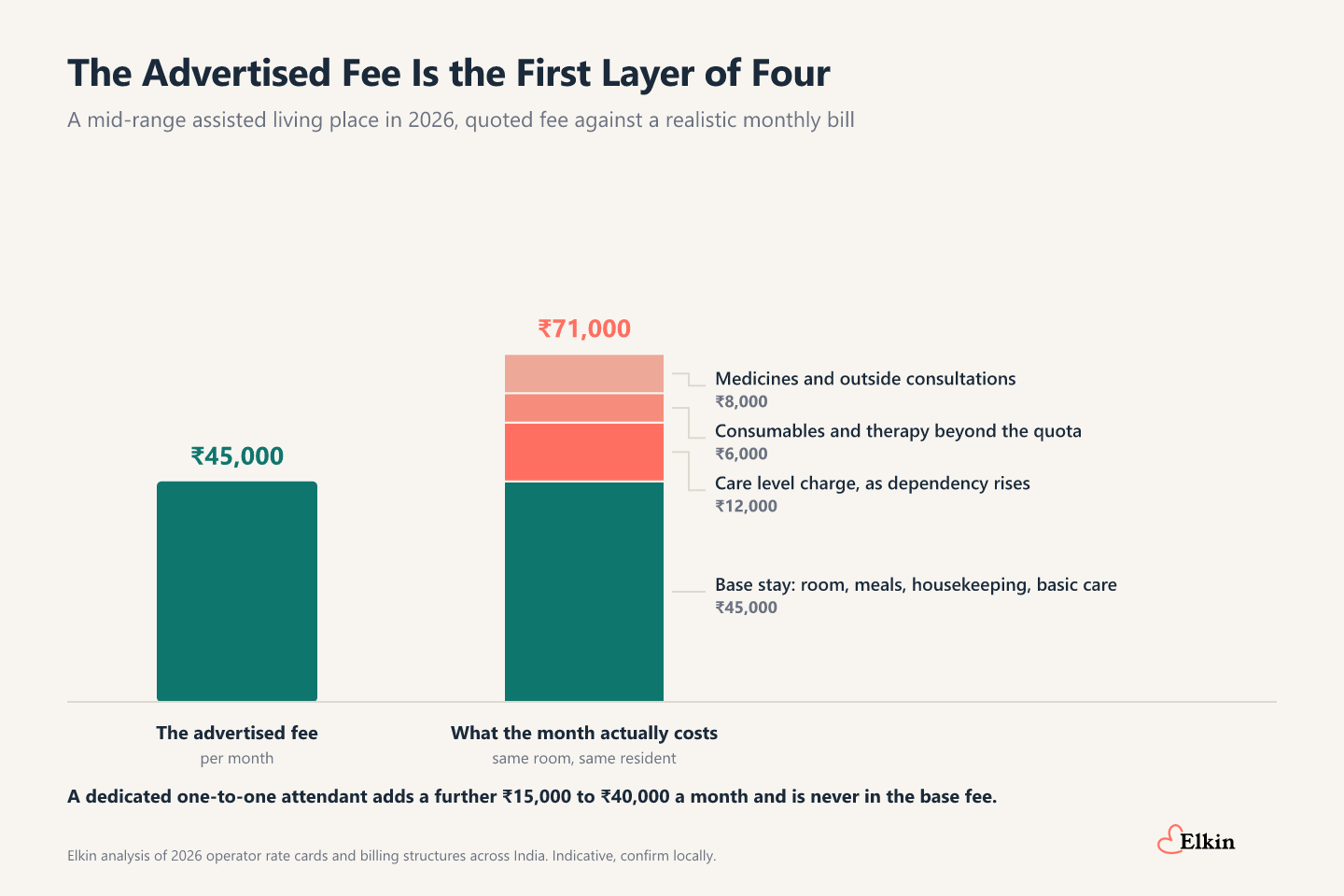
A mid-range assisted living place in 2026.
An assisted living bill has four layers:
- Base stay, typically 60% to 75% of the total. Room, meals, housekeeping and basic care.
- Care level charge, 10% to 30%. Rises as dependency rises, and the tiers are explained in levels of care in assisted living.
- Add-ons, from nothing to 40%. Consumables, extra therapy, escorts, medicines.
- One-time charges. An admission fee of ₹10,000 to ₹50,000 and a security deposit of ₹10,000 to ₹4,00,000, paid before the first night.
A ₹45,000 quoted place realistically runs at ₹65,000 to ₹75,000 a month once everything is counted, and a dedicated one-to-one attendant adds a further ₹15,000 to ₹40,000 on top of that.
Full pricing is in how much assisted living costs in India, and the tax position in is assisted living tax deductible in India.
What the government says must be included
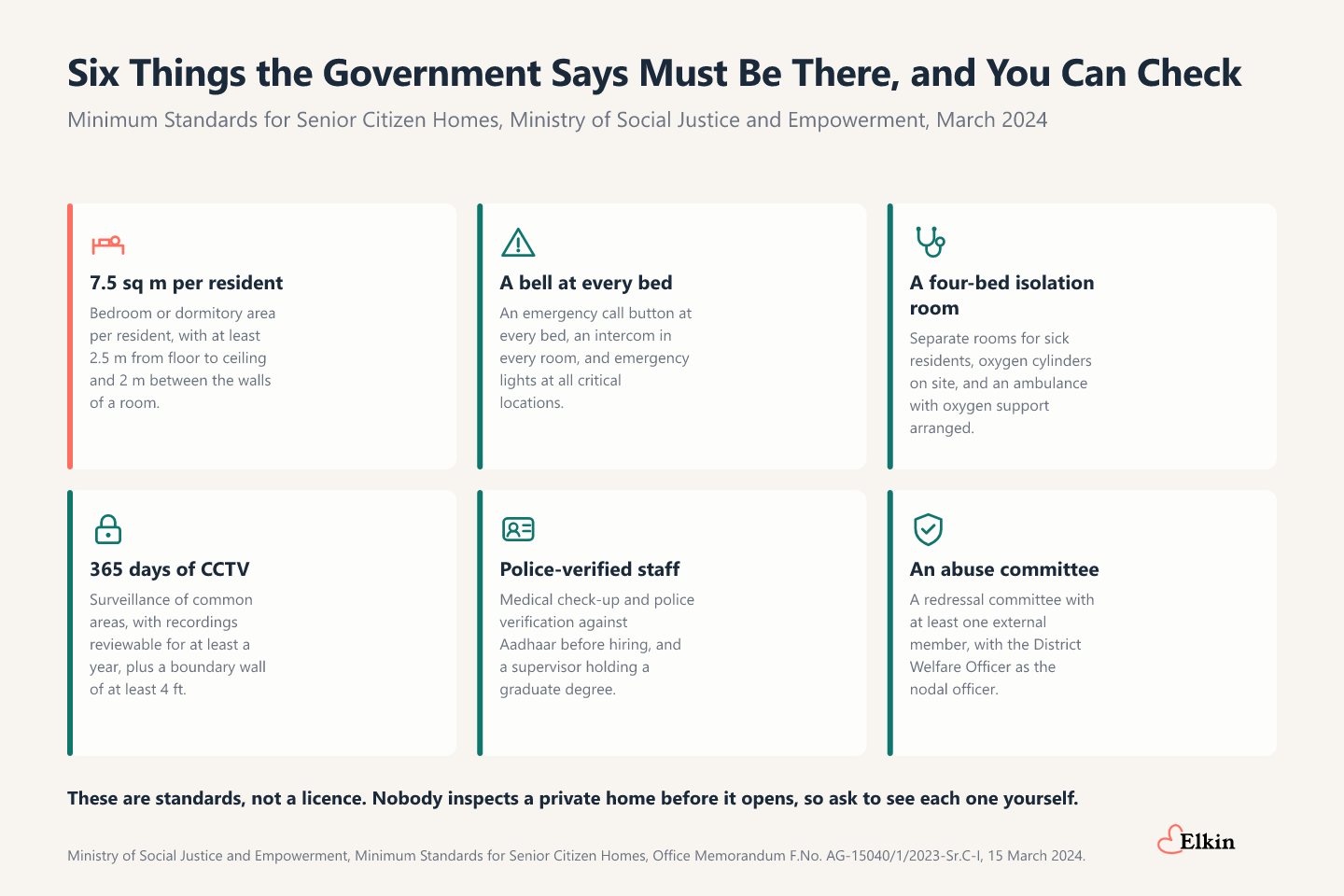
Minimum Standards for Senior Citizen Homes, Ministry of Social Justice and Empowerment, March 2024.
In March 2024 the Ministry of Social Justice and Empowerment issued Minimum Standards for Senior Citizen Homes, a fifteen-section document covering everything from location to governance. It is the closest India has to a national specification for what a senior citizen home must provide.
Requirements you can verify on a single visit:
- 7.5 sq m of bedroom or dormitory area per resident, with at least 2.5 m from floor to ceiling
- An emergency call button at every bed and an intercom in every room
- A four-bed isolation room for sick residents, plus oxygen cylinders on site
- CCTV recordings reviewable for at least 365 days, and a boundary wall of at least 4 ft
- Medical check-up and police verification of every staff member before hiring, with a supervisor holding a graduate degree
- An abuse redressal committee with at least one external member, the District Welfare Officer acting as nodal officer
- Handrails at 900 mm to 1000 mm, anti-skid tiles, grab rails in bathrooms, and outward-opening bathroom doors
- Toilets cleaned three times a day, against a written schedule and a register
- A charter of residents' rights displayed prominently and handed to every resident at admission
One caution, and it matters. This is a standards document, not a licensing regime. Nobody inspects a private assisted living facility before it opens, and no penalty attaches to falling short. Alongside it sit the Ministry of Housing and Urban Affairs Model Guidelines for Retirement Homes from March 2019, and a voluntary accreditation matrix run by ASLI with Standards Wise International India, which Elkin joined as a primary member.
Standards, guidelines and voluntary accreditation. No licence. Which means the checking is yours to do, and the list above is a good checklist to do it with.
What is not included, anywhere
Worth stating plainly, because these are the assumptions that cause disputes:
- Medicines. The service of managing them is included. The drugs are billed at cost.
- Hospital admission. Any inpatient treatment is a separate medical expense.
- Specialist consultations outside the home's scheduled doctor visit.
- Skilled nursing. Ventilators, tracheostomy care, dialysis and IV therapy sit above assisted living.
- Personal shopping, mobile bills and personal transport.
- A dedicated attendant. Any one-to-one cover beyond the standard staffing ratio.
Nine questions to ask before you sign
- Which of the eight service groups are in the base fee, in writing?
- What is the exclusions list?
- How many care levels do you run, and what triggers a move to the next one?
- How much does each level cost, and how much notice do I get before the charge changes?
- How many trained staff are on the floor at 2am?
- How many physiotherapy sessions a month are included?
- Are medicines billed at cost or with a margin?
- Which hospital do you tie up with, and how far is it in traffic?
- What is the annual increment, and has it been higher than that in the last three years?
The wider shortlisting process is in how to choose a senior living home, and the physical facilities checklist in what are the facilities at old age homes.
The bottom line
The service list is not the hard part. Almost every operator will tell you it covers personal care, nursing, meals, housekeeping, emergency response, therapy and activities, and almost every operator will be telling the truth.
The hard part is the boundary. Which of those is in the fee, which is capped, and which lands as a separate bill in month two. Get that in writing before you sign, and compare homes on the exclusions list rather than the brochure.
Comparing homes? Elkin verifies care levels, staffing and registration before listing, so you can compare assisted living communities across India by care type, city and budget.
Frequently asked questions
What services are included in assisted living?
Eight groups: personal care with bathing, dressing, toileting and mobility; nursing and medical support; medication management; three meals a day adjusted for medical diets; housekeeping and laundry; emergency response with call buttons and overnight staff; physiotherapy and wellness up to a monthly quota; and social and recreational activities. Personal care is the service that defines the category.
What is not included in assisted living fees in India?
Medicines themselves, diapers and consumables, hospital admission, specialist consultations outside the scheduled doctor visit, skilled nursing such as ventilator or dialysis care, personal shopping and transport, and any dedicated one-to-one attendant beyond the standard staffing ratio.
Does assisted living include nursing care?
It includes nursing cover: nursing staff on site, medication administration, vitals monitoring and wound care. It does not include skilled nursing such as ventilator support, tracheostomy care, dialysis or IV therapy, which belong in a nursing home or a hospital-attached facility.
Does assisted living include meals?
Yes. Three meals and snacks daily are standard, prepared for medical diets including diabetic, renal, low salt and soft or pureed textures. India's Minimum Standards for Senior Citizen Homes also ask for a dietician, a menu that changes daily and is displayed, and safe food storage.
Are medicines included in the assisted living fee?
No. Managing medication is included, meaning storage, dispensing, recording and a register with expiry dates. The medicines themselves are billed at cost each month. Ask whether the home adds a margin.
How much does assisted living cost in India once everything is added?
A quoted fee of ₹45,000 a month realistically runs at ₹65,000 to ₹75,000 once care level charges, consumables, extra therapy and medicines are counted. Base stay is typically 60% to 75% of the bill, care level charges 10% to 30%, and add-ons the rest.
Is there a legal minimum standard for assisted living in India?
There are standards but no licence. The Ministry of Social Justice and Empowerment issued Minimum Standards for Senior Citizen Homes in March 2024, covering space per resident, call buttons, isolation rooms, staff verification, safety and governance. Nobody inspects a private facility before it opens, so families have to verify compliance themselves.
Does assisted living include physiotherapy?
Usually up to a set number of sessions a month, with additional sessions billed separately. India's minimum standards ask every senior citizen home to have a yoga instructor or physiotherapist, online or in person. Confirm the monthly quota before signing.
What is the difference between assisted living services and old age home services?
An old age home provides accommodation, meals, housekeeping and basic supervision. Assisted living adds hands-on help with the activities of daily living, nursing cover and medication administration. The personal care component is the difference, and it is what the higher fee pays for.