

The case for senior living is company, safety and care that arrives without anyone having to ask for it. The case against is cost, loss of a familiar life, and the fact that no regulator licenses a private senior living community in India, so quality varies enormously and nobody has checked on your behalf.
Both are true at the same time. This is not a question with a right answer, and any article that presents it as one is selling something. What follows is the honest trade, with the Indian evidence for each side, and a way to work out which set of problems your family would rather have.
Key takeaways
- The strongest argument for senior living is not safety, it is company. 13.6% of Indian seniors living alone report depression, against 8.4% of those living with someone.
- The strongest argument against is the absence of a regulator. India has minimum standards and a voluntary accreditation scheme, and no licence for a private facility.
- Quality varies enormously. The Tata Trusts, Samarth and UNFPA survey of 480+ facilities found poor hygiene, weak attention to dignity and privacy, and skewed staff-to-resident ratios at many of them.
- Cost is real and compounding. ₹30,000 to ₹70,000 a month for assisted living, rising 8% to 12% a year, with almost none of it insured or recoverable.
- Senior living works best in specific situations, above all a senior living alone with no adult child in the city.
- It works badly in one situation in particular: where the senior has not agreed and has not visited.
Quick answer: is senior living worth it?
The case for | The case against | |
Safety | Staff on the floor overnight, call buttons at the bed, a tested route to hospital | No regulator has verified any of it before you arrive |
Company | Daily company by default, which measurably reduces reported depression | The neighbours, the temple and forty years of a familiar street are gone |
Care | Medication administered rather than remembered, trained help with bathing and mobility | Quality varies enormously and the average Indian facility is not good |
Money | One predictable monthly figure instead of an attendant, a cook and a house to maintain | ₹30,000 to ₹70,000 a month, rising 8% to 12% a year, none of it insured |
Control | Freedom from running a household, which residents themselves rate highest | Institutional routine: fixed meal times, shared spaces, rules set by others |
Family | Adult children stop being unpaid night nurses | Visiting replaces living together |
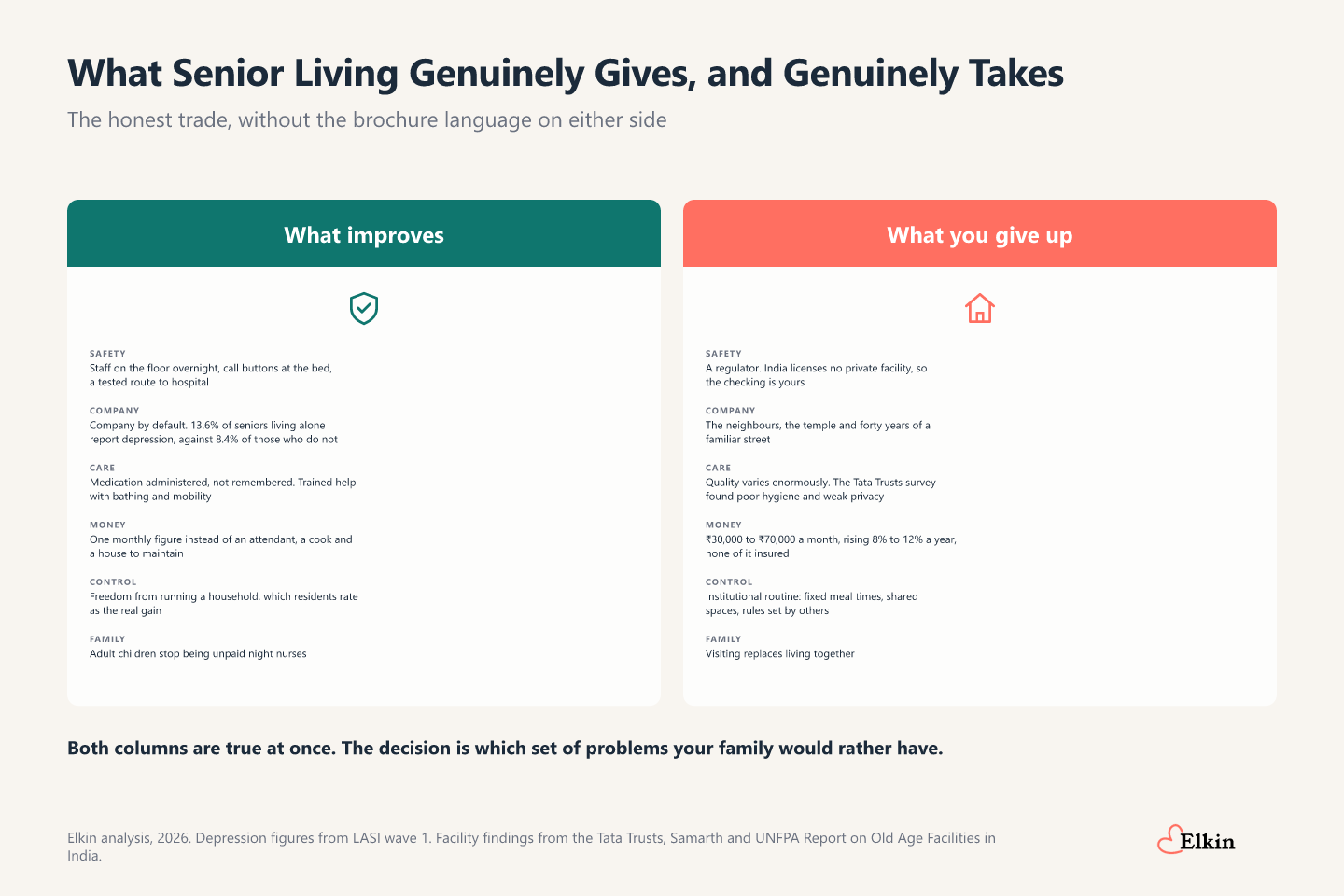
The honest trade, without the brochure language on either side.
The pros, with the evidence
1. Company, and what it does to mental health
This is the pro that families underweight and residents rate highest.
The Longitudinal Ageing Study in India found that 13.6% of older adults living alone reported depression, against 8.4% of those co-residing. Separately, 13.4% of Indian seniors report feeling lonely, rising to 17.5% among women.
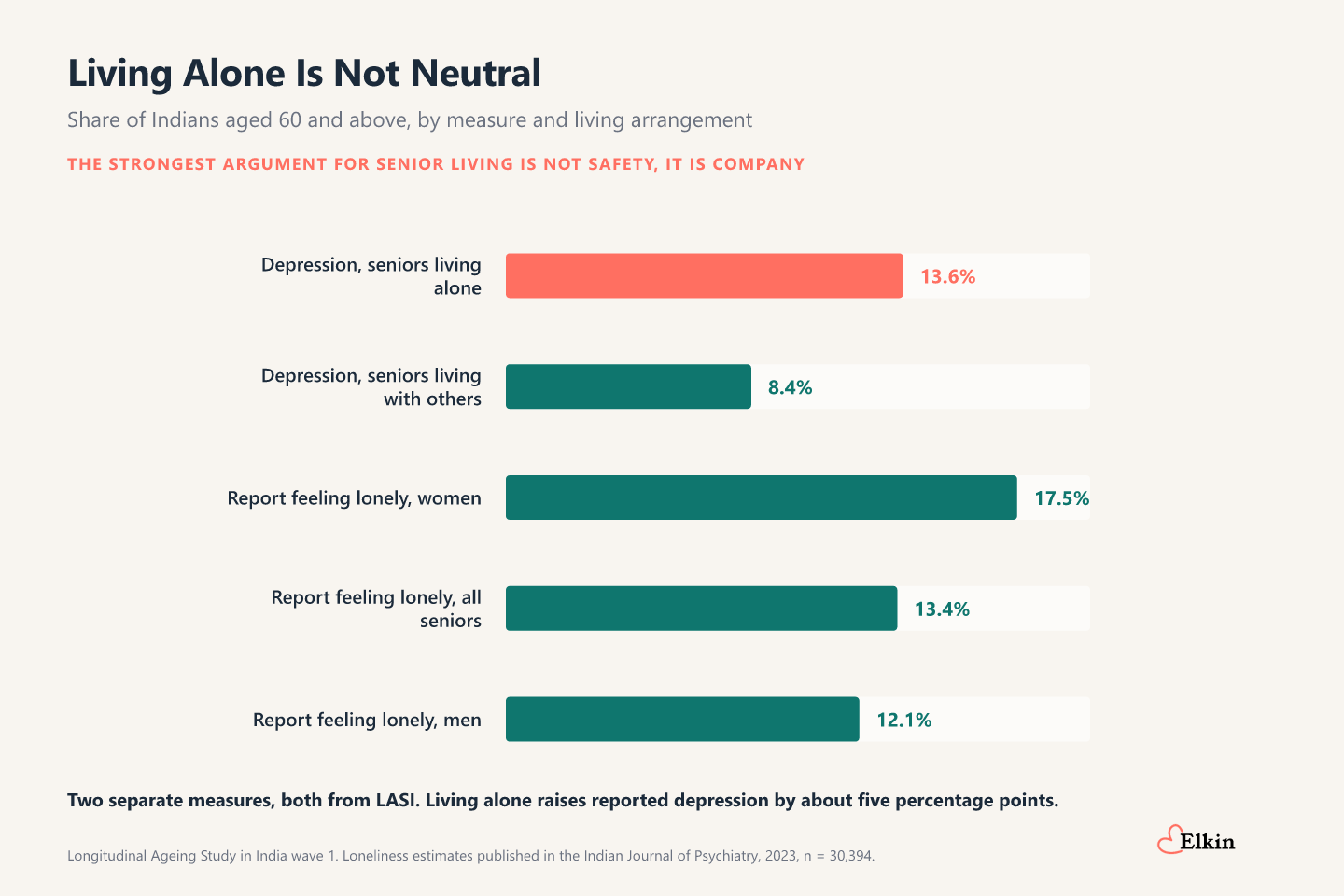
Share of Indians aged 60 and above, by measure and living arrangement.
Senior living does not solve loneliness by decree, and a resident who withdraws can be lonely in a full building. But daily company by default, with meals eaten alongside other people, is structurally different from a flat where the only conversation is a phone call from another time zone.
2. Safety that does not depend on someone noticing
Falls are the specific risk. A senior who falls at home alone may lie there for hours. In a good community there is a call button at the bed and in the bathroom, staff physically on the floor overnight, and an ambulance route somebody has actually driven.
India's Minimum Standards for Senior Citizen Homes, issued in March 2024, ask for exactly this: an emergency call button at every bed, grab rails in bathrooms and corridors, anti-skid tiles, outward-opening bathroom doors and emergency lights at critical locations. Whether a given home meets them is a question you have to answer yourself.
3. Care that scales without a crisis
At home, every increase in need becomes a project: find an attendant, train them, cover their day off, replace them when they leave. In a community, the care level changes and the fee changes with it. The full structure is in levels of care in assisted living.
4. One predictable number
Care at home is an attendant, a cook, a driver, medicines, a house to maintain and an ongoing management burden that usually falls on one adult child. Senior living replaces that with a single monthly figure and a named person to call. The comparison is worked through in assisted living vs home care.
5. The family relationship changes for the better
Understated, and for many families the real gain. When the daily work of care moves to paid professionals, adult children stop being exhausted night nurses and go back to being sons and daughters. Several families describe this as the point at which the relationship recovered.
The cons, stated plainly
1. Nobody licenses these places
The single most important thing to know. India has:
Minimum Standards for Senior Citizen Homes, Ministry of Social Justice and Empowerment, March 2024. Benchmarks, not a licence.
Model Guidelines for Retirement Homes, Ministry of Housing and Urban Affairs, 2019. Model guidelines for states to adopt.
A voluntary accreditation matrix run by ASLI with Standards Wise International India, which Elkin joined as a primary member.
No inspector visits a private facility before it opens. No penalty attaches to falling short. The checking is yours, and the method is in are old age homes safe in India.
2. The average Indian facility is not good
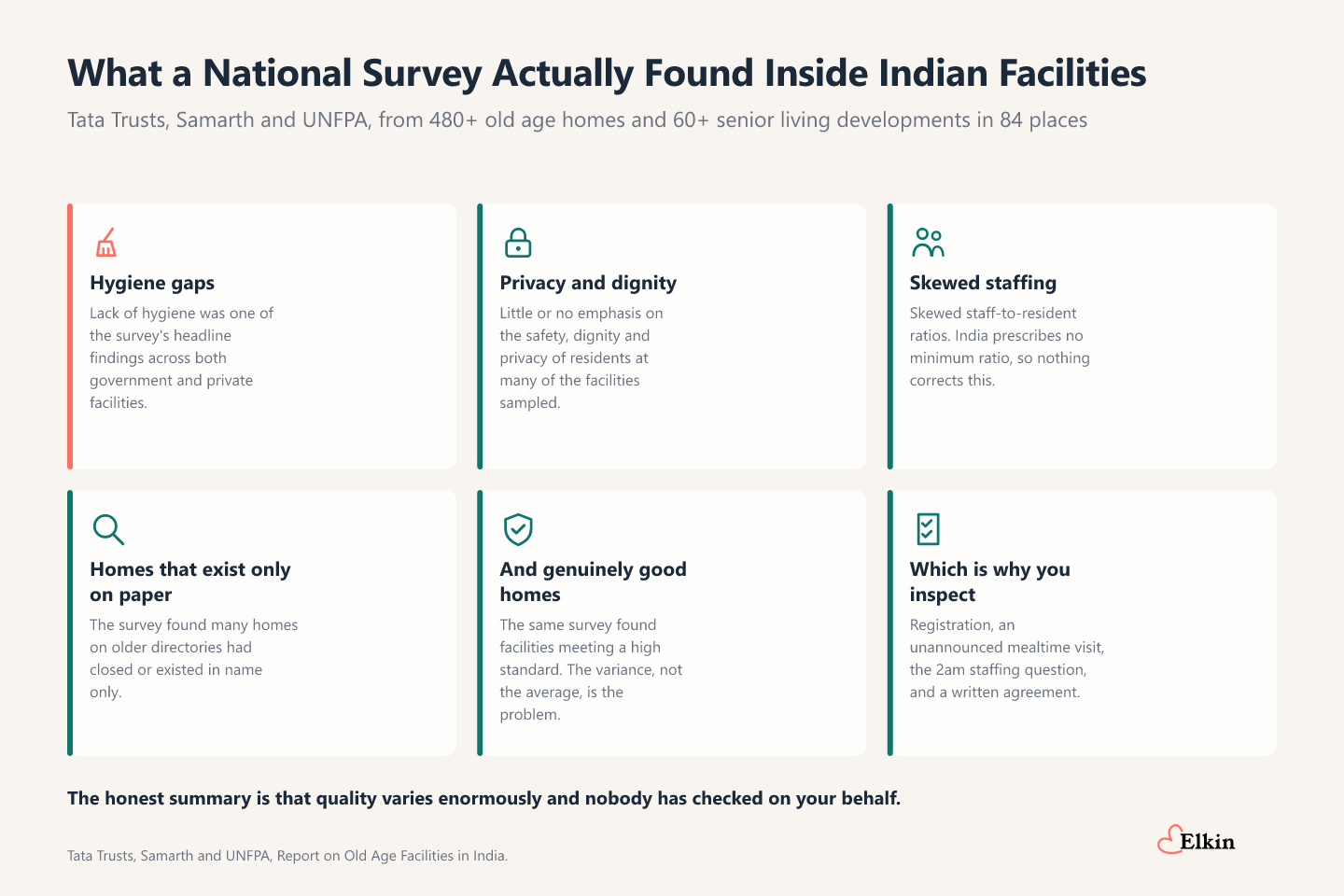
Tata Trusts, Samarth and UNFPA, from 480+ old age homes and 60+ senior living developments across 84 places.
The most credible national survey of Indian facilities, by Tata Trusts with Samarth and UNFPA, reported lack of hygiene, little or no emphasis on the safety, dignity and privacy of elders, and skewed staff-to-resident ratios.
The same survey found genuinely good facilities. That is the point: the variance, not the average, is the problem. A good Indian senior living community is very good. A bad one is worse than the family home it replaced, and from the website they look identical.
3. The cost, and the compounding
₹15,000 to ₹50,000 a month for independent living, ₹30,000 to ₹70,000 for assisted living, ₹75,000 to ₹1,50,000 for memory care. Add an admission fee of ₹10,000 to ₹50,000 and a security deposit of ₹10,000 to ₹4,00,000 before the first night.
Then add the annual increment of 8% to 12%, which over a ten-year stay roughly doubles the fee. And note that no Indian health policy covers a single rupee of it, as set out in does insurance cover assisted living in India. The only recovery route is tax relief on the medical portion, worth about ₹45,000 a year at a 30% marginal rate.
4. Leaving a life, not just a house
The vegetable seller who knows the order. The temple at the end of the road. Neighbours from four decades ago. Grandchildren dropping in unannounced. These are not amenities a community can replicate, and residents who moved reluctantly often name them for years.
5. Institutional routine
Meals at fixed times. Shared spaces. Visiting hours. Rules made by somebody else. India's own minimum standards suggest family visiting slots of 45 minutes to an hour, morning and evening, which tells you how structured a regulated day is expected to be.
Some seniors find this restful. Others experience it as a loss of adulthood. Which one your parent will be is worth asking them.
6. The stigma, which is fading but real
Placing a parent in a home still carries social cost in much of India, and it is stronger in smaller cities and where joint households remain the norm. The guilt question, which is the actual obstacle for most Indian families, is worked through in is it wrong to send parents to an old age home.
Who senior living suits, and who it does not
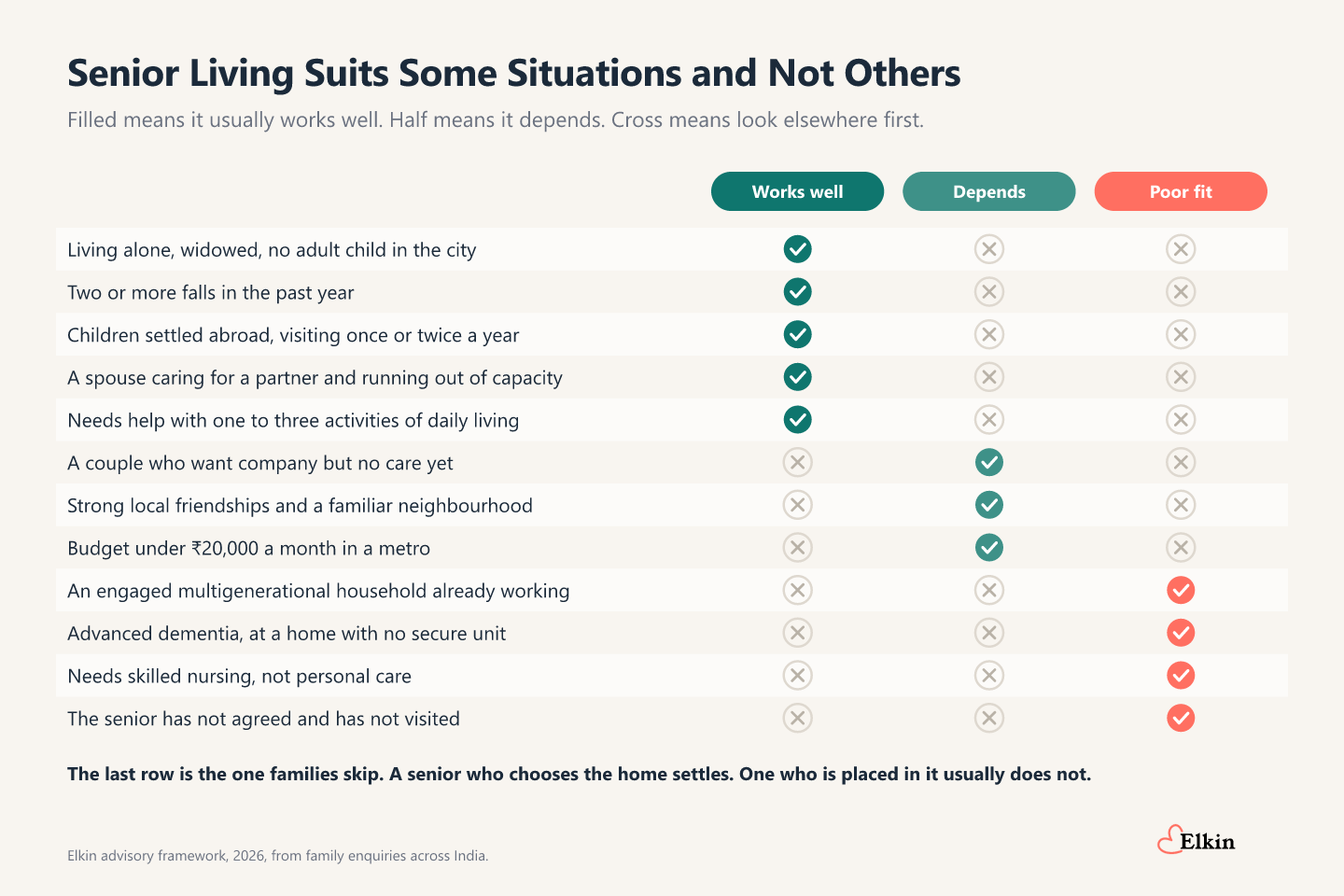
Filled means it usually works well. Half means it depends. Cross means look elsewhere first.
It usually works well when:
- The senior lives alone, is widowed, and has no adult child in the city
- There have been two or more falls in the past year
- Children are settled abroad and visit once or twice a year
- A spouse is caring for a partner and running out of capacity
- The senior needs help with one to three activities of daily living
It depends when:
- A couple want company but no care yet. Independent living may be the better first step, and the difference is in independent living vs assisted living.
- There are strong local friendships and a familiar neighbourhood worth protecting
- The budget is under ₹20,000 a month in a metro, where the honest options narrow considerably
Look elsewhere first when:
- An engaged multigenerational household is already working. Do not fix what is not broken.
- There is advanced dementia and the home has no secure unit. See assisted living for dementia patients.
- Skilled nursing is needed rather than personal care.
- The senior has not agreed and has not visited. This is the one families skip, and it predicts failure better than any other factor.
How to make the decision well
- Establish the actual need first. Count the activities of daily living honestly, using who needs assisted living. Half of India's seniors have some functional difficulty; only about 3% have severe ADL disability.
- Price the alternative properly. Compare against 24-hour care at home, all-in, using how much in-home senior care costs in India. The arithmetic turns at a predictable point.
- Shortlist three, and let the senior choose. A resident who chooses their home settles. One who is placed in it usually does not.
- Visit unannounced, at a mealtime. The scheduled tour shows you the best room on the best day.
- Ask for the ratio at 2am, not the one on the brochure.
- Read the exclusions list, not the amenities list.
- Ask what happens as needs rise, specifically whether the home keeps a resident who becomes bedridden or develops dementia.
- Agree a trial stay where the home offers one.
The bottom line
Senior living in India is a genuinely good answer to a specific problem: a senior living alone, without daily help, in a house that has become a risk. For that situation the pros are real and measurable, and the alternative is usually worse.
It is a poor answer to a different problem: family guilt, distance, or a vague sense that something should be done. Those are real too, and a paid facility does not fix them.
The single most useful thing to understand is that in India the variance is the story. Good communities and poor ones sit side by side, cost about the same, and photograph identically. The decision is less about whether senior living is right than about whether *this* home is, and that only an unannounced visit at a mealtime will tell you.
Weighing it up? Elkin verifies registration, care levels and staffing before listing, so you can compare senior living communities across India by care type, city and budget.
Frequently asked questions
What are the pros and cons of senior living?
The pros are company, overnight staffing and emergency response, care that scales without a crisis, one predictable monthly cost, and relief for family caregivers. The cons are the absence of any licensing regime in India, wide variation in quality, a cost of ₹30,000 to ₹70,000 a month rising 8% to 12% a year with no insurance cover, the loss of a familiar neighbourhood, and institutional routine.
Is senior living worth it in India?
It depends on the situation rather than on the category. It is usually worth it for a senior living alone with no adult child nearby, especially after a fall or where help is needed with one to three daily activities. It is usually not worth it where an engaged multigenerational household is already working, or where the senior has not agreed to the move.
What are the disadvantages of senior living communities?
No regulator licenses private facilities in India, so quality is unverified. A national survey by Tata Trusts, Samarth and UNFPA found poor hygiene, weak attention to dignity and privacy, and skewed staffing at many facilities. Costs compound at 8% to 12% a year and no health policy covers them. Residents also give up a familiar neighbourhood and accept an institutional routine.
Does senior living reduce loneliness?
The evidence suggests living arrangement matters. LASI found 13.6% of Indian seniors living alone reported depression against 8.4% of those living with someone, and 13.4% of seniors reported feeling lonely. A community provides daily company by default, though a resident who withdraws can still be isolated inside one.
How much does senior living cost in India?
Roughly ₹15,000 to ₹50,000 a month for independent living, ₹30,000 to ₹70,000 for assisted living and ₹75,000 to ₹1,50,000 for memory care, plus an admission fee of ₹10,000 to ₹50,000 and a security deposit that can reach ₹4,00,000. Fees typically rise 8% to 12% a year.
Is senior living regulated in India?
Not as care. The Ministry of Social Justice and Empowerment issued Minimum Standards for Senior Citizen Homes in March 2024 and the Ministry of Housing and Urban Affairs issued Model Guidelines for Retirement Homes in 2019, but neither creates a licence. ASLI runs a voluntary accreditation scheme. No inspector checks a private facility before it opens.
What is the difference between senior living and an old age home?
Senior living usually describes paid communities offering independent living, assisted living or both, with senior-friendly design and structured activities. An old age home usually describes a more basic setting providing accommodation, meals and supervision, often charitable or government run and often free or nominal.
Should I move my parent into senior living against their wishes?
It very rarely works. A senior who chooses their home settles into it; one who is placed there usually does not. Shortlist three, visit together unannounced, and let them decide. Most Indian families need three or four conversations across several months, and there is a guide to having them in how to talk about senior living in India.
When is senior living the wrong choice?
Where a multigenerational household is already working well, where the need is skilled nursing rather than personal care, where there is advanced dementia and the home has no secure unit, and where the senior has neither agreed nor visited.