

No. No mainstream Indian health insurance policy covers an assisted living fee, and India has no standalone long-term care insurance product at all. Ayushman Vay Vandana, which many families assume is elder care cover, pays ₹0 towards a monthly fee.
That is the whole answer, and it is worth stating first because a great deal of writing on this topic implies otherwise.
What insurance does do is reduce the *medical* costs that sit alongside the fee, and there is exactly one genuine recovery route on the fee itself: tax relief, worth about ₹45,000 a year, on the medical portion only, and only if you set the billing up correctly from day one.
Key takeaways
- No Indian health policy covers a residential care fee. Policies reimburse hospitalisation. Assisted living is not hospitalisation.
- India has no long-term care insurance product. Abroad it pays for home care, assisted living and nursing homes, triggered by ADL dependence. No Indian insurer sells it.
- Ayushman Vay Vandana pays ₹0 towards a monthly fee. It gives everyone aged 70 and above ₹5 lakh a year, for hospital admission only.
- Roughly 91% of an assisted living year is out of pocket.
- Tax relief is the only recovery route, worth around ₹45,000 a year at a 30% marginal rate, and only under the old tax regime.
- The one administrative decision that matters: get the home to bill medical items separately from room and board, from day one. Without that, the deduction is not claimable and cannot be fixed later.
- Insurance still matters. It covers the hospital admissions that happen alongside the stay, and the 2024 rule changes made senior cover materially better.
Quick answer: what pays for assisted living in India?
Source | What it pays towards a monthly fee |
The senior's savings and pension | Everything |
The family | Everything |
Tax relief under sections 80D and 80DDB | Up to about ₹45,000 a year, medical portion only |
Health insurance | ₹0 |
Ayushman Vay Vandana | ₹0 |
Long-term care insurance | Does not exist in India |
Government grant-in-aid | ₹0 to a paying family |
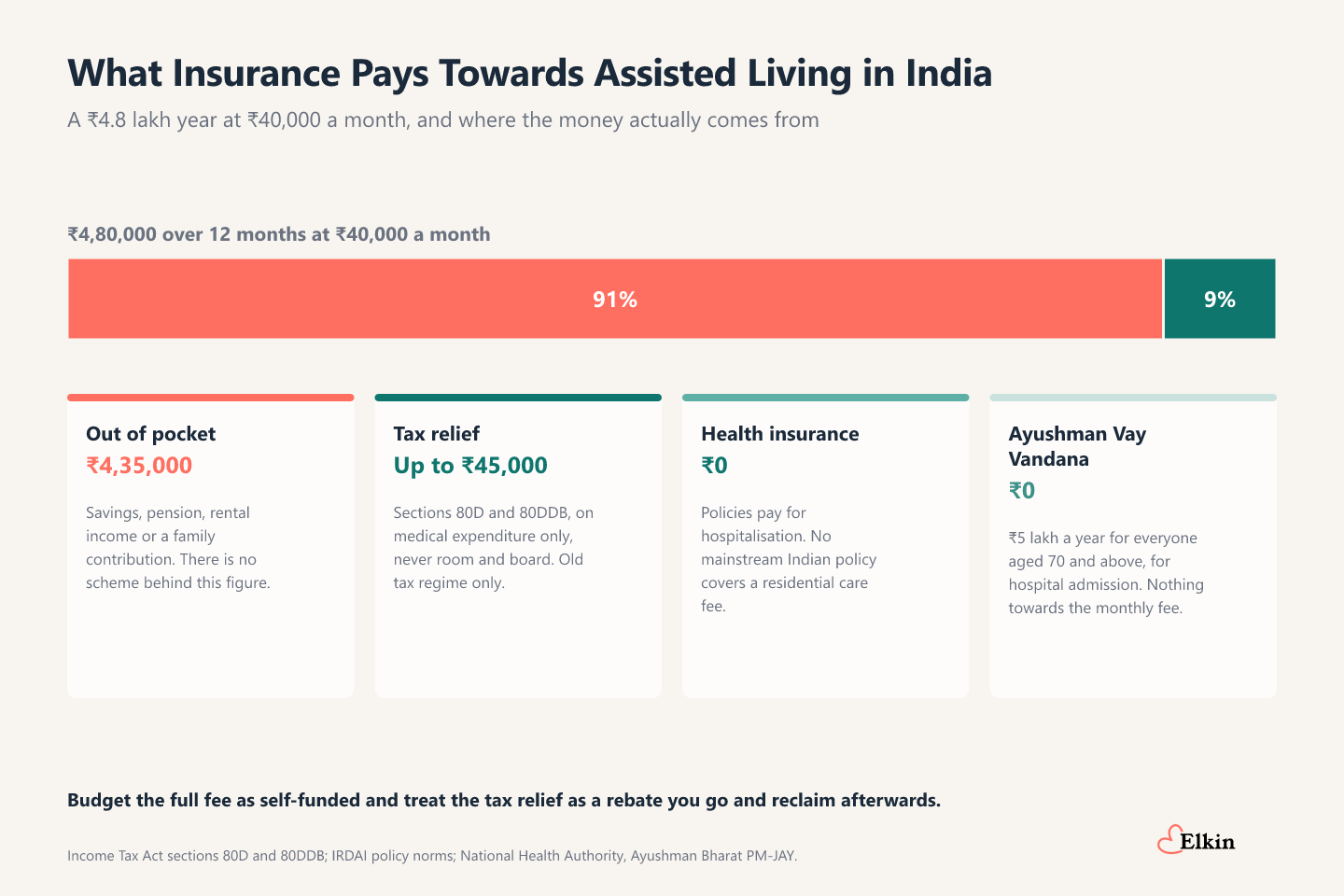
A ₹4.8 lakh year at ₹40,000 a month, and where the money actually comes from.
Why health insurance does not cover it
Not an oversight, and not a gap any insurer is about to close. Indian health insurance is built to reimburse hospitalisation, meaning treatment of a medical condition in a hospital. Assisted living is residential care: room, board, personal assistance and supervision. It is not treatment of a condition and it does not happen in a hospital.
So the fee sits outside the policy entirely. That remains true no matter how frail the resident is, how much nursing the home provides, or how many chronic conditions are being managed.
The same logic applies to old age homes and memory care. The broader funding picture is in who pays for old age homes in India.
What a senior's policy does reach
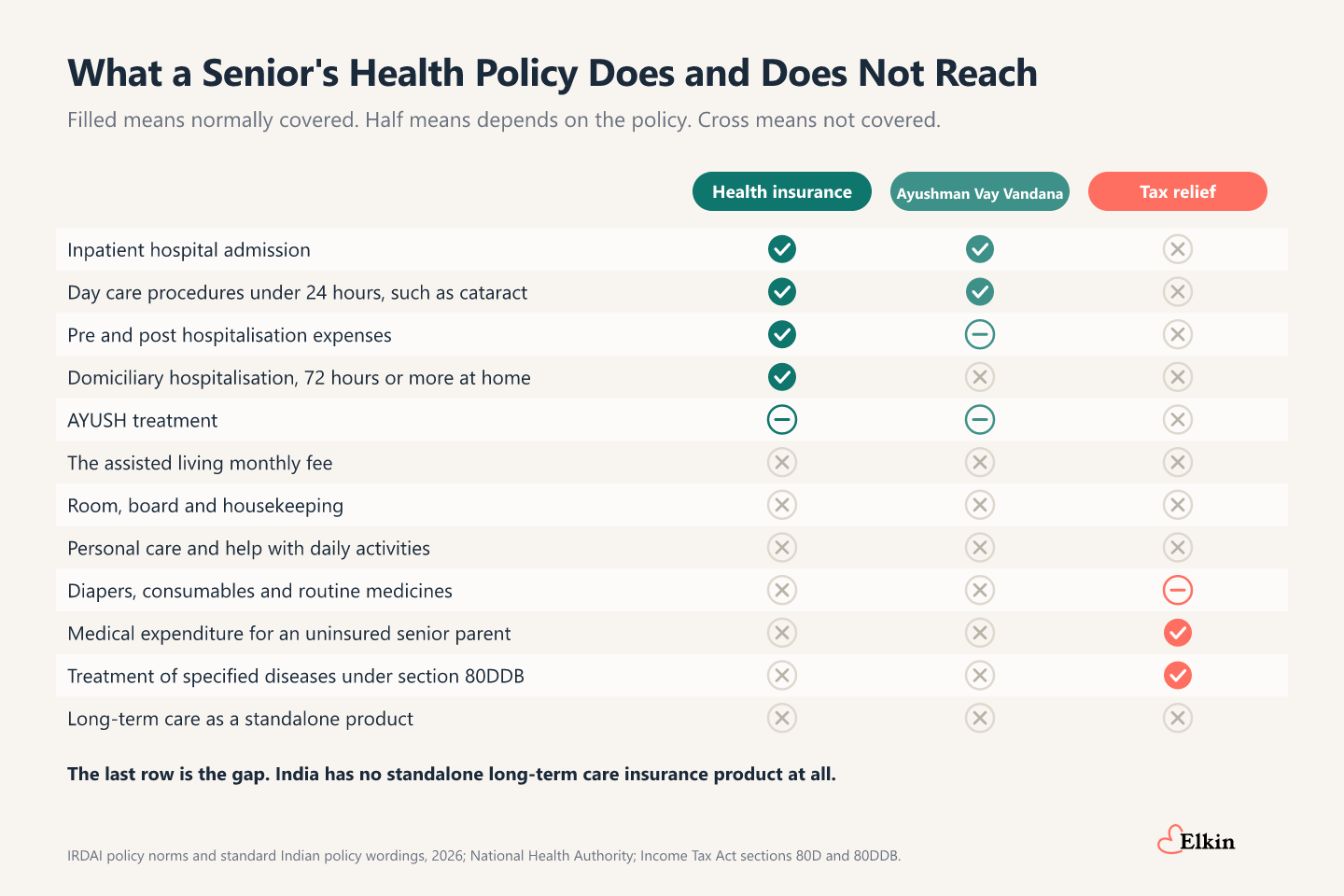
Filled means normally covered. Half means depends on the policy. Cross means not covered.
Worth knowing, because these are real costs that arrive alongside residential care.
Inpatient hospitalisation. Room, treatment, surgery and ICU during an admission. The core of the policy.
Day care procedures. Treatments needing under 24 hours of hospitalisation, cataract surgery being the standard example. Common in this age group and fully covered.
Pre and post hospitalisation. Usually 30 days before and 60 days after an admission, covering investigations, consultations and medicines connected to it.
Domiciliary hospitalisation. Hospital-level treatment delivered at home. This is the closest a policy comes to paying for care outside a hospital, and the conditions are strict: treatment must continue for at least 72 hours, and either the patient's condition must make transfer to a hospital unfeasible or no hospital bed or infrastructure must be available. AYUSH treatment is excluded from this benefit.
AYUSH treatment. Ayurveda, Yoga, Naturopathy, Unani, Siddha and Homoeopathy, covered under many senior plans, subject to policy terms.
What is never covered: the assisted living fee, room and board, housekeeping, personal care, and routine consumables such as diapers. Which of those sit in the base fee and which are billed on top is set out in what services are included in assisted living.
The 2024 changes that did help
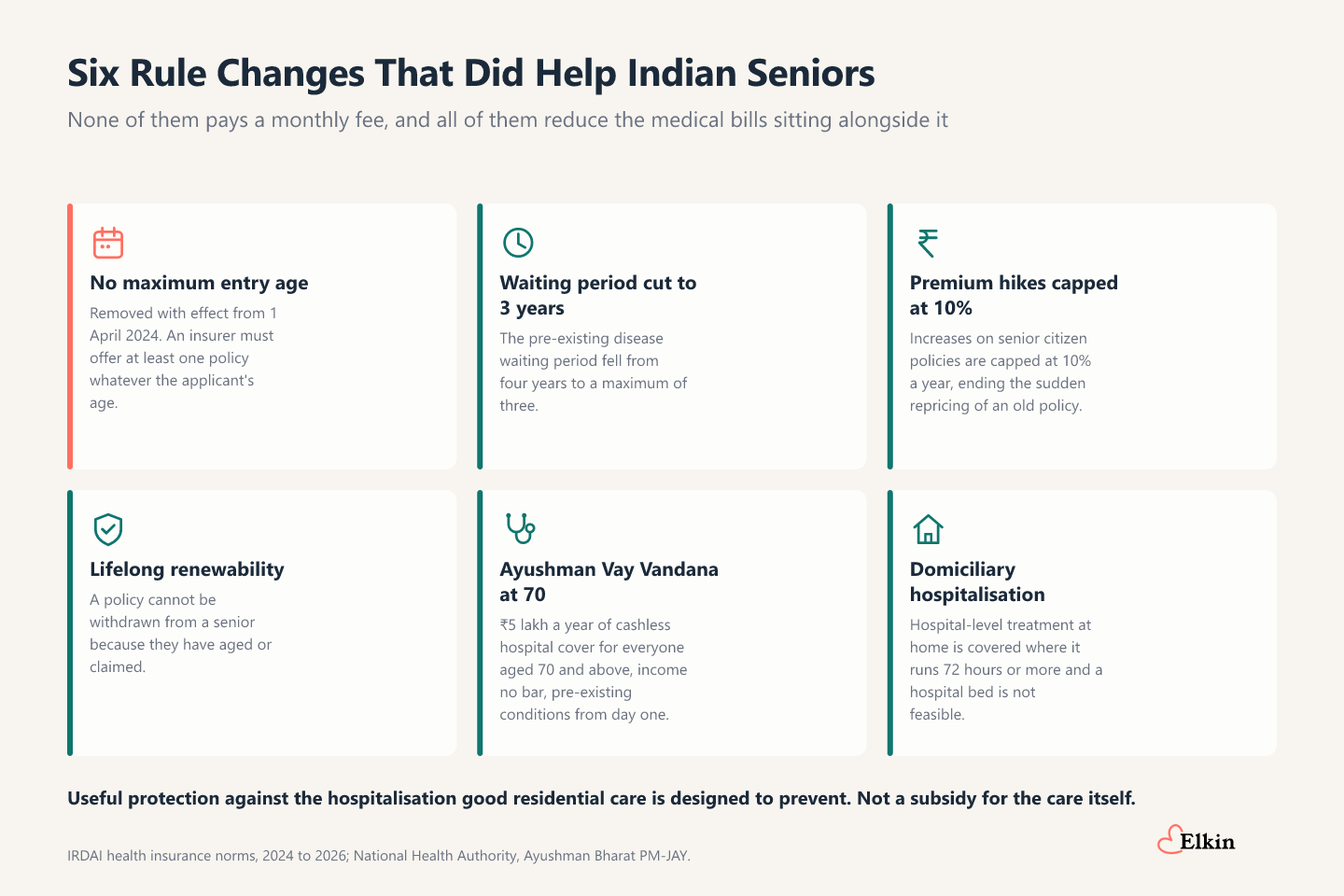
None of them pays a monthly fee.
IRDAI made senior health cover materially better, and it is worth reviewing an old policy against these:
- No maximum entry age. Removed with effect from 1 April 2024. An insurer must offer at least one policy whatever the applicant's age. Before this, a 68-year-old buying a first policy often had nowhere to go.
- Pre-existing disease waiting period cut from four years to a maximum of three.
- Premium increases on senior policies capped at 10% a year, ending the sudden repricing that used to force older policyholders out.
- Lifelong renewability. A policy cannot be withdrawn because a senior has aged or claimed.
- Ayushman Vay Vandana from 70. ₹5 lakh a year of cashless hospital cover for everyone aged 70 and above, no premium, no waiting period, pre-existing conditions from day one, income no bar.
- Domiciliary hospitalisation, on the 72-hour condition above.
- Every one of these reduces the medical bills that sit alongside residential care. None of them pays a rupee of the fee.
The three things families confuse with long-term care cover
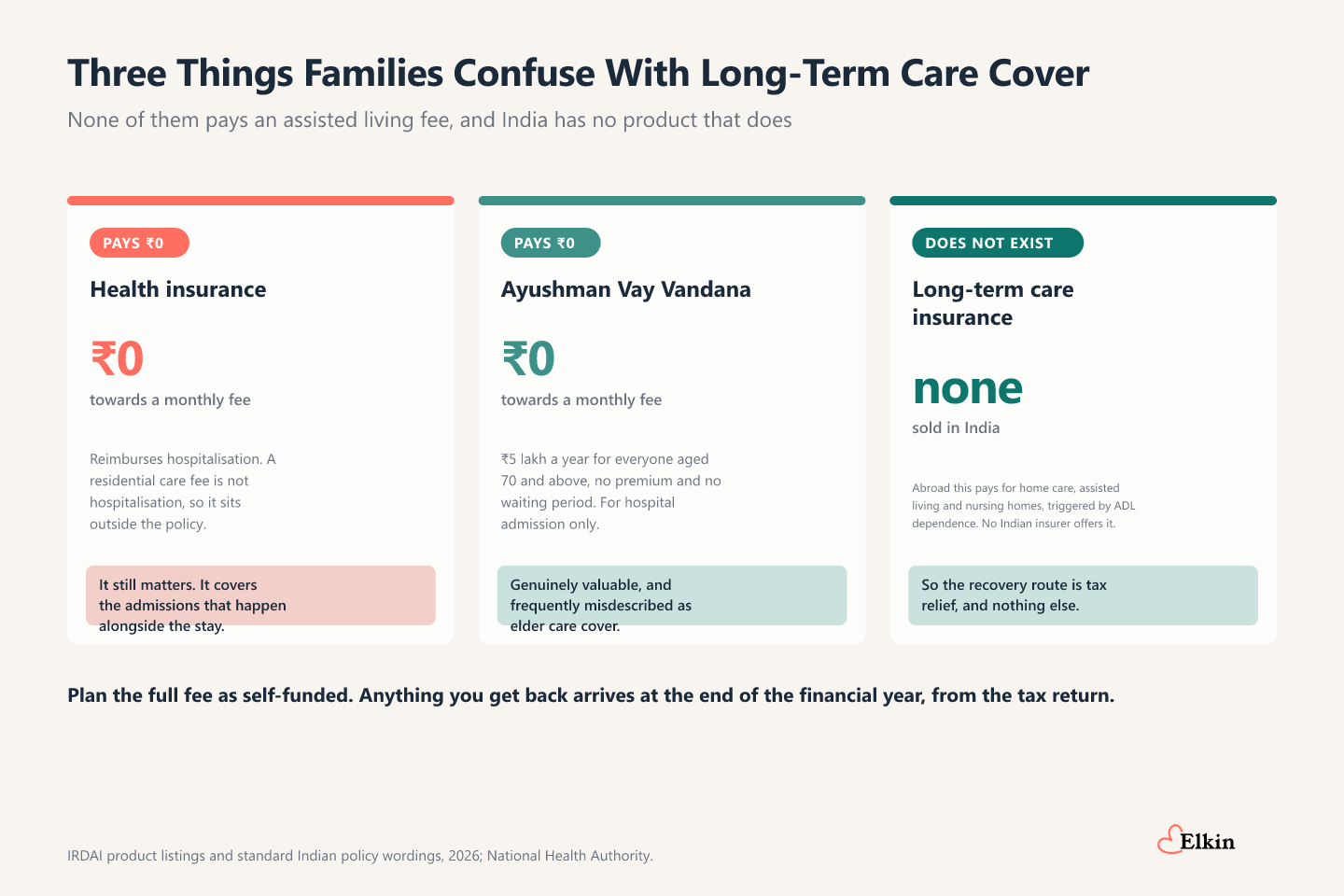
None of them pays an assisted living fee.
Health insurance. Reimburses hospitalisation. A residential care fee is not hospitalisation.
Ayushman Vay Vandana. Genuinely valuable and frequently misdescribed as elder care cover. It is hospital cover with a generous age rule.
Long-term care insurance. Abroad this is exactly the product families are looking for: it pays for home care, assisted living and nursing homes, triggered by an inability to perform activities of daily living. No Indian insurer offers it.
That absence is the whole story of senior care funding in India, and it is why almost the entire bill falls on families. It is also the strongest single argument in the honest ledger set out in the pros and cons of senior living.
The one route that does recover money
Tax relief, under the old regime only.
Section 80D allows up to ₹50,000 a year for a senior citizen parent. Where the parent has health insurance it covers the premium. Where the parent has no health insurance at all, it covers actual medical expenditure, which is the more useful case for a family paying assisted living fees.
Section 80DDB allows up to ₹1,00,000 a year for the treatment of specified diseases in a senior citizen, on a specialist's prescription. Several conditions common in high-dependency and memory care qualify.
Claimed in full at a 30% marginal rate, the two are worth around ₹45,000 a year in cash.
Four conditions that catch people out:
Old tax regime only. Neither deduction exists under the new regime. If your parent's care costs have jumped, redo the comparison, because the old regime may now be cheaper.
Medical expenditure only. Room, board and amenities are not deductible.
The home must bill medical items separately from day one. This is the decision that determines whether you recover anything at all, and it cannot be fixed retrospectively.
No cash payments for the 80D medical expenditure route, and keep every receipt.
The facility-fee question specifically is worked through in is assisted living tax deductible in India.
A worked example
A ₹40,000 a month assisted living place, over one year:
Item | Amount |
Annual fee, ₹40,000 x 12 | ₹4,80,000 |
Less: tax relief at a 30% marginal rate, both sections claimed in full | ₹45,000 |
Less: health insurance contribution | ₹0 |
Less: Ayushman Vay Vandana contribution | ₹0 |
Net cost to the family | ₹4,35,000 |
Plus, in year one only, an admission fee of ₹10,000 to ₹50,000 and a security deposit of ₹10,000 to ₹4,00,000. Full pricing is in how much assisted living costs in India, and the reason the bill rises over time is the care level charge explained in levels of care in assisted living.
What to actually do about it
Budget the full fee as self-funded. Treat tax relief as a rebate you go and reclaim in July, never as a discount you can plan around.
Ask the home to split medical billing from room and board before admission, and get it in writing. Everything else on this list is optional; this one is not.
Keep the parent's health policy running. It does not pay the fee and it does cover the hospital admissions that good residential care is designed to prevent but cannot always avoid.
Apply for the Ayushman Vay Vandana Card at 70. No premium, no waiting period, income no bar. There is no reason not to.
Review an older policy against the 2024 rules. No entry age cap, a three-year pre-existing waiting period and a 10% premium cap may make a switch or a top-up worthwhile.
Decide who claims before the first payment. Only the person whose name is on the payments can claim, and the limits apply per taxpayer.
Budget the annual increment of 8% to 12%. Over a five-year stay it compounds significantly.
Compare against care at home once round-the-clock nursing enters the picture. See how much in-home senior care costs in India.
The bottom line
Plan as though insurance does not exist for this expense, because for the fee itself it does not. Budget the full monthly amount from savings, pension and family contribution, add the 8% to 12% annual increment, and treat the roughly ₹45,000 of tax relief as money you go and reclaim afterwards.
Keep the health policy anyway. It will not pay the fee and it will pay for the hospital admission that arrives in year two, which is a bigger number than most families expect.
And do the one administrative thing that actually changes the outcome: get the home to bill medical items separately from room and board on day one. Families who skip it lose the deduction entirely, and there is no way to recover it in hindsight.
Working out the numbers? Elkin helps families across India compare verified assisted living communities by care level, city and budget.
Frequently asked questions
Does insurance cover assisted living in India?
No. No mainstream Indian health insurance policy covers an assisted living or residential care fee. Policies reimburse hospitalisation, and assisted living is not hospitalisation. India also has no standalone long-term care insurance product.
Does Ayushman Bharat cover assisted living?
No. The Ayushman Vay Vandana Card gives everyone aged 70 and above ₹5 lakh a year of cashless cover regardless of income, with no premium and no waiting period, but only for hospital admission and treatment. It contributes nothing towards a monthly assisted living fee.
Is there long-term care insurance in India?
No. Long-term care insurance, which abroad pays for home care, assisted living and nursing facilities when a person can no longer perform activities of daily living, is not sold as a standalone product by any Indian insurer.
What does health insurance cover for senior citizens in India?
Inpatient hospitalisation, day care procedures under 24 hours such as cataract surgery, pre and post hospitalisation expenses, domiciliary hospitalisation where treatment runs 72 hours or more at home and a hospital bed is not feasible, and AYUSH treatment under many senior plans. It does not cover residential care fees.
Can I claim tax relief on assisted living fees?
On the medical portion only, and only under the old tax regime. Section 80D allows up to ₹50,000 a year for an uninsured senior parent's medical expenditure and Section 80DDB up to ₹1,00,000 for specified diseases with a specialist's prescription. Together they are worth about ₹45,000 in cash at a 30% marginal rate. Room and board is not deductible.
What is domiciliary hospitalisation and does it cover home care?
It covers hospital-level treatment delivered at home, where treatment continues for at least 72 hours and either the patient cannot be moved to a hospital or no hospital bed or infrastructure is available. It is not general home care or attendant cover, and it excludes AYUSH treatment.
What changed for senior health insurance in India in 2024?
IRDAI removed the maximum entry age from 1 April 2024, cut the pre-existing disease waiting period from four years to a maximum of three, capped premium increases on senior policies at 10% a year, and confirmed lifelong renewability. Ayushman Vay Vandana was also extended to everyone aged 70 and above.
How much of an assisted living bill do families pay themselves?
Roughly 91% of a typical year. On a ₹4.8 lakh year, about ₹4,35,000 comes from savings, pension or a family contribution, with around ₹45,000 recoverable through tax relief and nothing from insurance or any government scheme.
Does insurance cover memory care or dementia care in India?
No. Memory care is residential care, so it sits outside health insurance in exactly the same way as assisted living. Section 80DDB may apply to the treatment of a specified disease with a specialist's prescription, and only to the medical portion of the bill.