

There is no eligibility test to pass. That is the single most important thing to understand before you read anything else on this question, because almost every article that ranks for it describes the American system, where a state-regulated assessment decides who qualifies.
India has no statutory eligibility criteria for assisted living. What exists instead is an operator deciding whether it can care for your parent safely. Age gets you considered. The care assessment decides it. Documents and payment finish it.
This guide sets out what Indian homes actually require, what gets an application refused, and how the process runs from enquiry to the first night.
Key takeaways
- No Indian law defines who qualifies for assisted living. Each operator sets its own criteria, because no licensing regime exists.
- The care assessment is the stage that decides it, not age and not paperwork.
- Minimum age is typically 60, and 55 at many private senior living communities. There is no maximum age anywhere.
- The five near-universal requirements are age, a medical fitness certificate, no active infectious disease, a named guarantor, and the ability to pay.
- Six things commonly cause a refusal, and none of them is age: advanced dementia without a secure unit, a need for skilled nursing, active infectious disease, unmanaged psychiatric illness, being fully bedridden on arrival, and having no next of kin.
- A refusal is usually honest. A home that admits a resident it cannot manage is the more dangerous outcome.
Quick answer: who qualifies for assisted living in India?
Someone qualifies when a home concludes it can meet their needs safely. In practice that means:
Requirement | Typical position at a private Indian home |
Minimum age | 60, or 55 at many senior living communities |
Maximum age | None |
Care need | One to three ADLs, up to whatever level the home is staffed for |
Medical fitness certificate | Required |
Free of infectious or communicable disease | Required |
Current medication list and recent investigations | Required |
The home's own care assessment | Required, and decisive |
Named guarantor or next of kin | Required at almost every home |
Ability to pay the monthly fee | Required |
Residency in that state | Not required |
Income or BPL certificate | Not required |
The last two rows are where private homes and government homes diverge completely, and applying to the wrong type is the commonest way families waste months.
Why the criteria you find online do not apply here
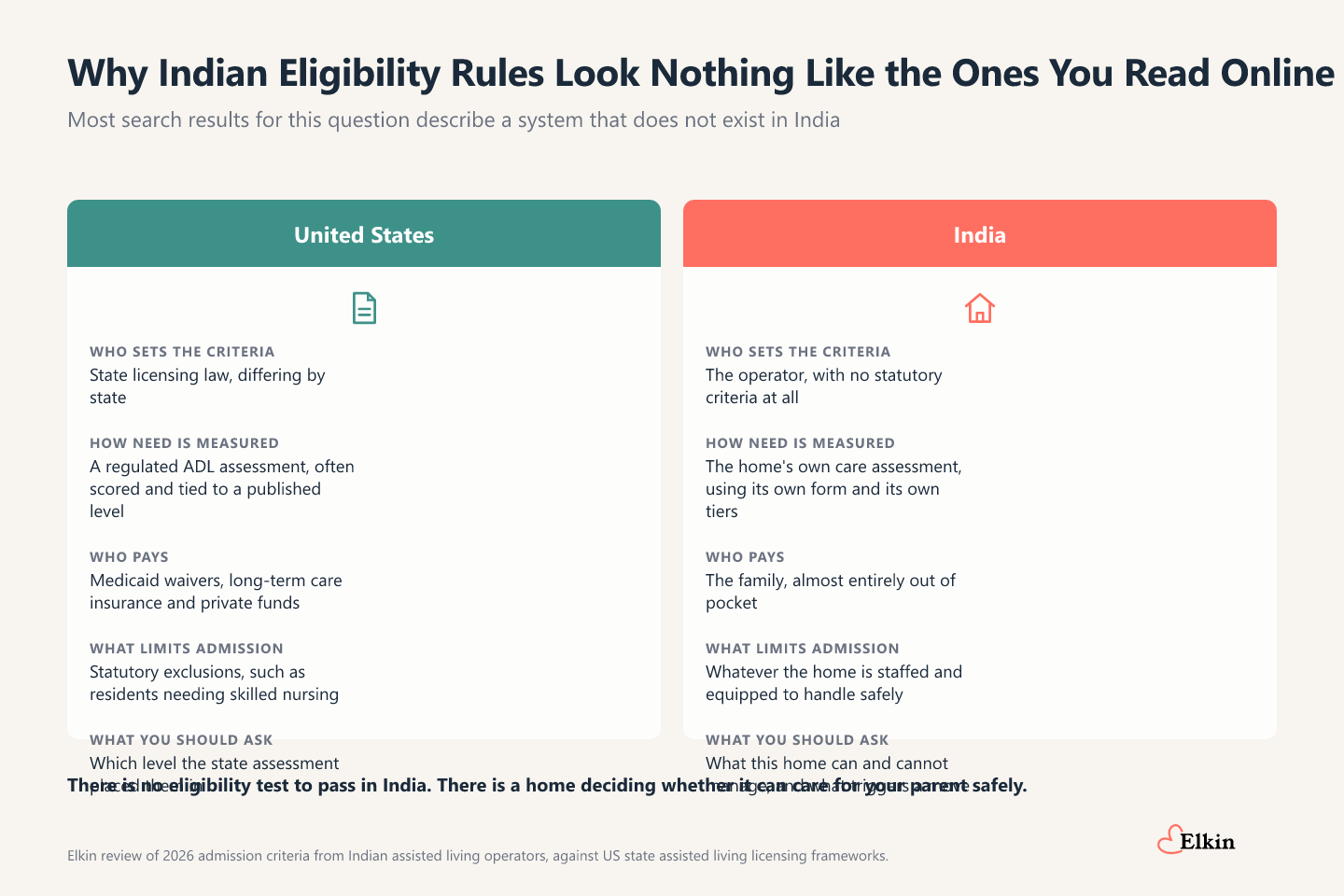
Most search results for this question describe a system that does not exist in India.
In the United States, assisted living is licensed state by state. A regulated ADL assessment produces a score, the score maps to a published level of care, and eligibility rules sit in statute. Medicaid waivers and long-term care insurance pay part of the bill.
- None of that exists in India. There is no licence, no statutory assessment, no published levels and no insurance route. What India has is:
- Minimum Standards for Senior Citizen Homes, issued by the Ministry of Social Justice and Empowerment in March 2024. A standards document, not a licence.
- Model Guidelines for Development and Regulation of Retirement Homes, issued by the Ministry of Housing and Urban Affairs in March 2019. Model guidelines for states to adopt.
- A voluntary accreditation matrix run by ASLI with Standards Wise International India and The Commonwealth Association for Ageing, launched in December 2020. Elkin is a primary member of ASLI.
- The Maintenance and Welfare of Parents and Senior Citizens Act, 2007, which gives seniors rights but licenses nothing.
Standards, guidelines and voluntary accreditation. No licence, and therefore no eligibility rule to satisfy. The practical consequence is that the same senior can be accepted at one home and declined at another, and both decisions can be correct, because the two homes are staffed differently.
The five requirements almost every home shares
1. Age. Minimum 60 at most homes, 55 at many private senior living communities. Set by the operator, since the Maintenance and Welfare of Parents and Senior Citizens Act, 2007 definition of a senior citizen binds government homes rather than private ones. No maximum age exists anywhere. The full picture by type of home is in the old age home admission age limit.
2. A medical fitness certificate, usually from a treating doctor and usually within the last 30 days, with recent investigations and a current medication list.
3. Freedom from active infectious or communicable disease. Tuberculosis is the specific screen most Indian homes name. This appears on essentially every exclusion list.
4. A named guarantor or next of kin who signs the agreement, can be reached in an emergency, and is responsible for the fee. Homes with no family available do exist, but they are charitable or government homes rather than private assisted living.
5. Ability to pay. Private assisted living is a commercial arrangement with no subsidy. Almost the whole bill is out of pocket, as set out in who pays for old age homes in India.
The care assessment: the stage that actually decides it
This is where eligibility is really determined, and most families do not realise it is happening.
The home assesses, usually in person and usually in a single visit:
ADLs, the six activities of daily living, and how many need another person's hands
Mobility, including transfers, walking aids and fall history
Cognition, including memory, orientation, wandering risk and behavioural symptoms
Continence, which materially changes the staffing required
Medication complexity, injections, and any clinical procedures
Comorbidities, particularly Parkinson's, stroke, COPD and neurodegenerative conditions
The output should be a care level and a written care plan. Ask for both. Ask specifically what the assigned level includes, what it costs, and what would move your parent to the next one, because that is what drives the fee later. The levels themselves are explained in levels of care in assisted living.
If a home offers you a place without assessing your parent, that is a warning sign rather than a convenience. How to count the ADLs yourself before that visit is in who needs assisted living.
Six reasons a home says no
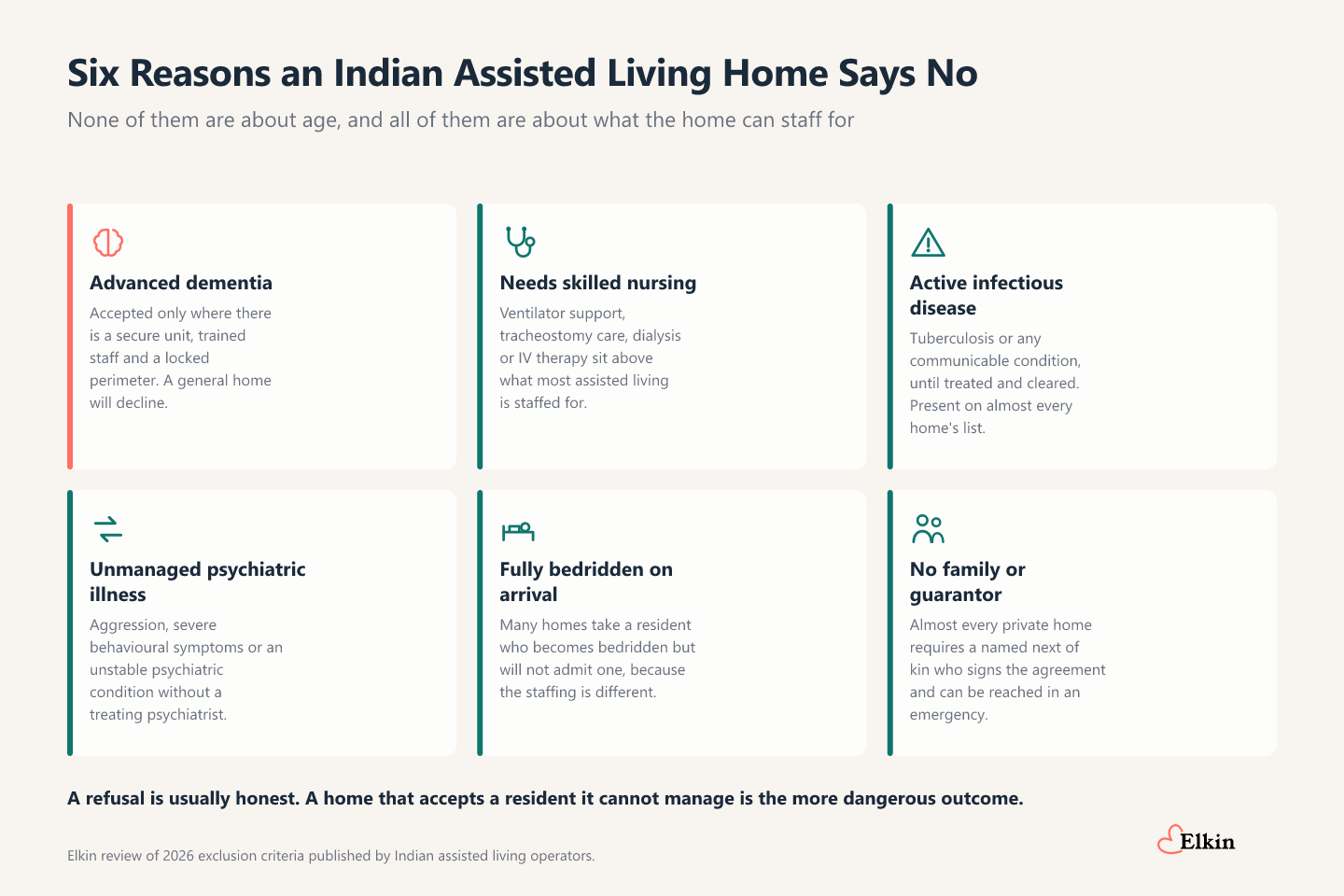
None of them are about age.
Advanced dementia. Accepted only where there is a secure unit, a locked perimeter and trained staff. A general assisted living home will decline, and should. This belongs in memory care.
A need for skilled nursing. Ventilator support, tracheostomy care, dialysis, IV therapy or complex wound care sit above what most assisted living is staffed for. See assisted living vs nursing home.
Active infectious disease. Tuberculosis or any communicable condition, until treated and cleared.
Unmanaged psychiatric illness. Aggression, severe behavioural symptoms or an unstable psychiatric condition with no treating psychiatrist. Homes with a psychiatric tie-up sometimes accept where there is an active treatment plan.
Fully bedridden on arrival. Many homes will keep a resident who becomes bedridden, with a turning schedule to prevent bed sores as the 2024 minimum standards require, but will not admit one, because the staffing model is different.
No family or guarantor. Almost every private home requires a named next of kin. Where there genuinely is none, government and charitable homes are the route, through the District Social Welfare Office.
A refusal is generally an honest answer. The homes to worry about are the ones that accept everybody.
What each type of home asks you to produce
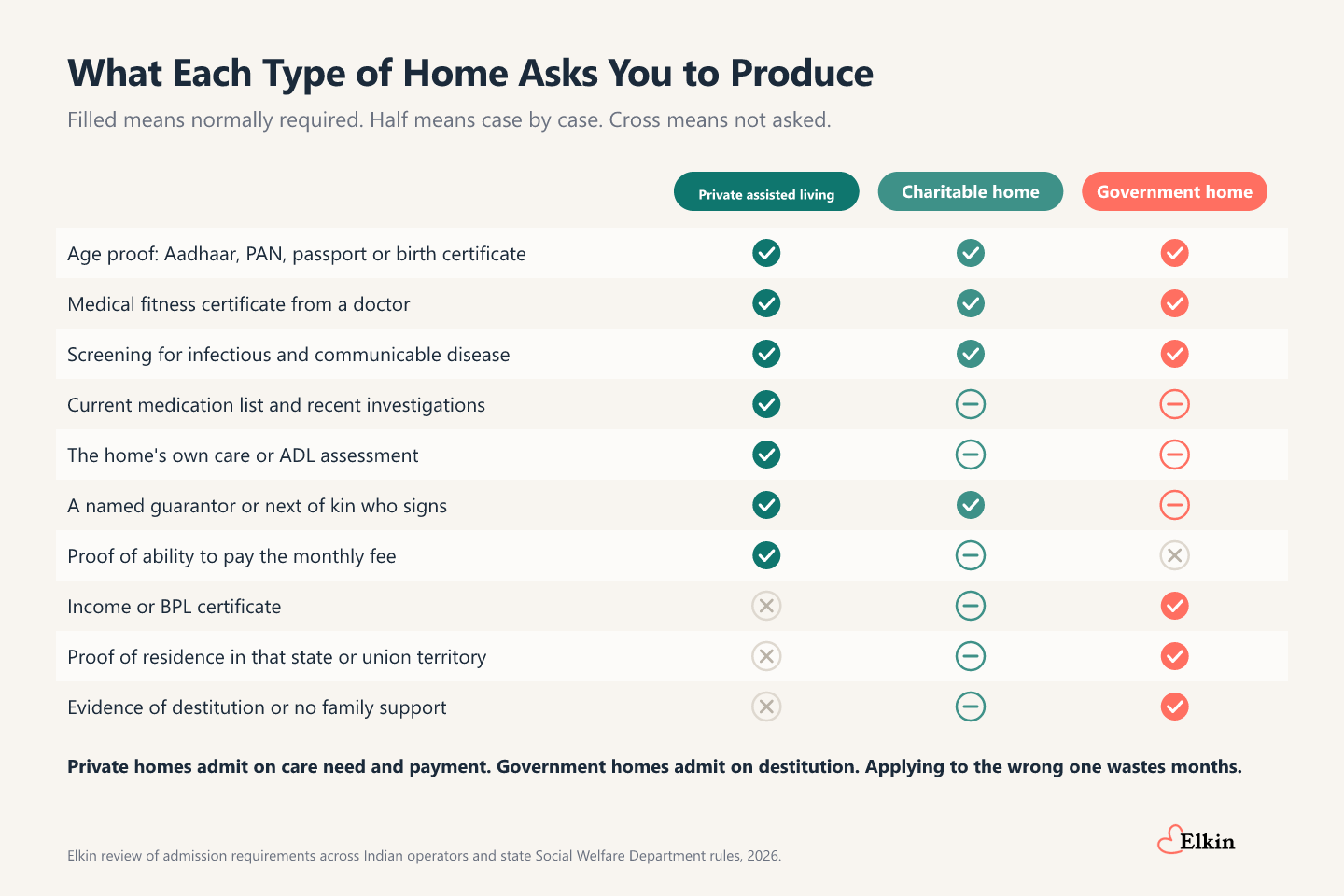
Filled means normally required. Half means case by case. Cross means not asked.
Bring originals plus two sets of photocopies of everything below.
Always:
- Age proof: Aadhaar, PAN, passport, birth certificate, voter ID or a pension payment order
- Photographs of the senior
- Medical fitness certificate from a doctor
- Screening for infectious and communicable disease
- Current medication list and recent investigation reports
At private assisted living homes, additionally:
- The home's own care or ADL assessment
- Identity and address proof of the guarantor or next of kin
- The signed agreement, admission fee and security deposit
At government and charitable homes, additionally:
- Income or BPL certificate, which is usually the document that decides eligibility
- Proof of residence in that state or union territory
- Evidence of destitution or of having nobody able to support them
The pattern is simple. Private homes admit on care need and payment. Government homes admit on destitution. Applying to the wrong one wastes months. The government route is set out step by step in how to get admission in an old age home in India, and the wider criteria in old age home eligibility.
The admission process, stage by stage
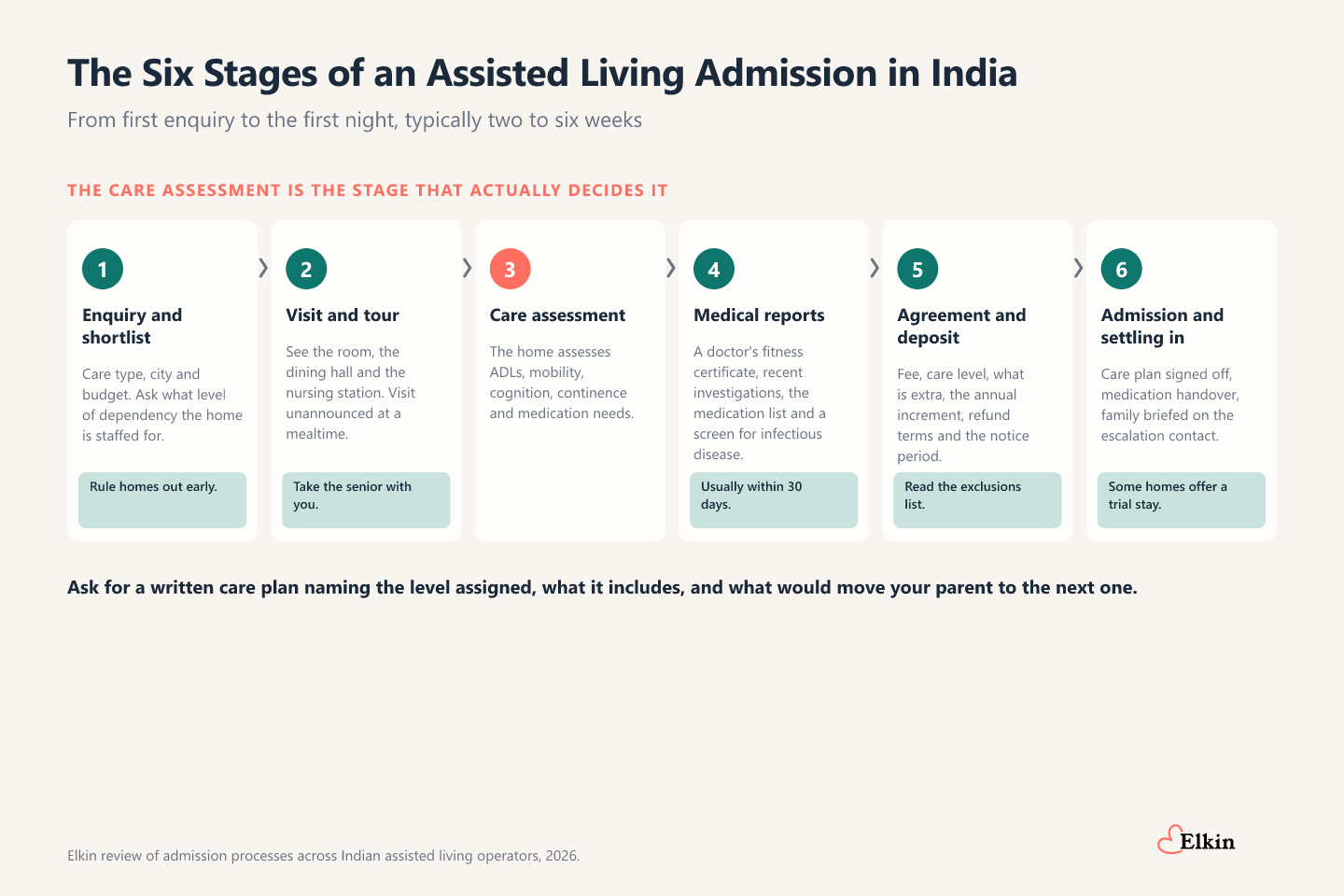
From first enquiry to the first night, typically two to six weeks.
1. Enquiry and shortlist. Care type, city and budget. Ask what level of dependency each home is staffed for and rule homes out early rather than late.
2. Visit and tour. See the room, the dining hall and the nursing station. Visit unannounced at a mealtime as well as on the scheduled tour, and take the senior with you.
3. Care assessment. The stage that decides the application, and the one to prepare for.
4. Medical reports. Fitness certificate, recent investigations, medication list, infectious disease screen. Usually required within 30 days.
5. Agreement and deposit. Fee, assigned care level, what is billed extra, the annual increment, refund terms and the notice period. Read the exclusions list, not the brochure.
6. Admission and settling in. Care plan signed off, medication handed over with the register started, and the family briefed on the named escalation contact. Some homes offer a trial stay of two to four weeks, and it is worth asking for one.
Two to six weeks is normal. Start before you need to, because a crisis admission means taking whatever has a bed.
Eligibility at government and charitable homes
Completely different criteria, because these are welfare provisions rather than commercial ones.
Government homes admit destitute seniors aged 60 and above who are residents of that state or union territory, have nobody able to support them, and are free of infectious disease. Delhi, for example, runs a means test rather than a flat fee: seniors with an annual income above ₹12,000 pay a nominal ₹500 a month, and those below it pay nothing. Maharashtra admits women from 55 and men from 60.
Charitable and trust homes mostly follow government criteria voluntarily, since many receive grant-in-aid under the Integrated Programme for Senior Citizens, part of Atal Vayo Abhyuday Yojana.
Neither route is available to a family that can afford to pay, and both carry waiting lists.
Eleven questions to ask the home
What is your minimum age, and do you have a maximum?
What level of dependency are you staffed for, and where does that stop?
Do you assess in person, and can I see the written care plan?
What care level would my parent be placed in, and what does it cost?
What triggers a move to the next level, and how much notice do I get?
What is your exclusion list?
Do you accept a resident who later becomes bedridden?
Do you accept a resident who later develops dementia?
How many trained staff are on the floor at 2am?
What documents do you require, and how recent must the medical reports be?
Do you offer a trial stay?
Question 7 and question 8 matter more than families expect. A home that will not hold your parent as needs progress means a second move, at the worst possible time.
The bottom line
Stop thinking of this as a test your parent has to pass. There is no national standard to meet, because India has no licence for assisted living, only standards and voluntary accreditation.
What there is, at every home, is a care assessment. Prepare for it: count the ADLs honestly, bring the medication list and the recent reports, and be straight about cognition and continence. Understating need to get an admission is the commonest mistake families make, and it produces a placement that fails within months.
Then ask the two questions that decide whether you will be doing this again in a year: will you keep my parent if they become bedridden, and will you keep them if they develop dementia.
Ready to shortlist? Elkin verifies care levels, staffing and registration before listing, so you can compare assisted living communities across India by care level, city and budget.
Frequently asked questions
What are the eligibility criteria for assisted living in India?
There are no statutory criteria. Each operator sets its own. In practice almost every private home requires a minimum age of 60, or 55 at many senior living communities, a medical fitness certificate, freedom from active infectious disease, a current medication list, a named guarantor, the ability to pay, and a pass in the home's own care assessment.
Who qualifies for assisted living?
Someone who needs hands-on help with one to three activities of daily living but does not need skilled nursing, whose needs the home is staffed to meet, who has a named next of kin, and who can pay the fee. The care assessment, not age or paperwork, is what actually decides it.
Is there an age limit for assisted living in India?
The minimum is usually 60, and 55 at many private senior living communities, which set their own floor because no statute binds them. There is no maximum age anywhere. What limits an older applicant is whether the home can meet their care needs.
What documents are required for assisted living admission in India?
Age proof such as Aadhaar or a passport, photographs, a medical fitness certificate, a screen for infectious disease, a current medication list and recent investigations, plus identity and address proof of the guarantor. Government homes additionally require an income or BPL certificate and proof of state residence.
Why would an assisted living home reject an application?
Advanced dementia without a secure unit, a need for skilled nursing such as ventilator or dialysis care, active infectious disease, unmanaged psychiatric illness, being fully bedridden on arrival, or having no next of kin to sign and be contactable. None of these is about age.
Can someone with dementia be admitted to assisted living in India?
Early-stage dementia, often yes. Advanced dementia, only where the home runs a secure memory care unit with a locked perimeter and trained staff. A general assisted living home will usually decline, and that refusal is the safer outcome.
Does insurance or the government decide eligibility for assisted living in India?
No. No Indian health policy covers residential care fees, Ayushman Vay Vandana pays nothing towards a monthly fee, and no government scheme funds an individual resident in a private home. Eligibility is decided entirely by the operator.
How long does assisted living admission take in India?
Two to six weeks from first enquiry to the first night, covering shortlisting, visits, the care assessment, medical reports and the agreement. Start before you need to, because a crisis admission usually means taking whatever has a bed rather than choosing.
What is the difference between assisted living eligibility and old age home eligibility?
Private assisted living admits on care need and ability to pay. Government old age homes admit on destitution, requiring an income or BPL certificate, proof of state residence and evidence that nobody can support the applicant. The two routes share only the age threshold and the medical screening.