

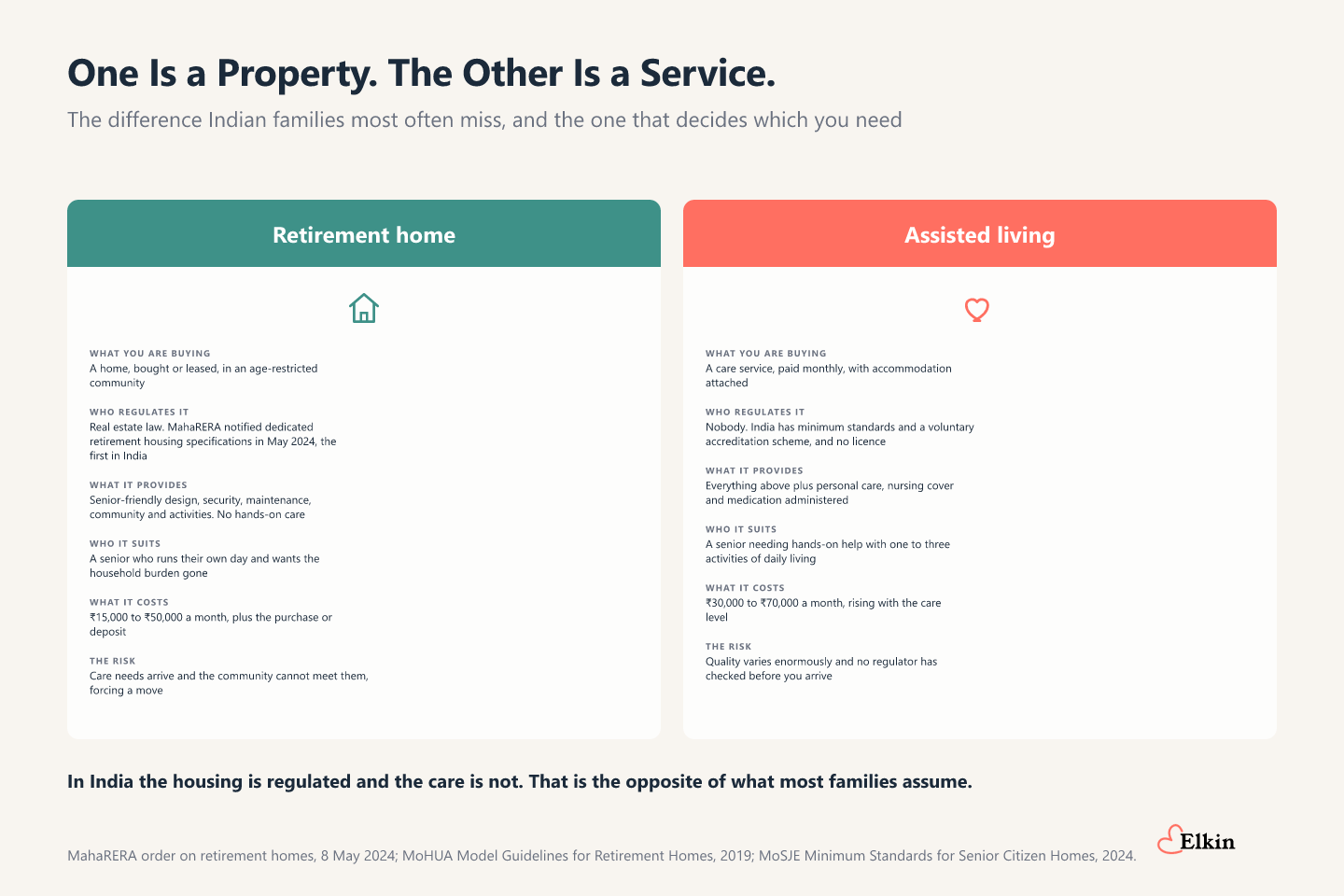
A retirement home is a property. Assisted living is a service. Everything else follows from that.
You buy or lease a retirement home and get senior-friendly design, security, maintenance and community. You pay monthly for assisted living and get all of that plus hands-on help with bathing, dressing and mobility, nursing cover, and medication administered rather than reminded.
There is a second difference nobody writes about, and in India it matters more than the amenities. The property is regulated. The care is not. In May 2024 MahaRERA became the first regulator in the country to notify mandatory specifications for retirement housing. No regulator anywhere in India licenses assisted living.
Key takeaways
- Retirement home means housing. Age-restricted, senior-friendly, no personal care.
- Assisted living means care, delivered monthly, with accommodation attached.
- The line between them is personal care: hands-on help with the activities of daily living.
- MahaRERA notified mandatory retirement housing specifications on 8 May 2024, the first Indian regulator to do so. Assisted living has standards and voluntary accreditation, and no licence.
- ₹15,000 to ₹50,000 a month for a retirement home, plus a purchase price or deposit. ₹30,000 to ₹70,000 for assisted living.
- The labels carry no legal meaning in India. Ask what a place provides, not what it calls itself.
- The real risk with a retirement home is care needs arriving and forcing a second move.
Quick answer: what is the difference?
Retirement home | Assisted living | |
What you are buying | A home, bought or leased, in an age-restricted community | A care service, paid monthly, with accommodation attached |
Who regulates it | Real estate law. MahaRERA notified dedicated specifications in May 2024 | Nobody. Standards and voluntary accreditation, no licence |
Personal care | None | Help with one to three activities of daily living |
Nursing | Sometimes on call | On site |
Medication | The resident manages it | Administered and recorded by staff |
Meals | Sometimes optional | Included, adjusted for medical diets |
Monthly cost | ₹15,000 to ₹50,000 | ₹30,000 to ₹70,000 |
Up front | A purchase price, or a deposit of ₹10 lakh to ₹50 lakh at premium communities | Admission fee ₹10,000 to ₹50,000, deposit ₹10,000 to ₹4,00,000 |
Who it suits | A senior who runs their own day | A senior who needs hands-on daily help |
The risk | Care needs arrive and the community cannot meet them | Quality varies and no regulator has checked |
The difference Indian families most often miss.
The one thing that actually separates them
Personal care. Hands-on help with the six activities of daily living: bathing, dressing, toileting, transferring, continence and feeding.
A retirement home will give your parent a beautiful accessible flat, a security guard, a garden, a yoga class and neighbours their own age. It will not help them into the shower.
That is the entire distinction, and every other difference in the table above descends from it. Higher staffing, nursing cover, medication administration and a higher fee all exist because somebody has to physically assist a resident every day.
If you are unsure which side of the line your parent falls on, count the ADLs using who needs assisted living. Zero ADLs points to a retirement home. One to three points to assisted living.
Six words that get used interchangeably and should not
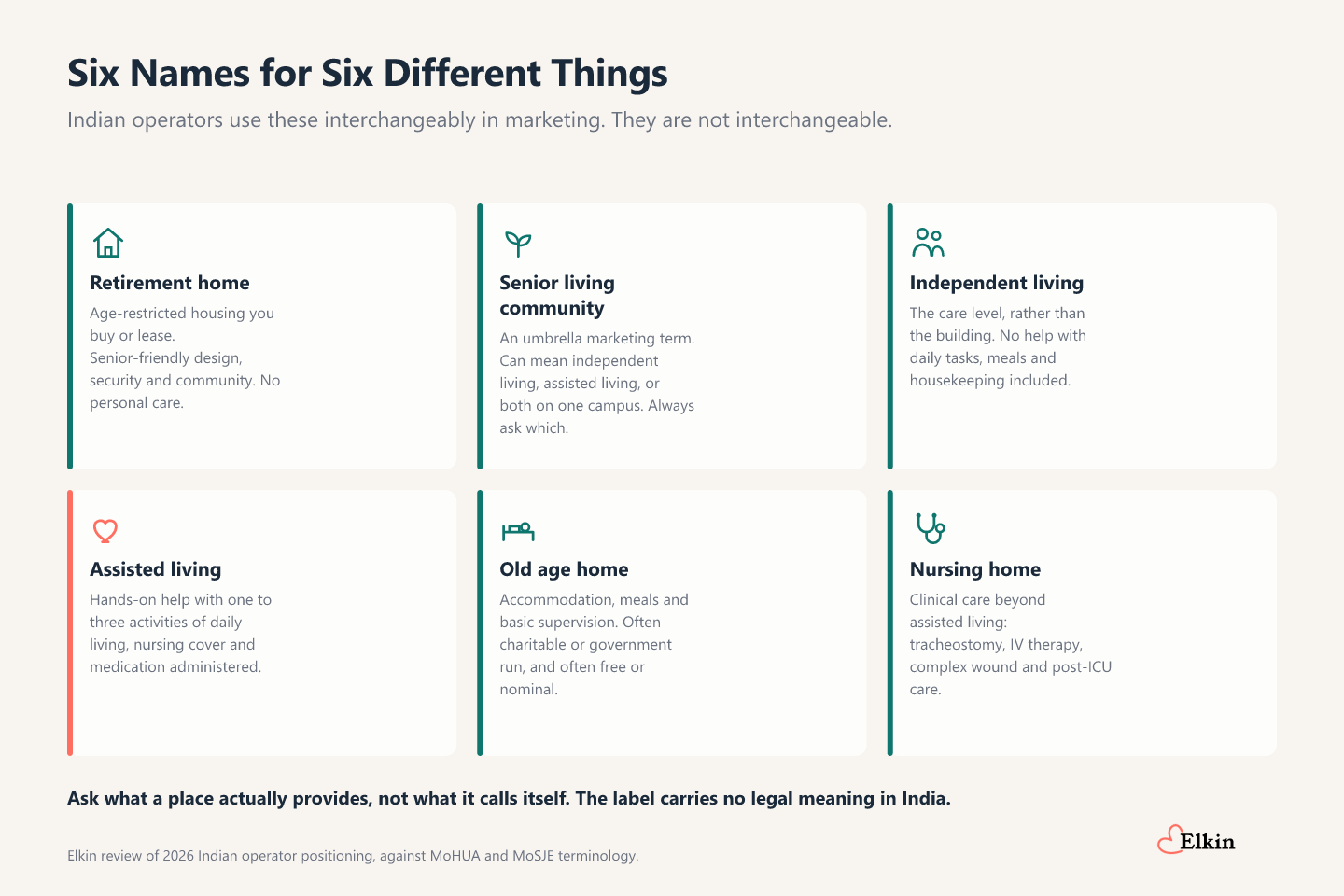
Indian operators use these interchangeably in marketing. They are not interchangeable.
Retirement home. Age-restricted housing you buy or lease. Senior-friendly design, security, maintenance and community. No personal care.
Senior living community. An umbrella marketing term. It can mean independent living, assisted living, or both on one campus. Always ask which.
Independent living. A care level, not a building. No help with daily tasks, with meals and housekeeping usually included. In practice, a retirement home and independent living describe much the same thing from two directions: one names the property, the other names the care level.
Assisted living. Hands-on help with one to three ADLs, nursing cover, medication administered.
Old age home. Accommodation, meals and basic supervision. Often charitable or government run, and often free or nominal. The comparison is in assisted living vs old age home.
Nursing home. Clinical care beyond assisted living: tracheostomy, IV therapy, complex wound and post-ICU care. See assisted living vs nursing home.
None of these labels carries legal meaning in India. A community may call itself any of them. Ask what it actually provides.
The regulation difference, which is the opposite of what you would expect
This is the part that surprises families, and it is genuinely useful when comparing two places.
Retirement homes are regulated as real estate
On 8 May 2024, following a draft in February, the Maharashtra Real Estate Regulatory Authority became the first regulator in India to notify dedicated specifications for retirement housing. They are mandatory before a project may be advertised or marketed as a retirement home, and they include:
Lifts in every building above one floor, sized for wheelchair users, with audio and visual signage
No steps in corridors, with ramps wherever the level changes
Treads and risers to the harmonised guidelines for senior citizens
Ergonomic senior-friendly furniture in lightweight, sturdy, smooth-edged materials
Easy-grip door knobs and lever-type handles
Alarm switches at main entry doors, in bedrooms, in common areas and separately in bathrooms
CCTV on every floor, in common areas and at gates, with security at ground-floor entry and exit
Power backup in each apartment, with a mandatory connection in the bathroom and kitchen
Lighting and ventilation compliant with MBBL and NBC standards
Fire-fighting and evacuation preparedness, and emergency contact numbers displayed near lifts
Behind it sits the Ministry of Housing and Urban Affairs Model Guidelines for Development and Regulation of Retirement Homes, issued 6 March 2019, which introduced the tripartite agreement between developer, service provider or operator, and allottee. That agreement is the document to read, because it is where the ongoing service obligations live long after the builder has gone.
Assisted living is not regulated at all
There is no licence for assisted living anywhere in India. What exists is:
Minimum Standards for Senior Citizen Homes, Ministry of Social Justice and Empowerment, March 2024. Benchmarks with checkable numbers, and no inspectorate.
A voluntary accreditation matrix run by ASLI with Standards Wise International India and The Commonwealth Association for Ageing, which Elkin joined as a primary member.
So in India the housing is regulated and the care is not. When you buy into a retirement home in Maharashtra there is a regulator behind the building. When you pay for assisted living anywhere, there is nobody behind the care, and the checking is yours. The method is in are old age homes safe in India.
What each one actually provides
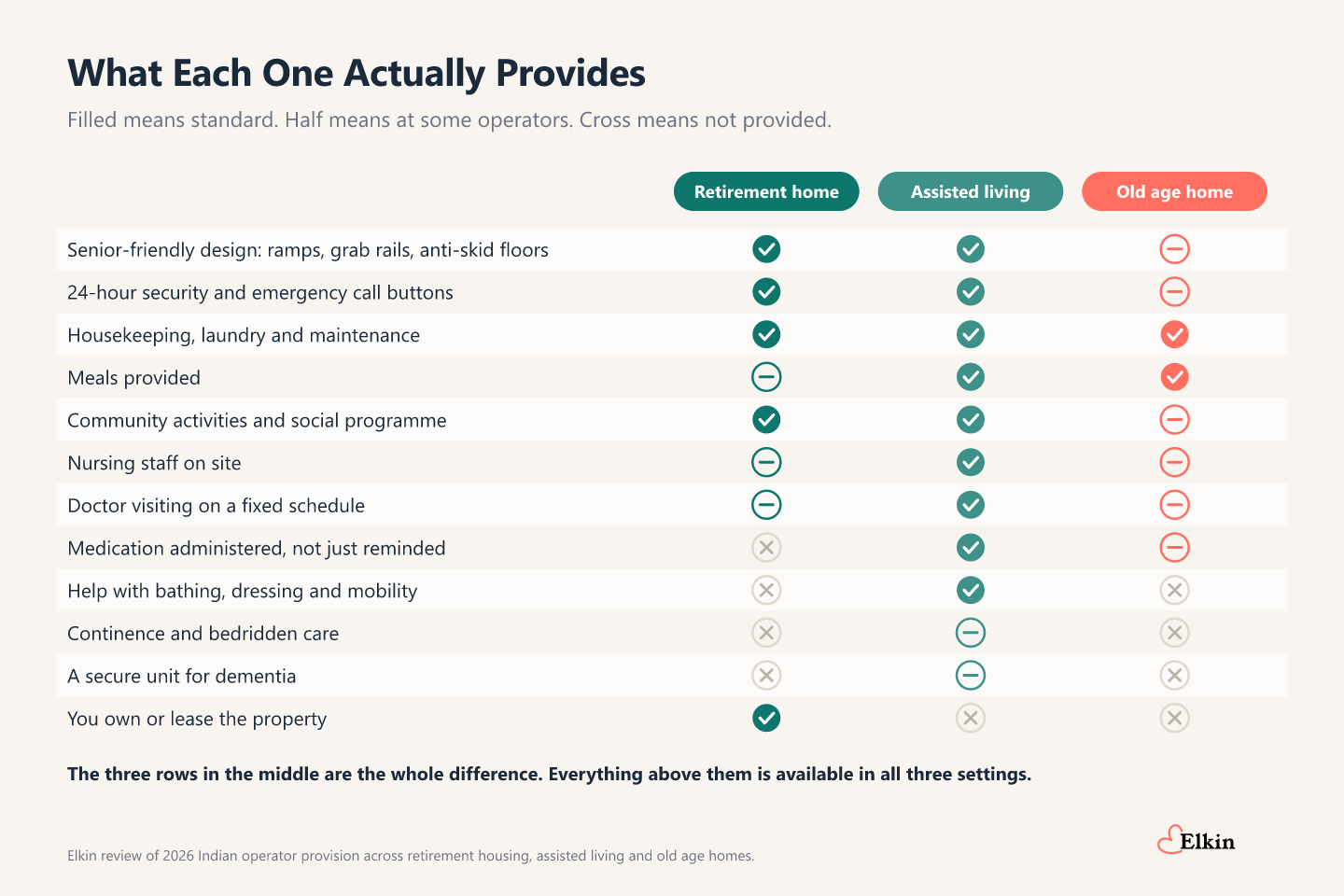
Filled means standard. Half means at some operators. Cross means not provided.
Look at the middle of that table. Senior-friendly design, security, housekeeping, meals and community activities are available in all three settings. So are nursing staff and a visiting doctor, at some operators.
Three rows are the whole difference:
- Medication administered rather than just reminded
- Help with bathing, dressing and mobility
- Continence and bedridden care
If your parent needs none of the three, you are paying an assisted living premium for services a retirement home already provides.
What each one costs
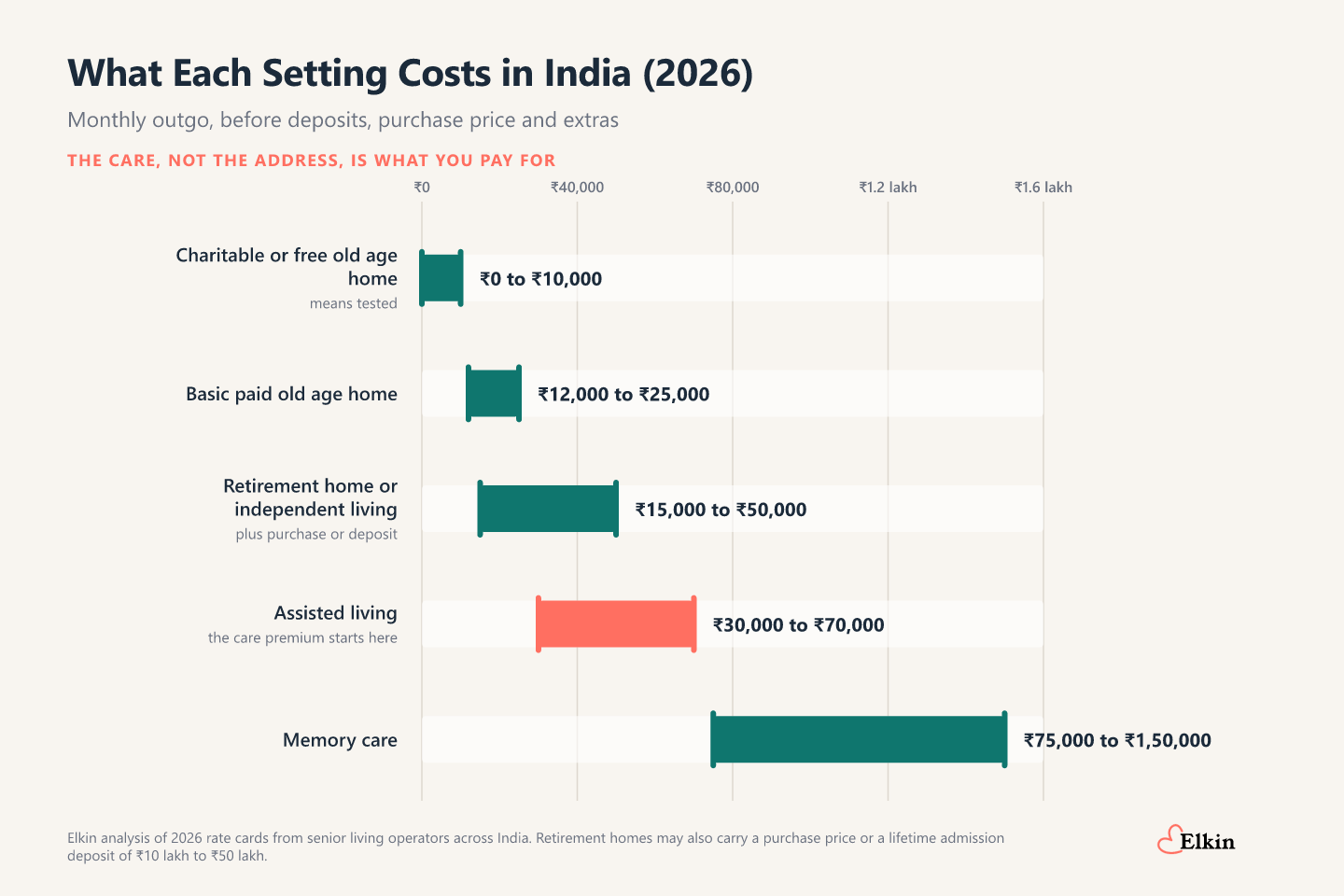
Monthly outgo, before deposits, purchase price and extras.
Setting | Monthly |
Charitable or free old age home | ₹0 to ₹10,000, means tested |
Basic paid old age home | ₹12,000 to ₹25,000 |
Retirement home or independent living | ₹15,000 to ₹50,000 |
Assisted living | ₹30,000 to ₹70,000 |
Memory care | ₹75,000 to ₹1,50,000 |
Two things the monthly figure hides.
A retirement home may carry a purchase price. You are buying or leasing property, and the monthly figure is maintenance and services on top. Premium communities often replace this with a lifetime admission deposit of ₹10 lakh to ₹50 lakh, typically around 60% refundable. Read the refund clause before anything else.
Assisted living has layers. Base stay is 60% to 75% of the bill, care level charges 10% to 30%, and add-ons the rest. A ₹45,000 quoted place commonly runs at ₹65,000 to ₹75,000. The breakdown is in what services are included in assisted living, and full pricing in how much assisted living costs in India.
The risk that decides this for most families
A retirement home is bought for the person your parent is today. Assisted living is paid for the person they are today.
That asymmetry is the whole risk. Buy into an age-restricted community at 62, and at 74 the care needs arrive. If the community has no assisted living on campus, you are selling a property and moving a frailer parent at exactly the moment a move is hardest.
The question to ask before any purchase: does this community offer assisted living on the same campus, and under what terms would my parent transfer into it?
Communities that run the full continuum, from independent living through assisted living to high dependency and sometimes memory care, cost more and avoid a second move. Those that stop at independent living are cheaper and carry that risk. The ladder is set out in levels of care in assisted living.
Which one should you choose?
Choose a retirement home when your parent manages every daily task, wants company and security rather than care, wants the burden of running a household gone, and either the community offers assisted living on campus or you accept the risk of a later move.
Choose assisted living when your parent needs hands-on help with one to three ADLs, medication is being missed or doubled, there has been a fall, or a family caregiver is running out of capacity.
Choose neither when the need is skilled nursing, or advanced dementia at a home with no secure unit. See assisted living for dementia patients.
Whichever you pick, note that no Indian health policy covers either, and the position is explained in does insurance cover assisted living in India.
The bottom line
Strip away the marketing and the question is simple: does your parent need someone to physically help them every day?
If not, a retirement home gives them a better life for less money, and there is at least one regulator standing behind the building. If yes, a retirement home cannot do it and no amount of amenity will change that.
Then ask the question that saves families a second move: which of these can this community do, and what happens when my parent needs the other one? A campus that runs both is worth paying for. One that runs only the first is worth entering with your eyes open.
Comparing both? Elkin verifies care levels, staffing and registration before listing, so you can compare retirement communities and assisted living across India by care type, city and budget.
Frequently asked questions
What is the difference between assisted living and a retirement home?
A retirement home is age-restricted housing you buy or lease, offering senior-friendly design, security, maintenance and community, with no personal care. Assisted living is a monthly care service with accommodation attached, adding hands-on help with bathing, dressing and mobility, nursing cover and medication administered by staff.
Is a retirement home the same as independent living?
Nearly. A retirement home names the property; independent living names the care level, meaning no help with daily tasks. In practice most Indian retirement homes provide independent living, and the two terms are used interchangeably by operators.
Which costs more, a retirement home or assisted living?
Assisted living, on the monthly figure: ₹30,000 to ₹70,000 against ₹15,000 to ₹50,000. A retirement home may however carry a purchase price or a lifetime admission deposit of ₹10 lakh to ₹50 lakh, so the total commitment can be higher even where the monthly outgo is lower.
Are retirement homes regulated in India?
In Maharashtra, yes. MahaRERA notified mandatory specifications for retirement housing on 8 May 2024, the first Indian regulator to do so, covering lifts, corridors without steps, alarm switches, CCTV, power backup and more. The Ministry of Housing and Urban Affairs issued Model Guidelines for Retirement Homes in 2019 for states to adopt.
Is assisted living regulated in India?
No. There is no licence for assisted living anywhere in India. The Ministry of Social Justice and Empowerment issued Minimum Standards for Senior Citizen Homes in March 2024, and ASLI runs a voluntary accreditation scheme with Standards Wise International India. Neither creates an inspectorate or a penalty.
Can a retirement home provide medical care?
Some have a nurse on call or a visiting doctor, and many have an ambulance tie-up. What they do not provide is personal care: help with bathing, dressing, toileting and mobility. Medication is the resident's own responsibility.
What happens if my parent needs care in a retirement home?
Either the community has assisted living on the same campus and transfers them into it, or you move. Ask before you buy whether assisted living is available on site and on what terms a resident transfers, because the alternative is selling a property and moving a frailer parent later.
Which is better for a couple where one needs care?
A community running both independent living and assisted living on one campus. That way one partner receives hands-on care while the other keeps their independence and the couple stays in the same place. Most Indian communities require only one partner to meet the minimum age.
Do I own the property in assisted living?
No. Assisted living is a monthly service with accommodation attached, so you pay a fee rather than acquire an asset. Retirement homes are the model where you buy or lease, which is why they are governed by real estate law and RERA.